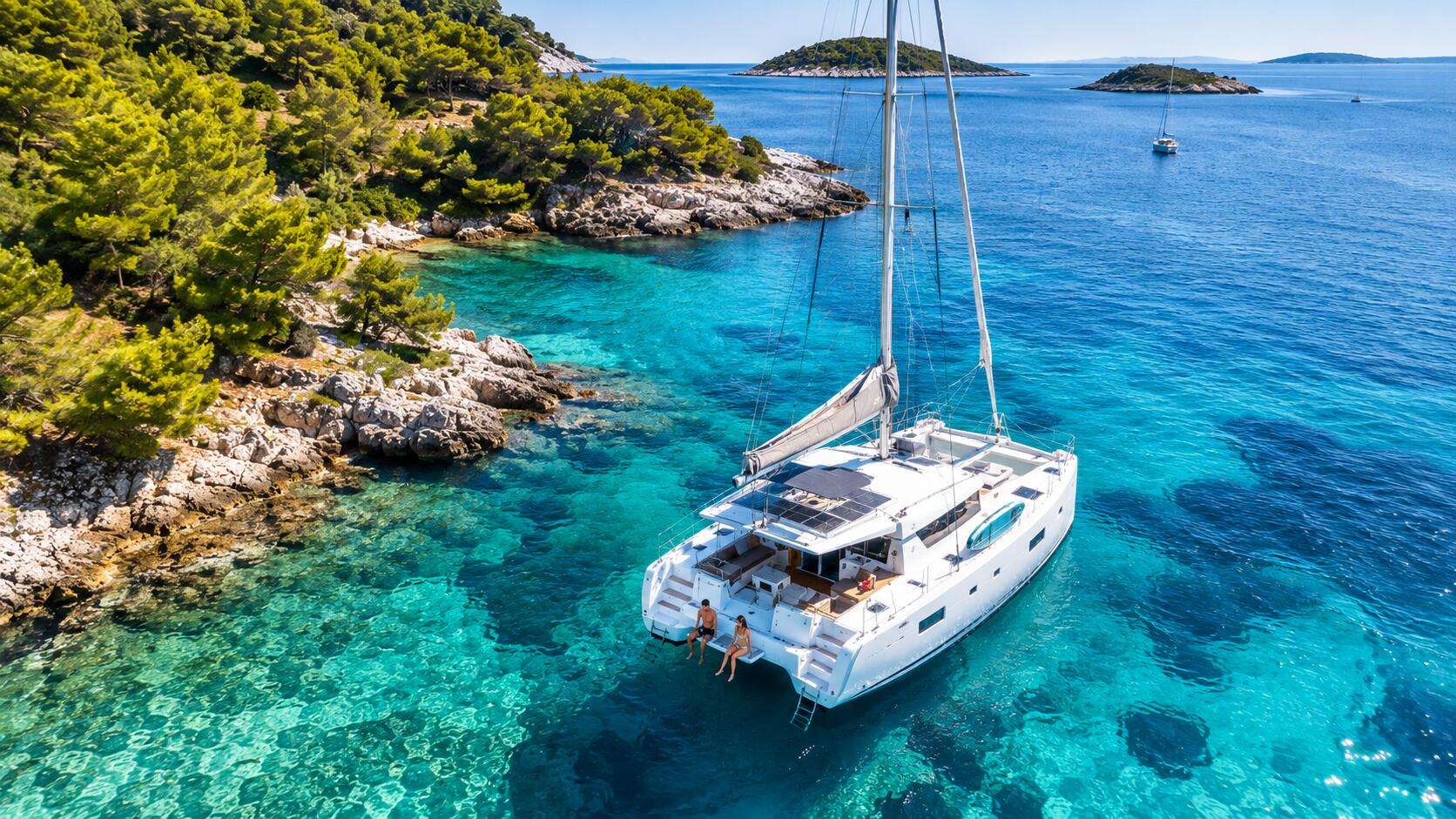
CROATIA YACHT CHARTER ITINERARIES THE BEST ROUTES FOR 7, 10 AND 14 DAYS
Planning a Croatia yacht charter is about more than drawing a line between a few famous islands on a map. The Adriatic offers an extraordinary concentration of places to visit, from historic harbour towns and lively island destinations to quiet coves, pine-covered shores and clear-water anchorages where the most memorable part of the day may simply be swimming from the yacht before lunch. The challenge is not finding somewhere beautiful to go, but deciding how much of Croatia you want to experience within the time you have. A seven-day yacht charter can create a wonderfully complete introduction to Dalmatia, while ten days allow the route to breathe and fourteen days open the possibility of travelling farther, staying longer and combining several different sides of the Croatian coast.
The ideal itinerary also depends on the kind of holiday you have in mind. A sailing yacht naturally invites more time under sail and a closer connection with the Adriatic, while a catamaran can make long days at anchor particularly comfortable for families and groups of friends. A motor yacht offers another rhythm, making it possible to cover greater distances while retaining plenty of time for swimming, dining and exploring ashore. Your chosen yacht, the season, weather conditions and the interests of everyone on board all play a role in shaping the route, which is why the most successful Croatia yacht charter itineraries are rarely about trying to see everything. They are about choosing the right combination of places and leaving enough time to enjoy them.
For many travellers, Split provides the natural starting point for a Croatian yacht charter, placing the islands of Šolta, Brač, Hvar and Vis within easy reach and creating numerous possibilities for a week-long escape. With more time, the route can extend towards Korčula, Mljet or Dubrovnik, or head north towards the Šibenik archipelago and the Kornati. Rather than treating these destinations as a checklist, a well-planned itinerary connects them through the experience of being at sea: morning departures across calm water, afternoons spent in sheltered bays, evenings in historic waterfront towns and nights anchored beneath the Adriatic sky. Whether you have seven, ten or fourteen days, Croatia rewards an itinerary that balances discovery with time simply being aboard the yacht.
HOW TO CHOOSE THE RIGHT CROATIA YACHT CHARTER ITINERARY
Choosing a Croatia yacht charter itinerary begins with a deceptively simple question: what do you want the holiday to feel like? The number of days available is important, but it is only one part of the decision. A week devoted to relaxed island cruising will look very different from a ten-day route designed around historic towns, while a fourteen-day charter can combine several regions without requiring the yacht to move every day. The best itinerary is therefore not necessarily the one that covers the greatest distance, but the one that gives the right balance between sailing, swimming, exploring and enjoying life on board.
Your starting point has an immediate influence on the possibilities. Split is one of the most popular gateways for a Croatia yacht charter because the Central Dalmatian islands are close enough to create a rewarding route even within seven days. From there, Šolta and Brač offer an easy introduction to island life, while Hvar, Vis and Korčula provide opportunities to add longer passages, historic towns, secluded bays and distinctive local character. For a charter beginning farther south, Dubrovnik opens a different perspective, with routes that can incorporate the Elaphiti Islands, Mljet and Korčula. In northern Croatia, Zadar and Šibenik provide access to a landscape of smaller islands, intricate channels and the remarkable Kornati archipelago.
The length of your charter should also influence how ambitious the route becomes. Seven days usually work best when the itinerary remains relatively concentrated, allowing enough time to enjoy each stop rather than spending the holiday constantly moving between destinations. Ten days create more flexibility, making it possible to include additional islands or spend longer in particularly appealing locations. With fourteen days, the Adriatic begins to feel considerably more expansive, and it becomes realistic to combine different types of experiences, from lively island harbours and historic towns to remote anchorages where an entire afternoon can pass without a fixed plan. Longer charters can also build in rest days, which are often among the most enjoyable parts of a yacht holiday.
The yacht itself is another important consideration. A sailing yacht makes the route part of the experience, with the wind, coastline and changing conditions naturally influencing each day's pace. A catamaran offers generous outdoor living and can be particularly well suited to groups who want to spend long periods swimming, dining and relaxing at anchor. A motor yacht can make a more extensive itinerary practical, particularly when the priority is to combine several destinations within a limited period. None of these approaches defines a single way to experience Croatia; instead, they offer different rhythms for exploring the same extraordinary coastline.
Finally, a good itinerary should leave room for the Adriatic itself. Weather, local recommendations, harbour availability and an unexpectedly beautiful bay can all change the shape of a day. Allowing some flexibility means that the route does not become a rigid schedule that has to be followed regardless of conditions. The most memorable Croatia yacht charter itineraries often have a clear direction without planning every hour: enough structure to make the most of the islands, and enough space for a long lunch, an unplanned swim or another evening spent exactly where the view feels too good to leave.
WHERE TO START: SPLIT, DUBROVNIK, ZADAR OR ŠIBENIK?
Choosing where to begin a Croatia yacht charter can shape the character of the entire holiday. The country’s coastline is divided into several distinct cruising regions, each offering its own combination of islands, landscapes, historic towns and sailing conditions. Split is the natural gateway to the best-known islands of Central Dalmatia, Dubrovnik opens the door to the southern Adriatic, while Zadar and Šibenik provide access to the more intricate island landscapes of northern Croatia. Rather than looking for a single starting point that suits every traveller, it is more useful to consider which part of the Croatian coast best matches the experience you want from your itinerary.
Split is particularly well suited to a first Croatia yacht charter because so many different experiences are within reach. After beginning among the historic streets and waterfront of the city, a yacht can head towards Šolta, Brač, Hvar or further towards Vis and Korčula. This concentration of destinations makes the area especially practical for a seven-day itinerary, while longer charters can venture farther without making every day feel like a long passage. The Central Dalmatian islands also offer considerable variety, meaning one route can combine lively waterfront restaurants with quiet anchorages, historic settlements with secluded swimming spots and active sailing days with slower afternoons on board.
Starting in Dubrovnik creates a distinctly southern Croatian experience. The city itself provides a remarkable beginning or ending to a yacht charter, with its historic walls rising above the Adriatic and its waterfront offering an immediate sense of place. From Dubrovnik, the nearby Elaphiti Islands and Mljet provide opportunities for shorter cruising days, while a longer itinerary can continue north towards Korčula and other islands of southern Dalmatia. This region can suit travellers who want to combine cultural exploration with a more secluded island atmosphere, particularly when the itinerary allows enough time to move beyond the city and discover the coastline from the water.
Zadar and Šibenik offer a different perspective altogether. Northern Croatia is characterised by a complex network of islands, channels and sheltered waters, with the Kornati archipelago providing one of the country's most distinctive sailing landscapes. The scenery here can feel more rugged and open than the greener, more developed character found in parts of Central Dalmatia. Šibenik also provides access to the Krka region, creating an interesting combination of sea and inland landscapes, while Zadar works well as a starting point for exploring the northern island groups. For travellers who are drawn to sailing itself, quieter anchorages and less urbanised scenery, this part of Croatia can create a very different kind of charter.
The right starting point ultimately depends on more than geography. Charter length, preferred yacht type, arrival arrangements, the destinations that matter most and the pace you want to maintain all influence the decision. A seven-day charter may benefit from staying within one region, while a ten- or fourteen-day itinerary can make a broader route possible. Starting and finishing in the same location can also simplify logistics, whereas a carefully planned one-way itinerary may allow more distance to be covered. Whichever gateway you choose, the advantage of Croatia is that the coastline offers enough variety to build an itinerary around the experience you want rather than forcing every charter into the same route.
7 DAYS IN CROATIA BY YACHT: THE CLASSIC DALMATIAN ROUTE
A seven-day Croatia yacht charter is long enough to experience the distinctive rhythm of the Adriatic without requiring an ambitious itinerary. For many first-time visitors, the classic Dalmatian route from Split towards Šolta, Brač, Hvar and Vis offers an appealing combination of historic towns, secluded bays, clear swimming waters and relaxed time on board. Rather than attempting to cover every famous island, this type of itinerary works best when a handful of destinations are connected into a natural progression, allowing each day to feel different while keeping the cruising distances comfortable. The result is a Croatian sailing holiday that feels varied without becoming rushed.
Beginning in Split, the first stage of the journey can be deliberately easy. The city provides a fascinating starting point, with its waterfront, historic centre and remarkable Roman heritage offering plenty to explore before departure or after returning from the islands. Once aboard, the nearby island of Šolta provides a gentle introduction to life on the Adriatic, with sheltered waters, small coastal settlements and a quieter atmosphere than some of the better-known destinations. From there, the route can continue towards Brač, where landscapes of stone, pine-covered slopes and attractive bays create opportunities to spend time swimming, relaxing and exploring ashore before continuing towards Hvar.
Hvar brings another dimension to the itinerary. The island is famous for its historic town, waterfront restaurants and lively summer atmosphere, but its appeal extends well beyond the main harbour. A yacht allows you to explore stretches of coastline where the character becomes considerably quieter, with small coves and islands offering a more private setting away from the busiest areas. This contrast is part of what makes Hvar work so well within a seven-day Croatia yacht charter: one day can include an elegant evening in town, while another can be centred almost entirely around an unhurried afternoon at anchor.
Vis introduces yet another side of the Dalmatian coast. Farther from the mainland and known for its comparatively secluded character, the island combines rugged scenery, traditional settlements, vineyards and a strong maritime identity. Depending on conditions and the interests of the group, time around Vis can include swimming in clear coves, visiting local villages or simply enjoying the slower pace of island life. For many travellers, this is where a Croatia yacht charter begins to feel less like a conventional sightseeing holiday and more like an authentic escape into the Adriatic.
A seven-day route does not need to follow exactly the same sequence every time. Weather, marina availability and the preferences of those on board can all influence the final itinerary, and that flexibility is one of the advantages of travelling by yacht. Some groups may prefer additional time around Hvar and Brač, while others may prioritise Vis or choose to include a quieter island such as Šolta. The most successful seven-day Croatia yacht charter leaves enough room for these decisions while retaining a simple geographical flow. With mornings on the water, afternoons dedicated to swimming and exploration, and evenings spent either ashore or anchored beneath the stars, a week can offer a remarkably complete introduction to the Croatian Adriatic.
DAY-BY-DAY: A 7-DAY YACHT CHARTER FROM SPLIT
A seven-day yacht charter from Split works best when the itinerary is treated as a framework rather than a timetable. The Central Dalmatian islands are close enough to create a varied route without spending the entire holiday travelling, which means each day can combine some time underway with swimming, exploring and simply enjoying the yacht. A route through Šolta, Brač, Hvar and Vis provides a natural progression, but the exact order can change according to weather, sea conditions and the atmosphere you want from the week. The following example offers a sense of how a classic Croatia yacht charter could unfold while leaving room for the flexibility that makes travelling by sea so appealing.
Day 1 - Split to Šolta: After boarding in Split, the first afternoon is an opportunity to settle into the yacht and leave the mainland behind at an easy pace. Šolta is close enough to make the opening passage relatively relaxed, allowing the first hours of the charter to be about getting into the rhythm of life at sea rather than immediately chasing the next destination. A swim in a sheltered bay, a leisurely lunch on board and an evening in one of the island's coastal settlements can provide a gentle beginning before the longer days of cruising ahead.
Day 2 - Šolta to Brač: The next morning brings a short passage towards Brač, one of the most recognisable islands in the Adriatic. The island offers a pleasing mix of natural scenery, traditional stone architecture and attractive coastal areas where the yacht can pause for swimming. Rather than filling the day with sightseeing, there is value in allowing the coastline to dictate the pace. A morning under way can lead into a long afternoon at anchor, followed by dinner ashore or a quiet evening on board as the light fades across the water.
Day 3 - Brač to Hvar: Continuing towards Hvar introduces a livelier dimension to the journey. Hvar Town offers historic architecture, a beautiful waterfront and a wide choice of restaurants, making it a natural destination for an evening ashore. Yet the island is much more than its famous harbour, and a yacht charter makes it possible to experience both sides of Hvar. Depending on conditions and preference, the day can include time in a secluded bay before arriving in town, creating a balance between peaceful time at sea and the energy of one of Croatia's best-known island destinations.
Day 4 - Exploring Hvar: Rather than moving every morning, a seven-day itinerary can benefit from spending a full day around Hvar. This creates time for swimming, exploring smaller coastal settlements or simply enjoying the yacht without watching the clock. The Pakleni Islands nearby offer another possibility, with sheltered waters and numerous places to pause for a swim or lunch. By allowing one day to unfold without a major passage, the itinerary becomes less about collecting destinations and more about experiencing the Adriatic itself.
Day 5 - Hvar to Vis: The route can then continue towards Vis, bringing a noticeable change in atmosphere. The island feels more secluded and understated, with rugged landscapes, traditional villages and a strong connection to its maritime past. The passage itself becomes part of the experience, particularly aboard a sailing yacht when the conditions allow time under sail. Once around Vis, an afternoon swim followed by an evening exploring the island offers a slower counterpoint to the livelier atmosphere of Hvar.
Day 6 - Vis to Brač or Šolta: The return journey towards Split can be shaped around another coastal experience rather than treated simply as a transfer. Depending on conditions and the chosen route, the yacht might pause around Brač or Šolta for a final afternoon of swimming and relaxation. This is often the point in the charter when the group has settled completely into life on board, making a quiet bay and a long lunch just as appealing as another major sightseeing stop. Keeping the final evening relatively close to Split also provides a comfortable buffer before disembarkation.
Day 7 - Return to Split: The final morning offers one last chance to enjoy breakfast on the water before returning to Split. After several days of moving between islands, the approach to the city provides a natural conclusion to the route, bringing the yacht back into the urban landscape where the journey began. A seven-day itinerary such as this demonstrates why Central Dalmatia works so well for a Croatia yacht charter: within a single week, it is possible to experience historic cities, quiet islands, lively harbours, secluded anchorages and long stretches of open Adriatic, while still leaving enough time for the simple pleasures of being on the water.
10 DAYS IN CROATIA BY YACHT: MORE ISLANDS, MORE TIME AT SEA
Ten days changes the character of a Croatia yacht charter. Where a seven-day itinerary benefits from keeping the route relatively concentrated, an extra three days create room to travel farther without making the holiday feel like a race between destinations. There is more time for long afternoons at anchor, more opportunities to explore the islands beyond their best-known towns and greater flexibility when weather or local recommendations suggest changing course. A ten-day Croatia yacht charter can still focus on Central Dalmatia, but it also opens the possibility of extending towards Korčula or combining several different island experiences into a route that feels considerably more expansive.
A popular approach is to begin in Split and gradually work south through Šolta, Brač and Hvar before continuing towards Vis and Korčula. This route brings together some of the Adriatic's most recognisable destinations while leaving enough time to appreciate the differences between them. Šolta offers a quieter introduction to island life, Brač brings a combination of dramatic coastal scenery and traditional island character, while Hvar adds historic streets, restaurants and a lively waterfront. Vis then changes the pace again, with a more secluded atmosphere and rugged coastline, before Korčula introduces another layer of history, architecture, vineyards and maritime heritage.
The additional days make it possible to spend longer in places that deserve more than a brief stop. Instead of arriving at Hvar, exploring the town and leaving the following morning, a ten-day itinerary might allow time for both the famous harbour and quieter sections of the island. Similarly, Vis can be treated as more than an overnight destination, giving the crew time to explore its villages, swim in nearby coves and enjoy the island's distinctive landscape. This slower approach is particularly appealing for travellers who see the yacht itself as an important part of the holiday rather than simply a means of reaching the next destination.
Ten days also create greater flexibility around the rhythm of the charter. A full day at anchor can be followed by a longer sailing passage, while a day spent exploring ashore can lead naturally into an evening aboard the yacht. Groups travelling with children may appreciate having unhurried days built into the route, while couples and friends can use the additional time to combine lively evenings with quieter stretches of coastline. The itinerary can therefore shift between exploration and relaxation without either feeling like an afterthought.
For those wanting to travel farther, the southern end of the route can reach Korčula and potentially continue towards Mljet, depending on the starting point, yacht and prevailing conditions. This creates a broader view of the Croatian Adriatic, where the landscape gradually changes and each island contributes something different to the journey. The important consideration is not simply how many nautical miles can be covered, but whether the route leaves enough time to enjoy each place. Ten days provide an ideal middle ground: enough time to explore beyond the classic seven-day circuit, while still maintaining a relaxed pace that allows the sea, the islands and life aboard the yacht to remain at the centre of the holiday.
DAY-BY-DAY: A 10-DAY ADRIATIC YACHT CHARTER ITINERARY
A ten-day yacht charter from Split offers enough time to explore Central Dalmatia at a relaxed pace while reaching farther south than a typical one-week route. The itinerary below is best understood as an example rather than a fixed schedule, since weather, sea conditions, harbour availability and the preferences of those on board can all influence the final route. Its appeal lies in the balance: several of Croatia's best-known islands are included, but there is also room for swimming, long lunches, quiet evenings and days when the yacht itself becomes the destination.
Day 1 - Split to Šolta: After boarding in Split, the first passage can be kept short, allowing everyone to settle into the yacht and ease into the rhythm of the Adriatic. Šolta makes a natural first stop, with a quieter atmosphere and sheltered coastal areas that are well suited to an opening swim. The evening can be spent enjoying a relaxed dinner ashore or remaining on board, watching the coastline become quieter as the first day of the charter comes to an end.
Day 2 - Šolta to Brač: The route continues towards Brač, where the landscape becomes a defining part of the experience. Depending on the chosen anchorage, the day can combine time under way with a long swim and lunch beside the water. Brač offers plenty of opportunities to explore the coast without making the day feel overly structured, while an evening ashore provides a chance to experience one of the island's traditional settlements before returning to the yacht.
Day 3 - Brač to Hvar: Hvar introduces a livelier side of the Croatian islands. The approach by yacht provides a striking view of the coastline before the route moves towards the historic town and its waterfront. Rather than spending the entire day in the harbour, there is time to stop for a swim or explore one of the island's quieter coastal areas first. An evening in Hvar Town can then provide a change of atmosphere, with restaurants, historic streets and the energy of the summer waterfront.
Day 4 - Exploring Hvar and the Pakleni Islands: With ten days available, there is no need to leave Hvar immediately. A full day can be devoted to the island and nearby Pakleni Islands, creating time for swimming, paddleboarding, relaxing on board or discovering quieter bays. The absence of a major passage gives the group an opportunity to slow down and enjoy the yacht without constantly preparing for the next departure. By evening, the route can remain in the same area or move to a more peaceful anchorage depending on conditions.
Day 5 - Hvar to Vis: The journey towards Vis changes the atmosphere of the charter. The island's more secluded character, rugged coastline and traditional settlements create a contrast with Hvar's busier summer scene. The passage itself can become part of the day, particularly when sailing conditions allow the yacht to travel under wind power. Once around Vis, the afternoon can be spent swimming or exploring before dinner ashore or a quiet evening aboard.
Day 6 - Discovering Vis: One of the advantages of a ten-day itinerary is having enough time to remain in a destination rather than treating every island as a single overnight stop. Vis rewards that approach. The day might include exploring the island's villages, discovering its maritime history or visiting a nearby bay for a long swim and lunch. There is also something particularly appealing about leaving part of the day unplanned, allowing the island and the conditions at sea to determine the pace.
Day 7 - Vis to Korčula: The route can then continue towards Korčula, adding another significant destination to the itinerary. The passage is longer than some of the earlier island hops, making the journey itself an important part of the day. Once approaching Korčula, the scenery shifts towards wooded hillsides, sheltered coastal waters and historic settlements. An evening around Korčula Town offers the opportunity to explore its atmospheric old centre and experience the island's long maritime tradition.
Day 8 - Exploring Korčula: Rather than immediately continuing south, a second day around Korčula creates a more relaxed rhythm. The island offers a combination of historic architecture, smaller coastal communities, vineyards and attractive swimming areas. A yacht makes it possible to divide the day between time ashore and time on the water, perhaps beginning with breakfast in a quiet anchorage before exploring the island and finishing with dinner overlooking the Adriatic.
Day 9 - Korčula to Brač or Šolta: The return towards Split can be broken into a more leisurely final passage, with the exact stop depending on the route and conditions. Returning through a different part of the coastline can also give the journey a sense of progression rather than simply retracing the outward route. A final afternoon swim, a long lunch and an evening at anchor provide a fitting transition from exploration back towards the mainland.
Day 10 - Return to Split: The final morning begins with the familiar pleasures of life aboard: breakfast on deck, a final swim and one last stretch of open water before returning to Split. Approaching the mainland after several days among the islands provides a natural sense of conclusion. A ten-day Croatia yacht charter such as this allows travellers to experience several distinct sides of the Adriatic without treating the coastline as a checklist, combining celebrated destinations with quieter moments and giving the journey between islands as much importance as the places themselves.
14 DAYS IN CROATIA BY YACHT: TAKING THE TIME TO GO FURTHER
Fourteen days on a Croatia yacht charter opens up a very different kind of Adriatic experience. With two full weeks available, the itinerary no longer has to revolve around fitting as many destinations as possible into each day. Instead, there is time to travel farther, remain longer in the places that capture your attention and build genuine pauses into the route. A two-week charter can connect several of Croatia's island groups, combine lively historic towns with secluded anchorages and create a holiday in which sailing, swimming, dining and exploring all have room to unfold naturally.
For many travellers, a longer itinerary begins in Split and follows the Central Dalmatian islands before continuing towards Korčula and the southern Adriatic. Starting with Šolta and Brač provides an easy introduction to island cruising, while Hvar and Vis bring greater variety in atmosphere, landscape and coastal character. From Vis, the route can continue towards Korčula, with additional time allowing for exploration beyond the main town and into the island's quieter coastal areas. Depending on the yacht, conditions and overall plans, the journey can then extend towards Mljet and Dubrovnik, creating a route that connects central and southern Croatia in a single holiday.
The greatest advantage of fourteen days is not necessarily the distance covered, but the freedom to stay longer. A destination that might receive only one night on a shorter charter can become a two- or three-day experience, giving travellers time to discover different parts of an island rather than seeing only its main harbour. Hvar, for example, can combine an evening in the historic town with another day devoted to secluded bays, while Vis can be explored at a slower pace that allows its villages, coastline and local character to emerge. Korčula similarly rewards travellers who give themselves time to move beyond the best-known sights.
A two-week itinerary can also introduce greater geographical variety. After the familiar landscapes of Central Dalmatia, the southern route towards Mljet brings a different sense of tranquillity, with forested landscapes and protected natural surroundings. Continuing towards Dubrovnik adds a historic and architectural dimension, with the famous walled city providing a dramatic contrast to the quieter islands and anchorages experienced earlier in the journey. Rather than making Dubrovnik the sole purpose of the southern passage, a longer charter allows the city to become one part of a much broader Adriatic story.
There is also more opportunity to allow the sea itself to shape the holiday. Two weeks make it easier to build in days with shorter passages, extended swimming stops and evenings spent at anchor rather than moving between ports. Weather can influence the order of destinations, and a flexible itinerary means the crew can respond to local conditions rather than forcing a predetermined route. For sailing enthusiasts, additional time may mean more opportunities to enjoy longer passages under sail; for families and groups of friends, it can mean more afternoons where the yacht becomes a private base for swimming, dining and relaxing.
A fourteen-day Croatia yacht charter therefore works particularly well for travellers who want to experience the country as a collection of connected coastal landscapes rather than a sequence of individual stops. From Split and the islands of Central Dalmatia to Korčula, Mljet and Dubrovnik, the longer route creates room for contrasts that shorter itineraries cannot always accommodate. Most importantly, it allows the holiday to develop its own rhythm. There can be days filled with exploration and days devoted almost entirely to the water, lively evenings followed by quiet mornings and long passages balanced by lazy afternoons in a secluded bay. With two weeks on the Adriatic, the destination is no longer simply somewhere you visit; it becomes the environment in which the entire holiday unfolds.
DAY-BY-DAY: A 14-DAY CROATIAN YACHT CHARTER ADVENTURE
A fourteen-day Croatia yacht charter from the Trogir area offers enough time to create a genuine Adriatic circuit rather than simply extending a seven-day route. The advantage of the longer charter is that the journey can reach as far south as Dubrovnik and Lastovo while still allowing time for several different island experiences on the return to the mainland. A practical route needs to take the distances between destinations seriously, particularly on a sailing yacht, so the itinerary below follows a proven two-week pattern: Trogir, Brač, Hvar, Korčula, Mljet, Dubrovnik, the Elaphiti Islands, Lastovo and Vis before returning to Trogir. Navigare Yachting's published 14-day route follows this general circuit, with individual passages ranging from shorter island hops to longer sailing days.
Day 1 - Trogir to Milna, Brač: After completing embarkation and leaving the base, the first passage is deliberately manageable. Milna on Brač lies around 12 nautical miles from Trogir, making it a practical first overnight destination. The sheltered harbour provides an easy introduction to the rhythm of the charter, with time for a swim, dinner ashore or a relaxed evening aboard.
Day 2 - Milna to Hvar: The route continues south towards Hvar, with a passage of roughly 17 nautical miles. A stop around the Pakleni Islands can provide time for swimming before continuing towards Hvar Town or another suitable overnight location. This gives the day a useful combination of sailing, time on the water and an evening in one of Croatia's best-known island destinations.
Day 3 - Hvar to Korčula: The third day involves one of the longer passages of the central section, at approximately 32 nautical miles. A stop around Šćedro can provide an opportunity for swimming before continuing towards Korčula. Reaching Korčula Town in the evening creates a natural transition from a day spent under way to an evening exploring the historic waterfront and old town.
Day 4 - Korčula to Pomena, Mljet: From Korčula, the route heads towards Mljet, with Pomena approximately 14 nautical miles away. This is a relatively short sailing day and leaves time to experience Mljet National Park, explore the surrounding landscape or simply enjoy a quieter afternoon on the yacht. The shorter passage is also useful after the longer sailing day from Hvar.
Day 5 - Pomena to Sobra or Okuklje, Mljet: Rather than immediately leaving Mljet, the itinerary moves along the island, with the published route allowing another day within the Mljet area. The distance is approximately 13 nautical miles, leaving plenty of time for swimming and exploring the island. This is an important feature of a realistic fourteen-day itinerary: not every day needs to involve a major destination change, and some of the best cruising days are deliberately shorter.
Day 6 - Mljet to Dubrovnik: The route then turns towards Dubrovnik, with approximately 23 nautical miles between the Mljet area and the city. The approach by sea provides one of the most memorable arrivals of the charter, with the historic city emerging as a striking contrast to the quieter islands. Depending on the timing and harbour arrangements, the evening can be dedicated to exploring Dubrovnik or enjoying dinner ashore.
Day 7 - Dubrovnik to Cavtat: Rather than attempting to leave Dubrovnik and immediately make a long return passage, the itinerary uses the following day to explore the southern coast. Cavtat lies around 12 nautical miles away and provides a much smaller-scale coastal experience after the intensity of Dubrovnik. This short passage creates another opportunity for swimming and a relaxed evening before beginning the journey north.
Day 8 - Cavtat to Šipan: The return route moves back towards the Elaphiti Islands, with Šipan approximately 21 nautical miles from Cavtat. The island provides a quieter setting after Dubrovnik and Cavtat, with traditional villages, stone architecture and a more relaxed pace. The day also breaks up the return journey into manageable stages rather than turning the second week into one long passage back to Trogir.
Day 9 - Šipan to Mljet: The route returns towards Mljet, with Polače around 23 nautical miles from Šipan. Although the yacht has already visited the island, approaching from the north and using a different overnight location creates a different experience. The return visit also demonstrates an important principle of longer yacht charters: revisiting a region is not necessarily repetitive when the route allows you to see another part of the coastline.
Day 10 - Mljet to Lastovo: From Polače, the yacht continues towards Lastovo, with Zaklopatica approximately 23 nautical miles away. Lastovo adds one of the more remote-feeling stops to the itinerary and provides a noticeable contrast with Dubrovnik and the busier islands. The harbour at Zaklopatica offers a practical overnight point while the island itself provides opportunities for walking, swimming and experiencing a quieter side of southern Croatia.
Day 11 - Lastovo to Vela Luka, Korčula: The journey then turns north towards Vela Luka on the western side of Korčula. The passage is approximately 16 nautical miles, leaving enough time to stop around Proizd for a swim before continuing to the harbour. This section of the route avoids simply retracing the earlier Korčula Town stop and introduces another side of the island.
Day 12 - Vela Luka to Vis: The next passage covers approximately 24 nautical miles and brings the yacht back towards Vis. Stopping around Stončica provides an opportunity for swimming before continuing to the island. After the longer southern section of the itinerary, Vis offers a welcome return to a more familiar Central Dalmatian atmosphere while still feeling sufficiently different from the earlier destinations.
Day 13 - Vis to Komiža: Instead of immediately beginning the final return to the mainland, the route spends another day on Vis, moving towards Komiža on the island's western coast. The passage is only around 13 nautical miles, allowing time to stop around Budikovac or another suitable swimming location along the way. Komiža provides a fitting final island evening, with its fishing heritage, waterfront setting and distinctive local character.
Day 14 - Komiža to Trogir: The final passage is one of the longer days of the itinerary, at approximately 30 nautical miles, making it important to allow sufficient time for the return to the Trogir base. Depending on conditions, the route can include a final swimming stop around Biševo before continuing towards the mainland. After two weeks of moving through Brač, Hvar, Korčula, Mljet, Dubrovnik, the Elaphiti Islands, Lastovo and Vis, the arrival back in Trogir provides a natural conclusion to a genuinely comprehensive Croatia yacht charter.
What makes this route operationally convincing is the balance between shorter island hops and the handful of longer passages that are necessary to connect the regions. It does not assume that every day can be spent sightseeing ashore, nor does it treat the yacht as if it can simply appear at each destination without accounting for the sailing involved. The longer passages are part of the experience, while shorter days create room for swimming, exploration and time aboard. Most importantly, the route remains a framework rather than a promise of fixed timings: actual passages and overnight stops should always be adapted to the yacht, crew, weather, sea conditions and local recommendations. Navigare's own published itineraries similarly describe their routes as suggestions and emphasise itinerary planning with charter staff and skippers.
HVAR, VIS AND KORČULA: THE ISLANDS AT THE HEART OF A DALMATIAN ITINERARY
Hvar, Vis and Korčula are among the most rewarding islands to connect on a Croatia yacht charter, not simply because they are famous, but because each offers a noticeably different experience of the Adriatic. Together, they create a route with enough variety to keep a longer itinerary interesting without requiring constant changes of scenery. Hvar brings historic waterfronts, restaurants and a lively summer atmosphere; Vis offers a more secluded and understated character shaped by rugged coastline, traditional settlements and a strong maritime identity; while Korčula combines historic architecture, wooded landscapes, vineyards and a long connection with life at sea. Travelling between them by yacht makes these contrasts part of the holiday itself, with the passages providing time to appreciate the changing coastline rather than treating each island as an isolated destination.
Hvar is often the most immediately recognisable of the three, particularly for travellers arriving during the summer months. Hvar Town provides a natural focal point, with its historic centre, waterfront and choice of restaurants creating an attractive evening destination. Yet a yacht charter allows visitors to experience a broader side of the island. The coastline contains numerous coves and sheltered areas where a day can revolve around swimming, lunch and time on deck before heading into town later. The nearby Pakleni Islands add another layer to the experience, making it possible to combine a lively evening with a quieter afternoon on the water without having to travel far.
Vis changes the pace. Located farther from the mainland, the island has retained a more secluded atmosphere, with steep hillsides, traditional stone settlements and a coastline that rewards exploration from the sea. Komiža on the western side and Vis Town on the northeastern coast offer different perspectives on island life, while the waters around the island provide opportunities for swimming and anchoring when conditions are suitable. A longer Croatia yacht charter gives Vis the time it deserves because the island is not simply a stop between Hvar and Korčula; it is a destination where slowing down can become the main activity.
Korčula adds another dimension to the route. Its historic town, often approached dramatically from the water, provides a natural setting for an evening ashore, while the wider island offers a combination of forested landscapes, small settlements and vineyards. The western part of Korčula, including Vela Luka, can also form part of a longer itinerary, giving charterers a reason to explore beyond the island's best-known town. For a two-week route, this flexibility is particularly useful because Korčula can be approached from different directions and combined with destinations such as Mljet or Lastovo.
The real appeal of placing Hvar, Vis and Korčula within the same itinerary lies in the transitions between them. The route moves from a more energetic island atmosphere to the quieter character of Vis before arriving at Korčula's blend of history, nature and island culture. Those changes prevent the journey from feeling repetitive, even when the basic rhythm remains familiar: a morning passage, a swim in clear Adriatic water, lunch aboard, time exploring ashore and an evening overlooking the sea. Rather than simply collecting three famous Croatian islands, a well-planned yacht charter allows each one to contribute a different chapter to the same Adriatic experience.
BEYOND THE CLASSICS: ŠOLTA, BRAČ, MLJET AND CROATIA’S QUIETER CORNERS
Croatia's best-known islands naturally attract much of the attention, but a yacht charter becomes more interesting when the itinerary leaves room for places that do not need to compete for the spotlight. Šolta, Brač and Mljet each offer a different version of the Croatian coast, and together they demonstrate why a good itinerary should not be built entirely around famous names. These islands can provide quieter anchorages, traditional settlements, natural landscapes and long stretches of coastline where the day's main purpose is simply to enjoy being on the water. For travellers with ten or fourteen days available, adding less obvious stops can transform a route from a sightseeing circuit into a more varied Adriatic experience.
Šolta is particularly practical for charters beginning around Split because of its proximity to the mainland. The short passage means that the island can be included even within a relatively compact itinerary, giving travellers an immediate transition from the urban character of Split to a more rural coastal setting. Olive groves, small settlements and sheltered bays create an atmosphere that feels considerably removed from the mainland despite the short distance. Places such as Maslinica and Stomorska provide opportunities to go ashore, while the surrounding coastline offers plenty of reasons to remain on the yacht for an afternoon of swimming and relaxing.
Brač offers greater scale and a strikingly varied landscape. Although the island is well known, particularly for the distinctive Zlatni Rat beach near Bol, its appeal extends far beyond its most photographed locations. Coastal villages, stone architecture, pine-covered slopes and clear-water bays provide numerous possibilities for a yacht charter itinerary. Spending time away from the busiest areas can reveal a quieter side of the island, while the ability to approach different sections of the coast by yacht makes it possible to combine sightseeing with long periods at anchor. Brač can therefore work equally well as a destination for exploration or as a place to slow the itinerary down.
Further south, Mljet brings an entirely different atmosphere. Much of the island is characterised by forested landscapes and protected natural surroundings, creating a sense of calm that contrasts with the energy of destinations such as Hvar and Dubrovnik. Pomena and Polače provide practical bases for exploring the western part of the island, while the surrounding waters offer opportunities for swimming and quiet evenings aboard. On a longer Croatia yacht charter, Mljet is particularly valuable because it provides a natural pause between more substantial passages. Instead of filling the day with activities, travellers can spend time walking, exploring the island or simply enjoying the yacht in a peaceful setting.
The quieter side of Croatia can also be found within the larger and more famous islands themselves. Hvar has secluded coves away from its main town, Korčula offers smaller coastal communities beyond its historic centre, and Vis combines popular attractions with long stretches of relatively undeveloped coastline. A yacht makes these contrasts easier to experience because there is no need to remain close to the main harbour or rely on the same route as travellers moving by road. The itinerary can shift naturally between a lively evening ashore and a morning anchored somewhere that feels almost entirely removed from the summer crowds.
For this reason, the quieter corners of Croatia should not be treated simply as alternatives to the famous destinations. They work best alongside them. A route that combines Hvar with Šolta, Vis with Brač, or Dubrovnik with Mljet creates greater variation in pace and atmosphere while still including the places many visitors want to see. The result is an itinerary that feels less like a checklist of Croatian islands and more like a genuine exploration of the Adriatic, where some of the most memorable hours may happen in places that were never the main destination at all.
NORTH OR SOUTH? CHOOSING BETWEEN DALMATIA, THE KORNATI AND DUBROVNIK
Choosing where to cruise in Croatia is one of the most important decisions when planning a yacht charter, because the country's coastline offers several distinct cruising regions rather than one uniform experience. Southern Dalmatia is often associated with celebrated islands such as Hvar, Vis, Korčula and Mljet, while the northern Adriatic introduces the dramatic landscapes of the Kornati and the broader Šibenik and Zadar areas. Dubrovnik adds another dimension altogether, combining a historic city with the islands and sheltered waters of the far south. The right region therefore depends less on finding a single “best” route and more on deciding what kind of holiday you want the itinerary to create.
Central and southern Dalmatia are a natural choice for travellers interested in combining island life, historic towns and a strong variety of destinations within one charter. Starting around Split or Trogir, an itinerary can move through Šolta, Brač, Hvar, Vis and Korčula, with options to continue towards Mljet and Dubrovnik on a longer charter. This part of the coast is particularly appealing when the aim is to balance time at sea with evenings ashore, swimming stops and visits to historic island towns. The distances between destinations vary, so a realistic route should be shaped around the yacht, weather and available time rather than attempting to include every famous island.
The northern Adriatic offers a different character. The Kornati archipelago is defined by a striking landscape of numerous islands and islets, dry stone terrain and open stretches of sea, creating a setting that feels markedly different from the greener and more urbanised parts of Dalmatia. Nearby Šibenik and Zadar provide convenient gateways into the region, while the surrounding islands and channels allow for a charter focused more heavily on nature, sailing and time spent away from major tourist centres. For travellers who enjoy the visual drama of the coastline and the feeling of being surrounded by open water and unspoilt island landscapes, northern Croatia can become a central part of the experience rather than simply an alternative route.
Dubrovnik works particularly well as the focus of a southern itinerary, especially when the charter is designed around the islands lying between the city and the wider Adriatic. The Elaphiti Islands, Mljet and Korčula can all contribute different experiences, allowing a route to combine historic surroundings with quieter anchorages and days spent swimming offshore. Dubrovnik itself adds a memorable destination at either the beginning or end of the charter, although the city is only one part of the southern experience. The real appeal of this region comes from the contrast between the cultural richness of the mainland and the slower rhythm of the islands nearby.
For shorter charters, geography becomes especially important. A seven-day yacht charter is generally better suited to concentrating on one region than trying to travel from the northern Adriatic to Dubrovnik. With ten or fourteen days available, there is more room to create a route with greater geographical variety, although longer does not automatically mean that every major destination should be included. Sailing time, weather conditions and the desire to spend meaningful time in each location all influence how much ground it makes sense to cover. A successful itinerary leaves enough flexibility for the places that unexpectedly deserve another morning, another swim or another evening.
The choice between north and south is therefore less about comparing destinations and more about matching the region to the rhythm of the holiday. The Kornati and northern Dalmatia offer a distinctly island-focused landscape and a strong connection with nature, while central and southern Dalmatia provide a rich combination of famous islands, historic towns and varied coastal experiences. Dubrovnik brings its own identity to the far south, particularly when combined with Mljet and the Elaphiti Islands. Whichever direction you choose, a Croatia yacht charter works best when the route has enough structure to make the most of the coast without becoming so ambitious that the pleasure of being at sea is lost.
SAILING, CATAMARAN OR MOTOR YACHT: HOW YOUR YACHT CHANGES THE ROUTE
The yacht you choose for a Croatia yacht charter does more than determine where you sleep at night. It influences the pace of the holiday, the amount of time spent under way, the kind of anchorages that suit the itinerary and even how much attention you give to the journey between destinations. A sailing yacht creates a natural connection with the wind and the sea, while a catamaran places greater emphasis on outdoor living, stability and generous social areas. A motor yacht introduces a different rhythm again, making it possible to cover more ground between stops while keeping the focus on comfort and exploring a wider stretch of coastline. The best choice depends on the experience you want the route to deliver.
A sailing yacht is particularly well suited to travellers who want the act of sailing to be part of the holiday itself. Rather than treating the passage between islands simply as transport, sailing allows the route to respond more directly to wind, weather and conditions at sea. Days can develop around time under sail, followed by an afternoon anchored in a quiet bay or an evening in a historic harbour. This makes a sailing yacht especially attractive for those planning a Croatia sailing holiday where the pleasure comes as much from being on the water as from arriving at the next destination.
A catamaran changes the balance between sailing and living aboard. With its broad layout and emphasis on outdoor areas, it creates an environment that naturally suits groups who want to spend long periods together without feeling confined. The shallow-water cruising possibilities of many charter catamarans can also make them particularly convenient for days centred around swimming and anchoring. An itinerary aboard a catamaran can therefore leave more room for unhurried mornings, long lunches and afternoons spent close to the shore, rather than requiring every day to revolve around reaching another major port.
A motor yacht offers yet another perspective on the Croatian coast. Its ability to cover greater distances efficiently can make it useful for itineraries where travellers want to combine several distinct areas within one charter. A morning departure can lead to a completely different island or coastal town later in the day, creating opportunities to connect destinations that would require more careful planning aboard a sailing yacht. This can be particularly valuable on shorter charters, when time is limited but there is still a desire to experience several parts of the Adriatic.
The difference is not simply about speed, however. Each type of yacht encourages a different relationship with the coastline. Sailing yachts naturally make wind, navigation and the changing conditions of the sea part of the experience. Catamarans often encourage a more relaxed outdoor lifestyle, with the yacht functioning as a spacious base for swimming, dining and socialising. Motor yachts place greater emphasis on mobility, allowing travellers to move between destinations while maintaining a strong sense of comfort aboard. None of these approaches needs to define the entire holiday, but the yacht inevitably influences the way the itinerary feels.
For that reason, choosing a yacht should happen alongside planning the route rather than after it. A seven-day charter built around relaxed sailing between nearby islands may call for a different approach from a two-week itinerary designed to connect Split, the southern islands and Dubrovnik. Likewise, a group primarily interested in swimming and long days aboard may value the layout of a catamaran differently from travellers who want to spend more time exploring towns ashore. Matching the yacht to the itinerary creates a more coherent holiday, because the boat becomes part of the route rather than simply the means of getting between destinations.
Ultimately, there is no single way to experience Croatia by yacht. Sailing yachts, catamarans and motor yachts each shape the Adriatic differently, influencing the pace, atmosphere and possibilities of the charter. Once the choice is made according to how you want to spend your days - whether that means following the wind, stretching out at anchor or covering more coastline - the itinerary becomes easier to design around the experience you actually want from your Croatian yacht charter.
BALANCING SAILING, SWIMMING, SIGHTSEEING AND TIME ASHORE
A memorable Croatia yacht charter is rarely about how many destinations can be fitted into a single itinerary. The most rewarding routes usually create a natural balance between time under way, swimming in clear Adriatic water, exploring historic towns and simply enjoying the yacht without feeling that another activity is waiting around the corner. Croatia makes this balance particularly achievable because its islands combine sheltered bays, lively waterfronts, historic settlements and long stretches of coastline within relatively compact cruising areas. The challenge is knowing when to move on and when to stay exactly where you are.
Sailing time can become one of the pleasures of the day when the itinerary leaves enough room for it. A morning departure after breakfast allows the yacht to become part of the experience rather than simply a means of transportation. Depending on the route and conditions, the passage might take you along a rugged island coastline, across open stretches of the Adriatic or towards a new harbour on the horizon. For sailing holidays, the movement of the yacht is naturally part of the attraction, while motor yacht and catamaran charters can use cruising time to connect destinations efficiently without making every passage feel like a major event.
Swimming stops provide another essential rhythm to a Croatian itinerary. With so many bays, coves and offshore anchorages, there is little reason for every day to be structured around arriving in a harbour as early as possible. A quieter approach might involve leaving one island in the morning, stopping somewhere suitable for a swim and lunch, then continuing towards the next destination later in the afternoon. These pauses often become some of the most memorable parts of the charter because there is no sightseeing schedule to follow and the landscape is experienced entirely from the water.
Sightseeing naturally adds another layer. Historic towns such as Hvar, Korčula, Trogir or Dubrovnik can provide memorable evenings and opportunities to experience architecture, local restaurants and the cultural character of the coast. Yet trying to visit a major attraction every day can quickly change the character of the holiday. A yacht charter works best when time ashore is balanced with time aboard, allowing a morning spent exploring narrow streets to be followed by an afternoon back on the water, or an evening in a historic harbour to come after a relaxed day at anchor.
The same principle applies to meals. A Croatian yacht charter does not need to mean eating every meal ashore, just as it does not need to mean preparing everything on board. Some days naturally lend themselves to a long lunch overlooking the water, while others are better suited to a simple meal aboard after a swim. An evening in a harbour might call for a restaurant and a walk through the old town, whereas a secluded anchorage can make dinner on deck feel like the more memorable option. Building this variation into the itinerary helps each day feel different without requiring constant movement.
Time ashore should also reflect the interests of the group. Families may prefer longer swimming stops and shorter visits to busy towns, while couples might enjoy combining quiet anchorages with atmospheric evenings in historic centres. Groups of friends may want a mixture of beach time, restaurants and lively waterfronts, with enough flexibility to change plans as the week develops. The advantage of a private yacht charter is that the itinerary can accommodate these differences rather than forcing everyone into the same timetable.
The most successful routes therefore leave breathing room between the major destinations. Instead of measuring a charter by the number of islands visited, it can be more useful to think about how the days feel as a whole: a morning spent sailing, a secluded bay for swimming, lunch on deck, an afternoon passage and an evening exploring a coastal town. On another day, there may be no need for a long passage at all. That variation is part of what makes Croatia so well suited to yacht charter, allowing the itinerary to shift naturally between adventure, relaxation, culture and the simple pleasure of being on the Adriatic.
THE BEST CROATIAN ANCHORAGES FOR AN UNHURRIED DAY AT SEA
Some of the finest moments on a Croatia yacht charter happen when the itinerary temporarily stops moving. Instead of heading directly towards another harbour or island town, the yacht settles into a sheltered bay and the day begins to revolve around the water itself. Breakfast stretches into late morning, swimming becomes the main activity, lunch is served on deck and the afternoon passes with little reason to check the time. Croatia's intricate coastline offers countless places where this slower rhythm can become part of the itinerary, although the right anchorage always depends on weather, sea conditions, local regulations and the advice of the skipper or charter team.
Around the central Dalmatian islands, there are numerous coves and smaller bays that can provide a welcome pause between better-known destinations. The waters around Šolta, Brač and the Pakleni Islands are particularly suited to itineraries that mix time ashore with relaxed days at anchor. Rather than treating these locations as fixed overnight stops, it is often more useful to think of them as possibilities within the route. A sheltered bay can become the perfect place for a morning swim, while changing conditions may make another location more suitable later in the day. This flexibility is one of the advantages of exploring Croatia by private yacht.
The coastline around Vis can create an especially rewarding setting for an unhurried day. Away from the island's principal settlements, the landscape becomes quieter and more rugged, with clear water and rocky coves providing a natural backdrop for spending time aboard. After sailing into the area, the yacht can pause for swimming and lunch before continuing towards Vis Town or Komiža, depending on the wider itinerary. The attraction is not necessarily a particular bay or named anchorage, but the opportunity to experience the island from the water without turning every hour into a scheduled activity.
Mljet offers another distinctive setting for slowing down. Its western coastline, with its forested surroundings and sheltered waters, can provide a change of pace after longer passages through southern Dalmatia. A day around Pomena or Polače can combine time in nature with swimming, walking and relaxed meals aboard, while the island's protected landscapes give the experience a noticeably different atmosphere from the livelier ports farther north. For longer yacht charter itineraries, this kind of destination can be particularly valuable because it creates space between more active sightseeing days.
The Kornati region in northern Croatia offers a very different anchoring experience. The archipelago's stark island landscapes, rocky shores and numerous sheltered areas create an environment where the coastline itself becomes the attraction. Rather than planning a day around a major town, travellers can spend hours moving slowly through the islands, choosing suitable places to stop according to the conditions. The scenery changes continuously, yet the rhythm remains deliberately simple: cruise, anchor, swim, eat, explore and continue when it feels right.
A good anchorage is ultimately about more than scenery. Wind direction, sea conditions, depth, holding ground, local restrictions and the number of other yachts in the area all influence whether a particular location is appropriate on a given day. This is why experienced skippers and local charter teams play such an important role in route planning. A place that looks ideal on a map may not be the right choice in changing conditions, while a less famous bay can become the perfect stop when the weather and sea state align.
The best Croatian anchorages are therefore not necessarily the ones that appear most often in travel guides. They are the places that allow the itinerary to pause naturally and give the group time to enjoy the yacht without a timetable. On a well-planned Croatia yacht charter, these unhurried hours can become the counterpoint to historic towns, island excursions and longer passages, creating a holiday that feels varied without ever becoming rushed.
FROM HISTORIC HARBOURS TO HIDDEN BAYS: BUILDING VARIETY INTO YOUR ITINERARY
The beauty of a Croatia yacht charter lies in the contrast between its destinations. One day might begin beside the stone waterfront of a historic island town, followed by a relaxed passage and an afternoon anchored in a quiet bay with nothing but the sound of the sea around you. The next could combine a morning swim with an evening spent exploring narrow streets, local restaurants and centuries-old architecture. Building this kind of variety into an itinerary prevents the holiday from becoming repetitive and allows different sides of the Croatian coast to emerge naturally rather than trying to experience everything in the same way.
Historic harbours provide a sense of connection with Croatia's long maritime tradition. Arriving by yacht into a town such as Trogir, Hvar or Korčula offers a perspective that is distinctly different from arriving by road. The coastline becomes part of the arrival itself, with old stone buildings, waterfront promenades and church towers gradually appearing as the yacht approaches. Once ashore, the pace changes again, with time for an evening meal, a walk through the old town or a relaxed drink before returning to the yacht. These stops can give structure to the itinerary without dominating it.
Hidden bays provide the natural counterpoint. After the activity and atmosphere of a historic centre, spending the following morning somewhere quiet can make the next destination feel even more appealing. Croatia's islands are full of smaller coves and sheltered stretches of coastline where a yacht can pause when conditions are suitable. There may be no major attraction to visit and no particular reason to go ashore, which is precisely the point. Swimming, reading, having lunch on deck or simply watching the landscape from the water can become the entire purpose of the stop.
The balance between these two experiences can be adapted to the length of the charter. On a seven-day route, it may make sense to alternate a few key towns with quieter swimming locations rather than attempting to visit several major ports. A ten-day itinerary creates more flexibility, allowing destinations such as Vis or Mljet to be given additional time. With two weeks available, the route can develop more gradually, combining well-known islands with smaller settlements and secluded areas without making every day dependent on covering a particular distance.
Variety can also come from changing the type of experience rather than simply changing location. A morning in a historic centre might be followed by an afternoon under sail, while another day could focus almost entirely on swimming and relaxing aboard. A visit to a vineyard or local restaurant can add a culinary dimension, while a walk through a coastal village offers a different way of experiencing island life. When these experiences are distributed throughout the route, the itinerary gains a natural rhythm instead of feeling like a succession of similar stops.
It is also worth resisting the temptation to make every destination a major event. Some places are most enjoyable when given only a few hours, while others deserve an entire day. A lively harbour may be perfect for an evening before moving on the following morning, whereas a quiet island or protected bay may invite a slower schedule. Leaving room for these differences makes the itinerary more responsive to the character of each destination and gives the skipper greater flexibility to adapt the route to local conditions.
Ultimately, the strongest Croatia yacht charter itineraries are built around contrast rather than constant movement. Historic harbours provide culture, architecture and atmosphere; hidden bays offer privacy, swimming and stillness; open-water passages create a sense of transition between them. When these elements are allowed to complement one another, the itinerary becomes more than a list of places visited. It becomes a changing sequence of experiences that captures the many different moods of the Croatian Adriatic.
HOW WEATHER, SEASON AND LOCAL CONDITIONS SHAPE A CROATIA YACHT CHARTER
Weather is one of the most important factors shaping a Croatia yacht charter, not because it needs to determine every detail of the holiday, but because conditions at sea naturally influence where and when a yacht can travel. The Croatian Adriatic is generally well suited to summer cruising, yet wind, sea state, local weather patterns and seasonal conditions can change the character of a route from one day to the next. A good itinerary therefore needs a degree of flexibility, allowing the skipper or charter team to adjust the plan when conditions make another harbour, anchorage or sailing direction more appropriate.
For practical planning, it is useful to think of the weather in terms of both the forecast and the route. Before departure, check the marine forecast for the specific cruising area rather than relying only on the weather in your departure city, and look at wind direction, expected strength, wave conditions, precipitation and any warnings. During the charter, forecasts should be reviewed regularly because conditions can evolve as the route moves from one island group to another. Your skipper or local charter team can interpret these changes in the context of the actual yacht, proposed passages and available anchorages, which is particularly important when planning exposed crossings or deciding whether to remain at sea later in the day.
The summer months are popular for yacht charters because they combine warm weather with long days and excellent opportunities for swimming and outdoor living. During this period, the daily rhythm often develops around the conditions at sea: an earlier departure may make sense for a longer passage, while a sheltered bay can provide a comfortable place to spend the hottest part of the afternoon. Rather than following a rigid timetable, experienced crews can use local knowledge to determine when to sail, where to stop and which parts of the coastline offer the most suitable shelter on a particular day.
Wind is especially important for sailing yachts. The Adriatic is influenced by several regional and local wind patterns, with the bora and jugo among the best-known conditions affecting the Croatian coast. The bora can bring strong, cooler winds from the northeast, while jugo is associated with southerly winds and can produce different sea conditions. Their influence varies according to location and weather situation, which is why forecasts and local knowledge are essential when planning passages. For sailors, these changes are not simply obstacles; they are part of the natural character of the Adriatic and can shape the sailing experience considerably.
Motor yachts and catamarans are influenced by the same weather conditions, even though the experience of cruising may be different. A motor yacht can offer greater flexibility when connecting destinations, while a catamaran may provide a comfortable platform for spending time at anchor, but neither removes the need to consider wind, waves and local conditions. Harbour entrances, exposed passages and anchorages all need to be assessed according to the circumstances on the day. This is another reason why a professionally planned Croatia yacht charter should leave room for adjustments rather than treating a published route as a fixed timetable.
Weather can also change the appeal of different destinations. A bay that is ideal in one wind direction may be less suitable when conditions shift, while an exposed coastal passage may be more comfortable at another time of day. This creates opportunities as well as limitations. An itinerary with several possible stops gives the skipper more options, allowing the route to remain enjoyable without forcing the yacht towards a predetermined destination regardless of conditions. The practical approach is to keep a few alternative anchorages or harbours in mind, particularly on days when stronger winds are forecast, and to avoid building the entire itinerary around a single exposed passage that leaves little room for adjustment.
Seasonal timing matters as well. July and August typically bring the height of the summer charter season, with warm conditions and a lively atmosphere in many of Croatia's best-known ports. June and September can offer a somewhat different balance, with the possibility of a quieter atmosphere while still providing conditions suitable for enjoying life on the water. The choice of month depends on individual priorities, including weather preferences, tolerance for busy destinations and the type of experience desired from the charter.
It is also worth planning each day's sailing conservatively. Allow more time than the theoretical passage distance might suggest, particularly when the itinerary includes stops for swimming, changing conditions or manoeuvring into unfamiliar harbours. Avoid scheduling a demanding passage immediately before an important evening reservation or airport transfer, since weather can make even a straightforward route take longer than expected. On a longer charter, leaving one or two days with relatively modest sailing objectives can provide useful flexibility if an earlier passage needs to be delayed or shortened.
Ultimately, flexibility is one of the most valuable principles when planning a Croatian yacht charter. The itinerary should provide direction without becoming a constraint, leaving room for the skipper's local knowledge and the realities of the sea. Checking marine forecasts regularly, understanding the wind direction, identifying sheltered alternatives and allowing realistic time for passages can make the route both safer and more enjoyable. On the Adriatic, the best itinerary is not necessarily the one that follows the original plan most precisely, but the one that adapts intelligently while preserving the balance between sailing, exploration and time to enjoy the sea.
PLANNING YOUR PERFECT CROATIA YACHT CHARTER ITINERARY
Planning a Croatia yacht charter is ultimately about bringing together the right yacht, route, timing and pace so that the itinerary feels natural from beginning to end. Croatia offers enough variety to make almost any type of charter possible, from a relaxed week around the central Dalmatian islands to a two-week adventure extending towards Dubrovnik, Mljet or the quieter corners of the Adriatic. The key is not to fit as much as possible into the available days, but to create a route that reflects how you actually want to spend your holiday, with enough flexibility for the sea, the weather and the unexpected places that make a charter memorable.
Start by deciding how much time you genuinely want to spend moving between destinations. A seven-day Croatia yacht charter can offer an excellent introduction to the islands, particularly when centred on one cruising area rather than trying to cover the entire coast. With ten days, there is more room to combine well-known destinations with quieter stops, while a fourteen-day charter can develop into a more expansive itinerary with longer passages and greater regional variety. The number of days should therefore influence the geographical scope of the route from the beginning.
The choice of yacht comes next. Sailing yachts, catamarans and motor yachts each create a different experience and can influence how the itinerary works in practice. A sailing yacht may encourage a route built around the pleasure of moving with the wind, while a catamaran can work particularly well for groups who want generous outdoor living and plenty of time at anchor. A motor yacht can make longer distances more practical, especially when the aim is to connect several destinations during a shorter charter. Matching the yacht to the desired pace makes the rest of the planning considerably easier.
It is equally important to think about the group. A family with children may value swimming opportunities, short passages and convenient places to go ashore, while a group of friends might want a mixture of historic towns, restaurants and lively waterfronts. Couples may prefer a slower itinerary with more secluded anchorages and atmospheric evenings. These preferences do not need to dictate every day, but they should influence the balance between sailing, sightseeing, dining, swimming and time spent simply enjoying the yacht.
When building the route, give priority to a few destinations that genuinely interest you and then allow the rest of the itinerary to develop around them. Hvar, Vis and Korčula can form the backbone of a classic southern Dalmatian route, while Šolta and Brač offer opportunities to slow down closer to Split. Longer charters can introduce Mljet, Lastovo or Dubrovnik, while northern routes open up a completely different landscape around the Kornati and Šibenik area. Trying to include every famous island usually creates more sailing and less time to appreciate each destination.
Practical planning should also account for weather and local conditions. Marine forecasts need to be checked regularly, while the skipper or charter team can advise on suitable anchorages, exposed passages and alternative destinations when conditions change. It is wise to leave some flexibility in the schedule rather than arranging every evening around a fixed reservation. A route that can adapt to wind and sea conditions will generally feel more relaxed than one that requires the yacht to reach a particular harbour regardless of circumstances.
Think carefully about where you want to spend your evenings as well. Historic ports such as Hvar, Korčula or Dubrovnik can provide memorable nights ashore, but staying at anchor can offer an entirely different experience, particularly when the water is calm and the coastline becomes quiet after sunset. Alternating between lively harbours and peaceful bays gives the charter a stronger sense of rhythm and prevents every day from feeling the same.
Finally, leave room for the days you cannot plan in advance. A quiet bay that turns out to be perfect for swimming may deserve an extra few hours, while a small coastal village may prove more interesting than expected. Weather may suggest changing course, or the group may simply decide that another afternoon aboard is preferable to another excursion. That flexibility is not a weakness in the itinerary; it is one of the defining advantages of travelling by yacht.
A well-planned Croatia yacht charter should feel organised without feeling over-scheduled. Choose the yacht around your group, select a cruising region that matches the time available, build the route around a handful of meaningful destinations and keep enough flexibility for weather and local advice. From a week among the central Dalmatian islands to a longer journey through southern Croatia, the most rewarding itinerary is one that leaves space not only for the places you planned to visit, but also for the experiences that happen naturally along the way.