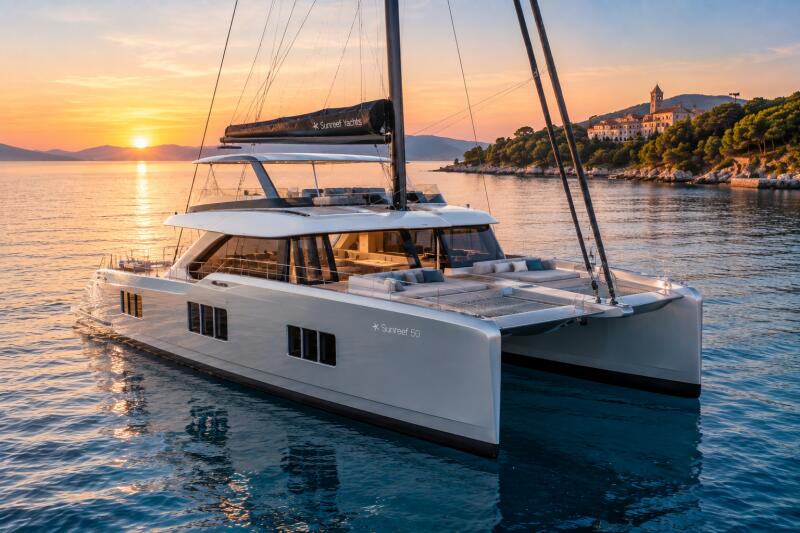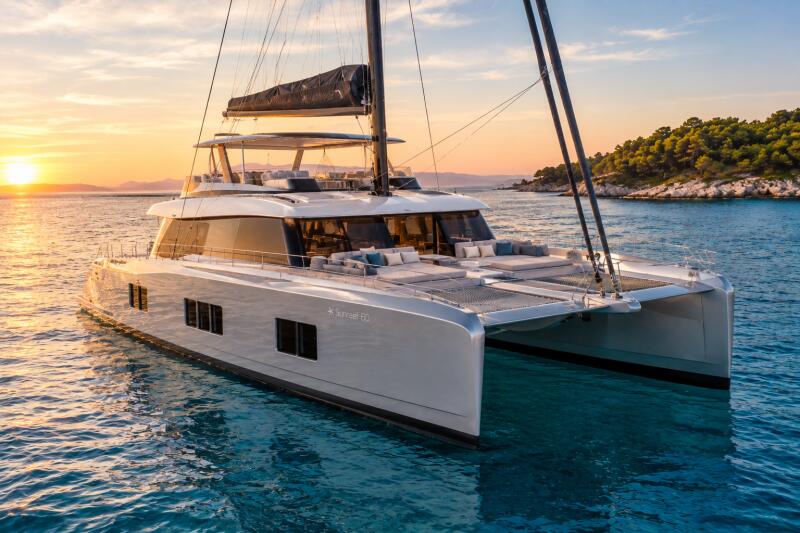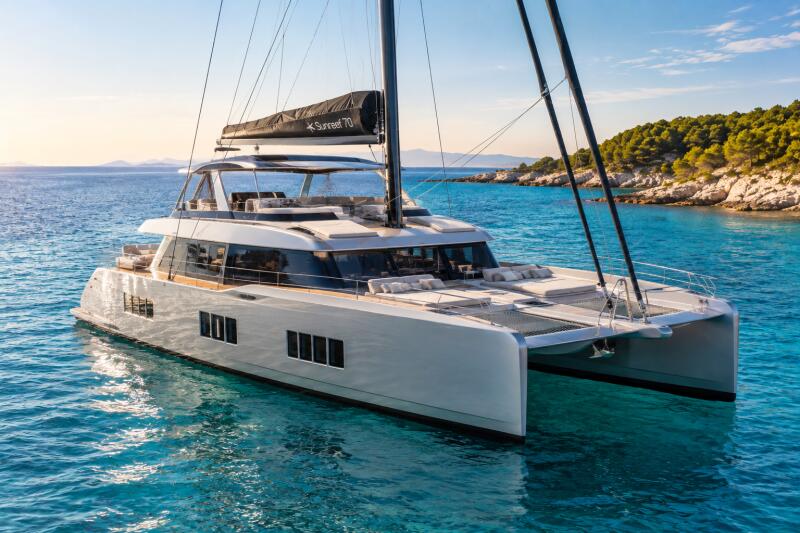
SUNREEF YACHTS - REDEFINING LUXURY CATAMARAN INNOVATION
Over the last two decades, Sunreef Yachts has played a transformative role in reshaping how catamarans are perceived within the global luxury yacht industry. Historically, multihull vessels were often associated primarily with practicality, charter operations, and functional cruising efficiency rather than prestige or high-end design. Their reputation centered on stability, shallow draft capability, and spacious layouts, but they were rarely considered direct competitors to luxury monohull yachts in terms of craftsmanship, aesthetics, or lifestyle appeal.
That perception has changed dramatically, and Sunreef has been one of the principal forces behind this evolution. By introducing a new generation of luxury catamarans that combine advanced engineering with superyacht-level comfort and contemporary architectural design, the company elevated the multihull concept into a fully established premium segment of modern yachting. Today, luxury catamarans are no longer viewed as purely practical alternatives to traditional yachts, but as highly desirable vessels offering a distinct and increasingly influential interpretation of life at sea.
A major reason for this shift lies in the inherent advantages of multihull architecture. Catamarans naturally provide greater beam, increased stability, and substantially larger usable living areas compared to monohulls of similar length. Sunreef Yachts recognized early that these structural advantages could be leveraged not merely for efficiency, but for luxury residential-style living onboard. Instead of focusing solely on sailing capability or charter utility, the company began designing yachts around comfort, openness, and long-term livability.
This approach fundamentally changed the onboard experience. Expansive salons, full-beam owner suites, oversized flybridges, and wide outdoor lounge areas became central design features rather than secondary additions. Large panoramic windows and seamless indoor-outdoor transitions reinforced a constant visual connection to the surrounding sea environment, creating spaces that feel far more architectural and residential than traditionally nautical.
At the same time, Sunreef continued advancing the technical side of multihull engineering. Its yachts combine lightweight composite construction, carefully optimized hull geometry, and sophisticated sail or propulsion systems designed to improve efficiency, range, and overall cruising performance. The twin-hull configuration delivers exceptional stability both underway and at anchor, significantly reducing roll motion and enhancing onboard comfort during extended voyages. This stability has become one of the defining advantages of luxury catamarans, particularly for owners and guests prioritizing relaxed long-distance cruising.
The company’s influence extends across both sailing and power catamaran sectors. Sailing models emphasize ocean-crossing capability combined with residential comfort, while power catamarans focus on efficient long-range cruising and large-scale onboard living. In both cases, the design philosophy remains consistent: maximizing space, enhancing connection to the water, and creating yachts intended for immersive lifestyle experiences rather than purely technical performance.
Long-range cruising capability is another defining characteristic of the brand. The wide beam and efficient hull forms of catamarans allow for substantial fuel and water storage, large solar integration surfaces, and extensive provisioning capacity, making these yachts particularly well suited for autonomous exploration. Owners increasingly use Sunreef yachts for extended stays aboard, remote island cruising, and global itineraries where comfort and self-sufficiency are essential.
Environmental awareness has also become increasingly central to the company’s identity. Through the development of hybrid propulsion systems, integrated solar technologies, and eco-focused yacht concepts, Sunreef has positioned itself at the forefront of sustainable luxury yachting. This reflects a broader shift within the industry, where modern yacht owners increasingly seek vessels capable of combining environmental responsibility with high-end comfort and global cruising capability.
As a result, Sunreef Yachts now occupies a unique position within the global marine industry. Its yachts represent far more than enlarged cruising catamarans - they embody a modern interpretation of luxury at sea where stability, openness, efficiency, and lifestyle integration redefine the expectations of contemporary yacht ownership.
THE RISE OF LUXURY CATAMARAN CRUISING
The growing popularity of catamarans reflects a much broader transformation within modern yachting culture, where priorities have shifted away from purely performance-driven navigation toward comfort, flexibility, and long-term onboard living. For decades, monohull yachts dominated the luxury market, particularly in sailing, where speed, racing heritage, and traditional naval architecture strongly influenced design philosophy. Interiors were often constrained by narrow hull geometry, deck circulation could be limited, and sailing performance frequently took precedence over residential comfort.
In recent years, however, owner expectations have evolved significantly. Modern yacht owners increasingly seek vessels capable of functioning not only as transportation platforms, but as floating lifestyle environments designed for extended stays at sea. Comfort, privacy, stability, fuel efficiency, and social space have become central considerations, particularly among families, long-range cruisers, and charter guests who prioritize the quality of everyday life onboard over aggressive sailing characteristics.
Catamarans naturally align with these changing expectations. Their multihull architecture offers structural advantages that directly translate into improved onboard livability. The wide beam of a catamaran creates dramatically larger interior and exterior living spaces compared to monohulls of similar length, allowing designers to develop open-plan layouts, expansive salons, and oversized outdoor lounging areas without sacrificing operational functionality.
This increased volume fundamentally changes how space is experienced onboard. Salons can be arranged more like contemporary waterfront residences, with full-height windows, integrated dining areas, and uninterrupted visual flow across the yacht. Cabins benefit from greater width and more flexible layouts, while outdoor areas such as flybridges, aft cockpits, and foredeck lounges become true social environments capable of accommodating larger groups comfortably.
Twin-hull construction also provides a major advantage in terms of stability. Because the yacht’s beam is distributed across two hulls rather than concentrated within a single narrow structure, catamarans experience significantly reduced heeling while sailing and less rolling motion at anchor. This creates a calmer and more predictable onboard environment, particularly important for guests who may be less experienced at sea or sensitive to motion. The reduction in movement enhances comfort during meals, overnight stays, and extended passages, making catamarans especially attractive for family cruising and luxury charter operations.
Fuel efficiency and cruising autonomy further contribute to the appeal of multihull yachts. The efficient hydrodynamics of twin-hull designs often result in lower resistance and improved energy consumption compared to similarly sized monohulls. Combined with large deck areas suitable for solar integration and substantial storage capacity for water, fuel, and provisions, catamarans are exceptionally well suited for long-range cruising and remote exploration.
These characteristics have made luxury catamarans increasingly dominant within the charter market as well. Charter guests typically prioritize space, stability, and outdoor living over technical sailing performance, and catamarans deliver these qualities exceptionally well. The ability to offer multiple social zones, private guest accommodations, and direct access to the sea creates an onboard atmosphere that feels relaxed, open, and highly suited to warm-weather cruising destinations such as the Mediterranean, Caribbean, Seychelles, and South Pacific.
Sunreef Yachts identified this cultural and market shift earlier than many traditional yacht builders. Rather than positioning itself merely as a manufacturer of practical cruising catamarans, the company approached multihull design from a luxury yacht perspective, applying superyacht-level thinking to spatial planning, material quality, engineering sophistication, and onboard lifestyle integration.
This distinction proved transformative. Instead of competing with conventional catamaran builders on functionality alone, Sunreef redefined the category entirely by demonstrating that multihull yachts could offer not only practicality and efficiency, but also architectural elegance, bespoke craftsmanship, and genuine luxury. Its yachts blurred the line between catamaran and superyacht, introducing a new segment of vessels capable of combining residential-scale comfort with serious cruising capability.
As a result, luxury catamarans are now widely regarded as one of the fastest-evolving sectors within global yachting. They represent a broader movement toward experiential travel, sustainable cruising, and lifestyle-oriented yacht ownership, where the focus is placed less on traditional maritime hierarchy and more on creating comfortable, immersive environments for life at sea.
A DISTINCTIVE DESIGN PHILOSOPHY
One of the most defining characteristics of Sunreef Yachts is its commitment to openness, spatial continuity, and architectural integration throughout the yacht. Rather than designing interiors and exterior decks as separate functional zones, Sunreef approaches the yacht as a unified living environment in which movement, visibility, and interaction flow naturally from one area to another. This philosophy represents a significant departure from more traditional yacht layouts, where spaces are often compartmentalised and strongly divided between operational and residential functions.
At the core of this approach is the idea that the surrounding sea should remain constantly present within the onboard experience. Traditional physical barriers between cockpit, salon, and deck areas are intentionally minimised, allowing spaces to merge visually and functionally into a single coherent environment. The yacht therefore feels less like a sequence of isolated rooms and more like an open architectural structure floating within the marine landscape.
Large sliding glass doors are central to this design language. When opened, they effectively dissolve the separation between interior and exterior living areas, transforming salons and aft cockpits into one continuous social space. This creates a highly flexible environment that adapts naturally to different cruising conditions, weather patterns, and social situations. Guests can move freely between shaded interior comfort and open-air deck living without interruption, reinforcing a strong sense of openness and fluidity throughout the yacht.
Panoramic windows further enhance this spatial experience by maximising natural light and maintaining uninterrupted visual connection with the surrounding environment. Instead of treating windows as secondary openings, Sunreef integrates them as structural and architectural elements that define the atmosphere of the interior itself. The result is a constant awareness of the sea, horizon, and changing light conditions, which gives the onboard environment a dynamic and immersive quality.
This extensive use of glazing also transforms the psychological perception of space onboard. Interiors feel significantly larger, brighter, and less confined than those found on many traditional yachts. Combined with the naturally wide beam of catamaran architecture, this creates living environments that resemble modern waterfront residences far more closely than conventional marine interiors.
The interior design philosophy reinforces this residential character. Sunreef interiors are typically based on clean architectural lines, restrained contemporary styling, and carefully balanced material palettes that prioritise calmness and comfort over excessive ornamentation. Natural woods, soft fabrics, neutral tones, and minimalist detailing create environments that feel refined yet highly livable, particularly during extended cruising periods.
Spatial volume plays an equally important role in shaping the onboard atmosphere. Catamaran geometry allows for large open-plan salons with elevated ceilings and broad floor areas rarely achievable in monohull yachts of comparable length. This additional width enables designers to create highly adaptable social spaces that support dining, relaxation, entertainment, and long-term living without creating visual clutter or restricting movement.
The emphasis on comfort is not limited to aesthetics alone. Furniture layouts, circulation paths, ventilation strategies, and seating arrangements are all engineered to support practical daily life onboard. The result is a design philosophy that prioritises how people actually inhabit and use the yacht over purely stylistic considerations.
This architectural approach becomes particularly evident in the company’s sailing catamarans, where the challenge lies in balancing expansive living spaces with genuine sailing capability. Sunreef addresses this by carefully integrating outdoor social areas into the broader sailing platform rather than treating them as isolated additions.
Flybridge spaces are designed not only for navigation but also as elevated leisure environments with panoramic visibility. Aft cockpits function as central gathering zones connected directly to the salon, while forward lounges create additional relaxation areas closer to the waterline. Together, these multiple outdoor living spaces allow guests to disperse naturally throughout the yacht, creating a sense of openness and privacy simultaneously.
Importantly, these lifestyle-oriented features are achieved without compromising sailing functionality. Helm stations remain ergonomically efficient, deck circulation is carefully planned for safe movement under sail, and sail-handling systems are integrated in ways that preserve operational practicality while maintaining visual elegance.
Through this philosophy, Sunreef Yachts has redefined what modern catamaran design can represent. Its yachts are conceived not simply as sailing or motor vessels, but as integrated floating environments where architecture, engineering, and lifestyle converge to create a uniquely immersive experience of life at sea.
SAILING CATAMARANS - COMFORT AND OCEAN CAPABILITY
Sunreef Yachts designs its sailing catamarans around a philosophy that combines genuine offshore capability with a level of onboard comfort more commonly associated with luxury residential living. Rather than forcing owners to choose between sailing performance and spacious accommodation, the company’s multihull approach seeks to integrate both elements into a single cruising platform capable of supporting long-range exploration without sacrificing quality of life at sea.
This balance is particularly evident in models such as the Sunreef 80 Sailing, which demonstrates how large-scale catamaran architecture can simultaneously support efficient sailing dynamics and expansive living environments. These yachts are conceived not merely as transportation vessels, but as self-sufficient floating residences capable of sustaining extended periods onboard across a wide variety of cruising regions.
One of the most important advantages of multihull design is the enormous increase in usable volume created by the yacht’s wide beam. Unlike monohull sailing yachts, where the narrowing hull shape limits interior proportions and forces designers to work around curved structural geometry, catamarans provide broad, stable platforms with nearly rectangular interior spaces. This creates far greater flexibility in spatial planning and allows layouts to resemble modern residential architecture more closely than traditional yacht interiors.
The result is an onboard environment defined by openness and versatility. Full-beam owner suites can be positioned within an entire hull, providing levels of privacy and spatial comfort rarely achievable on similarly sized monohulls. Expansive salons connect naturally with exterior deck areas, while guest cabins can be arranged in highly adaptable configurations depending on whether the yacht is intended for private cruising, charter operation, or long-term liveaboard use.
This flexibility is one of the defining strengths of Sunreef sailing catamarans. Layouts can accommodate wellness areas, office spaces, dedicated crew quarters, or large social lounges without compromising circulation or comfort. Storage capacity is also significantly improved due to the distributed hull volume, an important advantage for owners planning extended offshore passages or remote cruising itineraries.
Under sail, the twin-hull configuration delivers another major benefit: exceptional stability. Because buoyancy is distributed across two hulls separated by a wide beam, the yacht experiences significantly reduced heeling compared to monohull sailing yachts. Instead of leaning dramatically under sail pressure, the catamaran remains relatively level, creating a calmer and more predictable onboard environment.
This reduction in heel angle has a profound impact on daily life at sea. Movement throughout the yacht becomes easier and safer, dining and relaxation remain comfortable while underway, and long passages become less physically demanding for guests. For family cruising in particular, this stability enhances onboard confidence and usability, especially for children or less experienced sailors who may find heavily heeled monohulls intimidating or uncomfortable.
The same characteristics also make Sunreef catamarans highly attractive within the luxury charter market. Charter guests often prioritise comfort, social space, and reduced motion over pure sailing performance, and the stable platform provided by a catamaran significantly improves the overall onboard experience during multi-day itineraries.
Despite their strong emphasis on comfort and residential living, Sunreef sailing catamarans are engineered for serious offshore capability. Advanced composite construction techniques help optimise weight distribution while maintaining structural rigidity, allowing the yachts to handle demanding sea conditions efficiently.
Carbon mast configurations are frequently used to reduce weight aloft and improve sailing efficiency, while advanced sail-handling systems simplify operation for smaller crews. Electric winches, furling systems, and carefully integrated helm layouts allow large catamarans to be managed with relative ease despite their substantial size.
Hull forms are also carefully optimised to balance comfort with passagemaking efficiency. Narrow individual hull sections reduce drag and improve hydrodynamic performance, enabling efficient cruising speeds under sail while preserving fuel economy during auxiliary engine use. This efficiency becomes particularly valuable during long offshore passages where autonomy and energy management are critical considerations.
Importantly, all of these technical systems are integrated in a way that preserves the relaxed atmosphere expected from luxury cruising platforms. Operational areas remain unobtrusive, deck layouts maintain clean visual lines, and sailing functionality is incorporated without disrupting the residential character of the yacht.
In this way, Sunreef Yachts has successfully redefined the modern sailing catamaran. Its yachts demonstrate that ocean-going capability and luxury living are no longer opposing priorities, but complementary aspects of a new generation of long-range cruising vessels designed around comfort, autonomy, and immersive life at sea.
POWER CATAMARANS AND LONG-RANGE CRUISING
In addition to its sailing fleet, Sunreef Yachts has become one of the most influential names in the rapidly expanding luxury power catamaran sector. As modern yacht ownership increasingly shifts toward comfort-driven cruising, long-term liveability, and fuel-conscious operation, power catamarans have emerged as a compelling alternative to traditional monohull motor yachts. Sunreef recognized this transition early and developed a range of power multihulls designed not around maximum speed, but around efficiency, autonomy, and immersive residential living at sea.
This philosophy reflects broader changes in owner expectations. While high-speed performance once dominated the luxury motor yacht market, many contemporary owners now prioritize range, comfort, operational efficiency, and onboard quality of life. Rather than focusing on short, fast passages between marinas, they increasingly seek yachts capable of supporting slower, more flexible cruising patterns centered on extended stays at anchor, remote coastal exploration, and long-term travel.
Power catamarans are naturally well suited to this evolution because of the inherent efficiency of multihull architecture. The twin-hull configuration reduces hydrodynamic resistance compared to many monohull motor yachts offering similar interior volume. Each hull is relatively narrow, allowing the yacht to move through the water more efficiently and with less drag, particularly at moderate cruising speeds commonly used during long-distance passages.
This improved efficiency translates directly into lower fuel consumption and extended cruising range, two increasingly important factors in modern yachting. Owners are able to travel greater distances with reduced operational cost while maintaining large onboard living areas that would normally require substantially larger monohull platforms.
Stability is another defining advantage of power catamarans. Because buoyancy is distributed across two widely separated hulls, the yacht experiences reduced rolling motion both underway and at anchor. This creates a noticeably calmer onboard environment, particularly during overnight anchoring or when operating in mixed sea conditions. For extended cruising, this enhanced stability significantly improves guest comfort and reduces fatigue over long periods onboard.
The stable platform also supports a more residential onboard atmosphere. Furniture layouts, dining areas, and lounge spaces can be designed with fewer compromises related to vessel motion, creating interiors that feel closer to modern waterfront residences than conventional motor yachts. This is particularly valuable for owners who spend extended periods living onboard rather than using the yacht exclusively for short recreational outings.
Models such as the Sunreef 100 Power demonstrate how far this concept can be developed within the luxury segment. These yachts function almost as floating villas, combining the autonomy of long-range cruising vessels with the comfort and spatial volume of high-end architectural residences. Their expansive beam allows for exceptionally large salons, oversized owner suites, dedicated wellness spaces, and multiple outdoor social areas distributed across several deck levels.
Exterior spaces are especially prominent within Sunreef’s power catamaran philosophy. Large aft cockpits, elevated flybridges, and expansive foredeck lounges create multiple social environments capable of accommodating large groups comfortably while still preserving privacy and separation between guest areas. Beach club configurations on larger models further strengthen the connection to the sea by transforming the aft section into a multifunctional waterside living space.
Interior layouts are highly customizable, reflecting the increasing diversity of modern cruising lifestyles. Owners may configure yachts for private family use, charter operation, remote working environments, or long-term liveaboard exploration. Dedicated office areas, gyms, cinemas, wellness facilities, and crew accommodations can all be integrated into the yacht’s architecture without compromising circulation or overall spatial balance.
These characteristics make Sunreef power catamarans particularly attractive for owners who prioritize experiential travel over high-speed navigation. Slow-paced exploration, island-hopping itineraries, and extended anchoring in secluded bays align naturally with the capabilities of multihull power yachts. Rather than viewing the yacht purely as a transport platform, owners increasingly use these vessels as mobile living environments designed for immersive interaction with coastal and island regions.
This approach fits especially well within cruising destinations such as the Mediterranean, Caribbean, Seychelles, and South Pacific, where daily navigation distances are relatively short and much of the onboard experience revolves around outdoor living, water activities, and social relaxation at anchor.
By focusing on efficiency, comfort, and long-term autonomy rather than purely performance-oriented cruising, Sunreef Yachts has helped redefine what luxury motor yachting can represent. Its power catamarans illustrate a broader shift within the marine industry toward yachts designed not simply for movement across water, but for sustained and comfortable life at sea.
OUTDOOR LIVING AND CONNECTION TO THE SEA
Outdoor living lies at the very center of the Sunreef Yachts design philosophy, shaping nearly every aspect of how its yachts are configured and experienced. Rather than treating exterior decks as secondary recreational zones, Sunreef designs them as primary living environments where guests spend much of their time during both navigation and anchoring. This emphasis reflects broader changes in modern yachting culture, where the quality of outdoor experience has become just as important as interior luxury.
The multihull architecture of catamarans provides significant advantages in this regard. The exceptionally wide beam creates expansive deck surfaces that would be difficult or impossible to achieve on monohull yachts of comparable length. This additional width fundamentally changes the spatial possibilities onboard, allowing designers to create large, uninterrupted exterior areas that feel more like private waterfront terraces than conventional yacht decks.
Aft cockpits are among the most important of these spaces. Typically positioned on the same level as the interior salon, they function as natural extensions of the main living environment. Large dining tables, lounge seating, and open circulation paths create highly social spaces designed for shared meals, relaxation, and continuous interaction with the surrounding marine environment. Because of the yacht’s width, these areas remain spacious even when accommodating larger groups, reinforcing the relaxed and communal atmosphere that defines catamaran cruising.
Oversized flybridges further expand the available outdoor living area. Elevated above the main deck, these spaces provide panoramic views and often become the central social hub while underway or at anchor. Sun lounges, dining zones, bars, and secondary helm stations are commonly integrated into the flybridge design, allowing guests to enjoy open-air living with uninterrupted visibility across the sea and coastline.
Forward lounge spaces add another dimension to the outdoor experience. Positioned near the bow between the twin hulls, these areas create a uniquely open and stable environment close to the waterline. Sun pads, seating areas, and relaxation zones transform the forward section of the yacht into a quiet retreat where guests can experience direct connection with the sea while remaining protected from excessive motion.
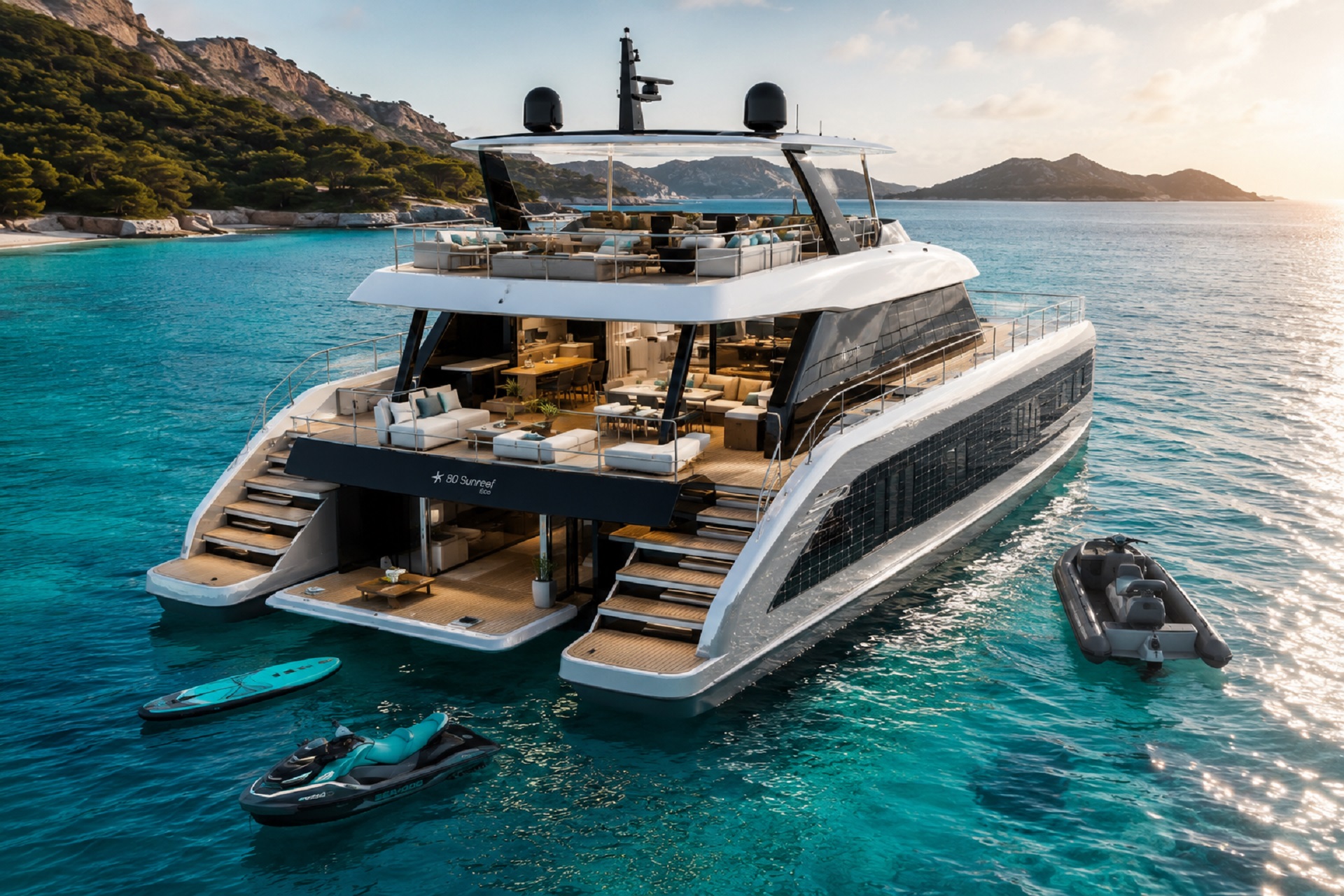
One of the most distinctive features of larger Sunreef models is the integration of beach club areas that strengthen the yacht’s relationship with the water itself. These spaces transform the stern into a multifunctional recreational platform designed around direct sea access and waterside living. Rather than simply serving as boarding points, beach clubs become active lifestyle zones where swimming, diving, sunbathing, and watersports naturally converge.
Hydraulic swim platforms allow guests to move easily between yacht and sea, while fold-out terraces increase usable deck area and create a more immersive waterfront atmosphere. Integrated tender garages and water toy storage systems support activities such as snorkeling, paddleboarding, diving, and jet skiing without disrupting the visual cleanliness of the yacht’s exterior design.
At anchor, these combined features effectively transform the yacht into a floating resort environment. Guests are able to disperse naturally across multiple outdoor zones, choosing between shaded lounge areas, elevated flybridge views, sea-level beach clubs, or private foredeck retreats depending on mood and activity. This distributed spatial design creates a strong sense of freedom and openness that is central to the Sunreef onboard experience.
The importance of outdoor living also reflects the cruising regions in which these yachts are most commonly used. In destinations such as the Mediterranean and the Caribbean, daily life onboard revolves around warm weather, calm anchorages, and continuous interaction with the sea. Owners and guests often spend entire days moving between swimming, dining outdoors, relaxing in shaded lounges, and making short passages between islands or coastal bays.
Sunreef’s design philosophy aligns closely with this lifestyle. Its yachts are engineered not simply for efficient travel between destinations, but for maximizing the quality of time spent within those environments. By prioritizing expansive outdoor spaces, seamless access to the water, and continuous visual connection with the surrounding landscape, Sunreef Yachts has created yachts that function as immersive platforms for contemporary coastal living at sea.
SUSTAINABLE INNOVATION AND ECO CATAMARANS
Sustainability has become one of the most significant pillars of recent development within Sunreef Yachts, reflecting a broader transformation taking place across the global marine industry. As environmental awareness increasingly influences owner expectations, luxury yacht builders are being challenged to reduce emissions, improve energy efficiency, and rethink the long-term environmental impact of large recreational vessels. Rather than treating sustainability as a secondary marketing concept, Sunreef has positioned eco-focused innovation as a central component of its future design philosophy.
This strategic direction is particularly important because luxury yachting has traditionally relied heavily on large diesel propulsion systems and energy-intensive onboard infrastructure. Modern yacht owners, however, are increasingly seeking vessels capable of combining high-end comfort with lower environmental impact, especially in sensitive cruising regions where sustainability regulations and ecological concerns are becoming more prominent.
Sunreef responded to this shift by investing heavily in renewable energy integration, electric propulsion technology, and advanced onboard energy management systems. The company’s Eco range represents one of the most ambitious attempts within the luxury yacht sector to create large-scale cruising catamarans capable of significantly reducing dependence on conventional fossil fuel operation while preserving the comfort and autonomy expected from modern luxury yachts.
A defining innovation within this concept is the integration of solar technology directly into the yacht’s structure itself. Rather than mounting traditional rigid solar panels as external additions, Sunreef developed custom photovoltaic systems embedded into hull sides, superstructures, flybridge hardtops, and other structural surfaces. This approach transforms large portions of the yacht into active energy-generating areas while maintaining clean architectural lines and aesthetic consistency.
The large surface area naturally available on catamarans makes them particularly suitable for this type of renewable energy integration. The broad beam, expansive roof sections, and extended deck structures provide significantly more usable space for solar generation compared to many traditional monohull yachts. As a result, Sunreef Eco catamarans are capable of producing substantial onboard electrical energy passively while underway or at anchor.
This renewable energy generation supports a wide range of onboard systems, including lighting, hotel loads, air conditioning support, and auxiliary functions, reducing reliance on generators and lowering overall fuel consumption. During favorable conditions, the yachts can operate many onboard systems for extended periods using stored solar energy alone.
Electric propulsion systems further extend this sustainability-focused approach. Hybrid and fully electric drive configurations allow the yachts to operate with significantly reduced emissions and noise levels, particularly during low-speed cruising or maneuvering in protected marine environments. Silent operation has become one of the defining experiential advantages of electric cruising, fundamentally changing the atmosphere onboard by eliminating much of the vibration and engine noise traditionally associated with motorized yacht operation.
Advanced battery storage technology plays a critical role in making these systems practical for luxury cruising applications. High-capacity battery banks allow energy generated through solar integration to be stored efficiently and distributed according to onboard demand. Intelligent energy management systems continuously regulate power consumption, balancing propulsion requirements, hotel systems, and renewable input to maximize operational efficiency and autonomy.
One of the most notable examples of this philosophy is the Sunreef 80 Eco, a yacht that represents one of the industry’s most advanced attempts to combine large-scale luxury cruising with low-emission operation. Rather than compromising comfort or reducing onboard amenities to achieve sustainability goals, the yacht demonstrates how renewable energy systems and luxury living can coexist within a highly sophisticated marine platform.
The significance of these developments extends beyond technical innovation alone. They reflect a broader cultural shift within luxury yachting itself, where environmental responsibility is increasingly viewed as compatible with premium lifestyle experiences rather than opposed to them. Modern owners are placing greater value on autonomy, efficiency, reduced environmental impact, and quiet operation, particularly as cruising increasingly involves remote natural environments and ecologically sensitive regions.
Catamarans are especially well suited to this transition because of their inherent efficiency and large renewable integration surfaces. Their stable platforms and efficient hull forms reduce overall energy demand, while expansive deck structures create ideal conditions for large-scale solar integration. Sunreef has effectively leveraged these structural advantages to position multihull yachts at the forefront of sustainable luxury cruising.
By investing aggressively in renewable technologies, integrated solar architecture, and electric propulsion systems, Sunreef Yachts has established itself as one of the leading innovators in the evolution of eco-conscious luxury yachting. Its Eco range demonstrates that the future of high-end cruising may increasingly depend not on larger engines or greater speed, but on intelligent energy use, long-range efficiency, and a more balanced relationship between luxury travel and the marine environment.
INTERIOR CRAFTSMANSHIP AND PERSONALIZATION
One of the defining strengths of Sunreef Yachts lies in its highly individualized approach to interior craftsmanship and spatial personalization. Rather than relying on rigid production layouts or standardized design packages, the company approaches each yacht as a customizable living environment shaped around the owner’s lifestyle, cruising ambitions, and long-term expectations for life at sea.
This flexibility is particularly important within the luxury catamaran sector because multihull architecture naturally provides far greater spatial freedom than traditional monohull yachts. The wide beam and expansive platform geometry allow designers to configure interiors with fewer structural limitations, creating layouts that can be adapted extensively without compromising circulation or onboard comfort.
As a result, owners are able to influence nearly every aspect of the yacht’s interior architecture. Cabin arrangements, salon configuration, dining layouts, galley positioning, and circulation flow can all be customized according to intended usage. Some owners prioritize large social areas for entertaining guests, while others focus on private long-term residential comfort, family cruising functionality, or remote working environments capable of supporting extended periods onboard.
Material selection also plays a central role in shaping the identity of each yacht. Interiors are typically designed around carefully balanced combinations of natural woods, stone surfaces, soft textiles, and refined contemporary finishes that emphasize warmth, calmness, and understated sophistication. Rather than relying on excessive ornamentation or overly formal styling, Sunreef interiors favor clean architectural lines and restrained material palettes inspired by modern luxury residences.
Neutral tones are especially common because they enhance the feeling of openness and allow natural light to become one of the defining visual elements within the interior itself. Soft beige, gray, sand, and warm wood tones create environments that feel relaxed and timeless while maintaining a strong visual connection to the surrounding marine landscape.
Large panoramic windows are fundamental to this design approach. Rather than functioning simply as openings within the structure, they are integrated as major architectural features that shape the overall atmosphere onboard. Natural light floods the salon and accommodation areas throughout the day, reducing the sense of enclosure often associated with traditional yacht interiors and reinforcing the spaciousness made possible by catamaran geometry.
Elevated ceiling heights further contribute to this residential atmosphere. Compared to many monohull yachts, where curved hull shapes and limited beam can create more confined spaces, Sunreef catamarans offer remarkably open interior proportions. This additional vertical and horizontal volume significantly changes how the onboard environment is perceived, making the yacht feel closer to a contemporary waterfront apartment than a conventional marine vessel.
Furniture design is similarly integrated into the broader architectural concept. Many interior elements are custom-built specifically for each project, allowing seating, storage, and functional spaces to align precisely with the owner’s lifestyle requirements. The focus remains on livability and comfort, particularly for extended cruising scenarios where the yacht functions as a full-time living environment rather than a short-term recreational platform.
The ability to create highly specialized spaces has also become one of the most important aspects of Sunreef personalization. Owners increasingly request private owner apartments that occupy large portions of the yacht, creating self-contained residential suites with dedicated lounges, offices, dressing areas, and private terraces. Wellness spaces such as gyms, spas, massage rooms, and yoga areas are becoming increasingly common as onboard health and relaxation gain importance within modern yachting culture.
Dedicated cinemas, entertainment lounges, and multimedia rooms further expand the residential character of these yachts, while fully integrated office spaces reflect the growing demand for remote working capability during long-term cruising. As more owners adopt flexible lifestyles that combine travel, business, and extended time at sea, yachts are increasingly expected to function as mobile homes and operational environments simultaneously.
These characteristics have significantly increased the appeal of Sunreef yachts among owners pursuing long-range cruising and liveaboard lifestyles. The yachts are not simply designed for occasional vacations or short coastal passages, but for sustained habitation across diverse cruising regions. Spacious interiors, customizable layouts, and residential-scale comfort allow owners to remain onboard for extended periods without sacrificing the conveniences associated with land-based luxury living.
In this way, Sunreef Yachts has redefined interior yacht design within the multihull sector by merging marine engineering with architectural personalization. Its yachts demonstrate how contemporary catamaran living can combine openness, craftsmanship, and adaptability into highly sophisticated floating environments tailored to the evolving realities of modern life at sea.
GLOBAL PRESENCE AND CHARTER POPULARITY
Sunreef Yachts has established a strong and steadily growing presence across both the private ownership and luxury charter sectors of the global yachting industry. Its catamarans are now widely recognized in many of the world’s most important cruising destinations, where their distinctive combination of spacious living environments, stability, and long-range comfort aligns closely with modern expectations of luxury travel at sea.
The increasing visibility of Sunreef yachts reflects broader changes within the charter market itself. Modern charter guests often prioritize experience, relaxation, and social interaction over traditional notions of performance-oriented yachting. Large outdoor spaces, stable cruising behavior, and residential-style interiors have become central components of high-end charter demand, particularly among families, groups of friends, and multi-generational travelers seeking immersive coastal experiences rather than purely technical sailing adventures.
Catamaran architecture naturally supports these priorities. The wide beam provides substantially larger social areas than many monohull yachts of similar length, while the stable twin-hull platform reduces motion both underway and at anchor. For charter guests, this translates into a calmer and more comfortable onboard atmosphere, especially during longer passages or overnight stays.
This stability is particularly valuable for guests with limited boating experience, as it reduces seasickness and creates a more approachable environment for life at sea. Large aft cockpits, expansive flybridges, and direct access to the water further enhance the relaxed and communal atmosphere that defines luxury catamaran cruising.
In major charter regions such as the Mediterranean, Caribbean, Seychelles, Maldives, and South Pacific, Sunreef catamarans have become increasingly common within premium charter fleets. These destinations share several important characteristics: warm climates, relatively short cruising distances between anchorages, and strong emphasis on outdoor living. In such environments, guests often spend much of the day swimming, dining outside, relaxing on deck, and moving casually between islands or coastal bays.
Sunreef yachts are particularly well suited to this style of cruising because their design philosophy revolves around maximizing the quality of life onboard rather than simply optimizing navigation performance. Expansive exterior lounges, beach club areas, panoramic salons, and multiple social zones create floating environments that function almost as private luxury resorts at sea.
The Mediterranean remains one of the most important regions for Sunreef charter activity. Along coastlines such as the French Riviera, Sardinia, the Greek islands, Croatia, and the Balearics, luxury catamarans have become increasingly popular among charter guests seeking more relaxed and spacious alternatives to traditional motor yachts or monohull sailing vessels. The combination of stable anchoring, shallow draft access, and open-air living aligns perfectly with the Mediterranean cruising lifestyle, where much of the onboard experience takes place outdoors.
In the Caribbean, Sunreef catamarans are equally attractive due to their suitability for island-hopping itineraries and protected anchorage cruising. Large deck spaces, water sports facilities, and direct sea access create ideal conditions for tropical charter experiences centered around snorkeling, diving, beach exploration, and social relaxation.
The Seychelles and other remote cruising regions further highlight another key advantage of Sunreef yachts: autonomy. Catamaran efficiency, large storage capacity, and reduced fuel consumption allow these vessels to operate comfortably for extended periods without frequent marina visits or heavy logistical dependence. This capability is increasingly important for both charter operators and private owners interested in exploring less developed cruising areas with greater independence.
For private owners, the appeal of Sunreef yachts often extends beyond comfort alone. Many owners are drawn to the freedom and flexibility that multihull cruising provides. The yachts support long-term exploration and liveaboard lifestyles while maintaining residential-scale comfort, making them particularly attractive for owners planning extended voyages or seasonal migration between cruising regions.
The shallow draft characteristics of catamarans also expand the range of accessible anchorages compared to many deeper-draft monohull yachts. Owners can approach secluded bays, shallow lagoons, and protected coastal areas that may be inaccessible to larger traditional yachts, increasing both cruising flexibility and privacy.
At the same time, the yachts’ expansive solar integration potential, efficient hull forms, and growing availability of hybrid or eco propulsion systems further enhance their suitability for autonomous long-range cruising. Reduced dependence on marinas and fuel infrastructure aligns closely with the growing desire among yacht owners for slower, more immersive travel experiences focused on remote destinations and extended time spent at anchor.
These qualities have helped position Sunreef Yachts as one of the defining names in the modern luxury catamaran market. Its yachts appeal not only to traditional yacht owners, but also to a new generation of globally mobile travelers seeking flexible, comfortable, and environmentally conscious platforms for life at sea.
THE FUTURE OF LUXURY MULTIHULL YACHTING
As the global yachting industry continues to evolve, a clear shift is taking place toward sustainability, comfort-driven design, and experience-focused travel. Owners are no longer defined solely by speed, size, or status, but increasingly by how they use their yachts - how much time they spend onboard, how comfortably they can live at sea, and how efficiently they can explore diverse cruising regions. Within this changing landscape, luxury catamarans are emerging as one of the most important and forward-looking segments of modern yacht design.
Sunreef Yachts has positioned itself directly within this transition by consistently investing in technologies and design philosophies that align with the future direction of the industry. Rather than treating innovation as incremental improvement, the company has focused on rethinking the fundamental relationship between yacht, environment, and onboard lifestyle. This approach is evident in its integration of eco-friendly propulsion systems, advanced energy management, and large-scale renewable energy capture through solar technology embedded into the yacht’s architecture.
The increasing importance of sustainability is not simply a regulatory or environmental consideration; it is becoming a core part of luxury identity itself. Modern yacht owners are more conscious of fuel consumption, emissions, and long-term environmental impact, particularly when cruising in ecologically sensitive regions such as coral reefs, protected marine parks, and remote island ecosystems. In this context, efficiency and reduced environmental footprint are no longer optional enhancements but key design priorities shaping purchasing decisions.
Sunreef’s continued development of integrated solar systems and hybrid-electric propulsion solutions reflects this broader transformation. By embedding energy generation directly into hulls, superstructures, and deck surfaces, the yachts are able to harness renewable energy passively while at anchor or underway. Combined with advanced battery storage and intelligent onboard energy distribution systems, this allows for significantly reduced reliance on traditional combustion engines during everyday operation.
Alongside sustainability, another defining trend shaping the future of multihull yachting is the increasing emphasis on long-range living concepts. Yachts are no longer viewed solely as temporary leisure platforms used for short seasonal escapes, but as extended living environments capable of supporting months of continuous travel. This shift has direct implications for design, pushing naval architecture toward greater autonomy, improved storage capacity, enhanced comfort systems, and more flexible interior layouts.
Catamarans are particularly well suited to this evolution due to their inherent structural advantages. The wide beam and dual-hull configuration allow for significantly larger interior volumes compared to monohull yachts of similar length, enabling more residential-style layouts, private owner zones, and multifunctional living areas. This makes them especially attractive for owners seeking to combine travel, work, leisure, and long-term habitation within a single platform.
Comfort is also becoming a central driver of future yacht design. Stability at anchor, reduced motion underway, quiet operation, and seamless indoor-outdoor integration are increasingly prioritized over pure performance metrics. Multihulls naturally excel in these areas, offering a smoother, more stable platform that enhances the quality of life onboard and reduces the physical strain associated with long passages.
Equally important is the growing focus on experiential travel. Modern yacht owners are less interested in simply moving from point A to point B and more focused on the quality of experiences along the way - anchoring in secluded bays, spending extended time in nature, and engaging with the marine environment in a more immersive and personal way. Catamarans support this shift by providing expansive outdoor living spaces, easy water access, and a relaxed onboard atmosphere that encourages slower, more intentional cruising.
Rather than positioning multihulls as alternatives to traditional yachts, Sunreef Yachts has helped redefine them as a distinct and fully mature category within luxury yachting. This category is characterized by a unique combination of stability, spatial freedom, efficiency, and lifestyle-oriented design that cannot be directly replicated by conventional monohull platforms.
In doing so, the company has contributed to a broader industry-wide recognition that the future of luxury yachting will not be defined by a single dominant yacht type, but by a diversification of platforms tailored to different ways of experiencing life at sea. Within this evolving landscape, luxury catamarans are set to play an increasingly central role, offering a vision of yachting that prioritizes openness, sustainability, and the seamless integration of comfort and exploration.
CONCLUSION - SUNREEF YACHTS AND THE EVOLUTION OF MODERN LUXURY CRUISING
Sunreef Yachts has fundamentally reshaped expectations of what luxury catamarans can represent within the global yachting landscape. What was once considered a niche segment focused primarily on stability and practical cruising has evolved into a fully established category of high-end marine design, defined by architectural living spaces, advanced engineering solutions, and a lifestyle-driven approach to life at sea.
At the core of this transformation is the company’s ability to merge multihull efficiency with superyacht-level sophistication. By applying the standards of bespoke yacht design - previously reserved for large monohull superyachts - to the catamaran platform, Sunreef has elevated the multihull concept into a legitimate alternative for luxury ownership and long-range cruising. This includes not only exterior design refinement and naval architecture, but also interior craftsmanship, onboard systems integration, and highly personalized living environments.
A key element of this evolution is the integration of sustainability into the identity of modern luxury. Through the development of hybrid propulsion systems, electric cruising capabilities, and large-scale solar energy integration, Sunreef has demonstrated that environmental responsibility and high-end yachting are no longer opposing ideas. Instead, they are increasingly interdependent, particularly as owners seek quieter, more efficient, and more autonomous ways to explore the world’s oceans.
Equally important is the redefinition of onboard space and livability. Sunreef catamarans prioritize openness, natural light, and seamless transitions between interior and exterior environments, creating yachts that feel closer to floating residences than traditional maritime vessels. Expansive decks, full-beam living areas, and multiple outdoor social zones enable a lifestyle centered around movement, relaxation, and continuous engagement with the surrounding sea.
This approach extends beyond design aesthetics into the practical realities of modern cruising. Enhanced stability at anchor, reduced motion underway, and generous onboard volume make these yachts particularly well suited to long-term living and extended voyages. Whether used for private ownership or luxury charter, they offer a consistent focus on comfort and usability across all aspects of operation.
Ultimately, the significance of Sunreef’s contribution lies not only in technological innovation or stylistic evolution, but in the broader shift it represents within contemporary yachting culture. Luxury is increasingly defined by experience rather than excess, by freedom of movement rather than sheer size, and by connection to the natural environment rather than separation from it.
In this context, Sunreef Yachts stands as one of the key pioneers of modern multihull cruising - a brand that has helped redefine luxury at sea as something more open, more sustainable, and more deeply connected to the lived experience of the ocean itself.