
Beneteau
Beneteau Yachts - French Innovation and the Evolution of Modern Cruising
Beyond its role as a yacht manufacturer, Beneteau can be understood as one of the key innovators that helped redefine what “modern cruising” actually means in contemporary sailing culture. The brand’s influence is not limited to individual models or design generations, but extends into the broader transformation of yacht design philosophy across the entire recreational boating industry.
At the heart of Beneteau’s identity is a distinctly French approach to design innovation - one that blends aesthetics, livability, and emotional experience with industrial-scale engineering. This combination allowed the company to bridge an important gap in the sailing world: the space between traditional handcrafted yacht building and modern production-driven accessibility.
Instead of treating cruising yachts as either purely technical sailing machines or static luxury objects, Beneteau positioned them as living environments designed for movement, social interaction, and everyday use at sea. This shift helped establish a new design language within the industry, where comfort, light, openness, and ease of handling became just as important as hull performance or racing pedigree.
One of the most significant contributions of Beneteau’s innovation model is the way it reshaped expectations around onboard living. Modern cruising yachts are now widely expected to feature bright interiors, flexible cabin layouts, and seamless indoor-outdoor flow between saloon and cockpit. These ideas, now common across the industry, were heavily accelerated by Beneteau’s design evolution and mass-market reach.
At the same time, the company’s production approach played a crucial role in making this innovation scalable. By combining advanced composite construction techniques with highly optimized manufacturing processes, Beneteau was able to deliver consistent quality across large production volumes. This industrial efficiency made modern cruising yachts more widely available, helping expand sailing culture far beyond its traditional geographic and social boundaries.
In this sense, Beneteau’s impact is not only visible in marinas and charter fleets, but also in the expectations sailors now bring to any modern cruising yacht. Features such as easy sail handling systems, open cockpit layouts, large hull windows, and ergonomic deck design have become standard references in the industry, largely shaped by decades of Beneteau’s development philosophy.
Today, when sailors step onboard a contemporary cruising yacht - whether in Croatia, Greece, Italy, or across the wider Mediterranean - they are often experiencing a design language that Beneteau helped popularize and refine. From island-hopping itineraries around Hvar or Kornati Islands to longer coastal passages along southern Europe, the principles of modern cruising comfort are now deeply embedded in the sailing experience itself.
Ultimately, Beneteau’s innovation is best understood not as a single breakthrough, but as a continuous evolution. The company helped shift cruising yachts from complex, specialist sailing platforms into accessible, lifestyle-oriented vessels designed for real people and real journeys. In doing so, it played a central role in shaping the modern identity of recreational sailing as we know it today.
The Origins of Beneteau
Beneteau is one of the most influential names in the global sailing industry, a brand that played a major role in shaping modern recreational boating across Europe and far beyond. Founded in France in 1884 by Benjamin Bénéteau, the company originally had little connection to luxury cruising or leisure sailing. Its roots were firmly tied to the practical maritime traditions of France’s Atlantic coast, where it initially specialized in building sturdy fishing boats designed for demanding commercial use.
This early background proved deeply important to the company’s long-term identity. Beneteau developed not from glamorous yacht culture, but from generations of real boatbuilding experience connected to everyday life at sea. Reliability, practicality, and functional design became embedded in the company’s philosophy long before it entered the recreational sailing market.
Over time, the company gradually evolved from traditional wooden construction into one of the world’s largest and most recognizable yacht manufacturers. This transformation closely mirrored the broader evolution of modern sailing itself. During the twentieth century - particularly in the decades following World War II - recreational boating expanded rapidly throughout Europe. Sailing was no longer viewed exclusively as a profession, military skill, or elite sporting activity. It increasingly became associated with travel, freedom, coastal exploration, and leisure.
Beneteau recognized this shift earlier than many competitors. The company understood that a growing number of people wanted practical and comfortable yachts that were enjoyable to use rather than technically intimidating or reserved only for experienced sailors. As a result, Beneteau successfully transitioned from commercial maritime production into leisure sailing, helping introduce entirely new generations of people to life at sea.
One of the brand’s greatest strengths was its ability to build yachts that felt approachable. Unlike companies focused exclusively on racing heritage, extreme performance, or ultra-luxury exclusivity, Beneteau concentrated on creating versatile cruising yachts that appealed to a much broader audience. Their boats combined usability, reliable sailing characteristics, comfort, and intelligent layouts in a way that made yacht cruising increasingly realistic for ordinary sailors and families.
This philosophy became especially important as Mediterranean charter culture expanded during the late twentieth century. Countries such as Croatia, Greece, Italy, and Spain emerged as some of the world’s leading sailing destinations, supported by growing marina infrastructure and island-based tourism. Charter companies needed yachts that could combine comfortable onboard living, manageable handling, and economic practicality. Beneteau fit this role exceptionally well.
As a result, the brand became deeply woven into Mediterranean sailing culture itself. Beneteau yachts appeared in marinas, charter fleets, and anchorages across the Adriatic and wider Mediterranean, becoming one of the defining visual symbols of modern cruising holidays. Thousands of sailors experienced their first meaningful time at sea aboard a Beneteau - whether during family holidays, island-hopping adventures, or week-long charter itineraries between coastal towns and hidden bays.
In Croatia especially, Beneteau became strongly associated with the Adriatic sailing lifestyle. Routes through islands such as Hvar, Vis, Brač, Korčula, and Mljet became closely connected with the experience of cruising aboard practical and comfortable Beneteau yachts. For many visitors, these boats represented freedom, summer travel, and the simple pleasure of moving slowly through Mediterranean landscapes under sail.
The origins of Beneteau therefore represent far more than the story of a successful yacht manufacturer. They reflect the broader democratization of sailing itself - the transformation of life at sea from a specialized activity into an accessible and widely shared modern lifestyle experience.
French Design Philosophy and Practical Innovation
One of Beneteau’s greatest strengths has always been its ability to combine practical cruising functionality with distinctly French design sensibilities. From the beginning, the company understood that a successful cruising yacht needed to do more than simply sail well - it needed to feel enjoyable, comfortable, and emotionally inviting for the people living onboard. Beneteau consistently focused on creating yachts that balance elegance and usability without becoming overly technical or unnecessarily complicated.
This balance gradually became one of the defining elements of the Beneteau identity. While some yacht builders concentrated heavily on racing heritage or highly specialized performance sailing, Beneteau focused on the broader experience of cruising itself. The company recognized that most sailors spend far more time relaxing in cockpits, anchoring in bays, dining onboard, and exploring coastlines than pushing yachts aggressively at maximum speed.
As a result, Beneteau yachts were designed around real cruising life rather than purely competitive sailing priorities. Comfort, intelligent layouts, approachable handling, and practical onboard living became central to the design philosophy. The yachts needed to function naturally during long summer holidays, family cruising trips, and Mediterranean island hopping - not only during technically demanding sailing situations.
French influence is visible throughout Beneteau’s design language. Compared to many traditional sailing yachts, Beneteau models often feel lighter, more open, and more socially oriented. The company embraced a style of yacht design that places strong emphasis on atmosphere and onboard lifestyle rather than purely mechanical functionality.
Cockpit spaces illustrate this philosophy particularly well. On many Beneteau models, the cockpit is designed as a true outdoor living area rather than simply a technical sailing workspace. Seating arrangements encourage conversation and shared meals, while wide stern sections and open layouts create a more relaxed social environment. This approach fits naturally with Mediterranean cruising culture, where much of daily life onboard takes place outside.
In regions such as Croatia, Greece, Italy, and Spain, sailing is often centered around anchoring, swimming, and spending long evenings in warm coastal conditions. Beneteau yachts support this lifestyle exceptionally well because their deck layouts are designed to encourage comfort and relaxation as much as navigation itself.
The interiors follow the same philosophy. Beneteau emphasized brightness, fluid movement, and welcoming communal spaces long before these ideas became widespread across the cruising yacht market. Large hull windows, panoramic deck hatches, and open saloon layouts create interiors that feel spacious and breathable rather than enclosed and heavily segmented.
Natural light became an especially important design element. Older sailing yachts often felt darker and more confined below deck, particularly during hot Mediterranean afternoons. Beneteau helped modernize the onboard atmosphere by creating brighter interiors that felt more connected to the surrounding environment. The result was a style of cruising yacht that appeared more contemporary, approachable, and comfortable for extended living onboard.
At the same time, Beneteau never abandoned practicality. Despite the elegant visual presentation, the yachts remained highly functional. Storage solutions were integrated carefully, cabin layouts prioritized real usability, and sailing systems remained manageable for ordinary owners and charter crews. The company consistently avoided turning its yachts into purely stylistic objects disconnected from real cruising requirements.
Behind this lifestyle-oriented design philosophy stood a strong commitment to industrial innovation and production efficiency. As Beneteau expanded internationally, the company invested heavily in advanced composite construction technologies, modern lamination systems, precision manufacturing processes, and large-scale production infrastructure. These investments allowed Beneteau to maintain consistent build quality while producing yachts at a scale few competitors could match.
This industrial capability became one of the company’s major competitive advantages. Beneteau succeeded in producing modern cruising yachts that remained financially accessible to a wide market while still offering reliable quality and contemporary design. The ability to combine large-scale manufacturing efficiency with attractive cruising-oriented design helped the brand dominate major segments of the international sailing market.
Over time, this combination of elegant French design and industrial reliability helped Beneteau become one of the most commercially successful yacht builders in modern sailing history. More importantly, it helped shape the broader culture of contemporary cruising itself. Beneteau demonstrated that sailing yachts could be practical without feeling austere, stylish without becoming impractical, and accessible without sacrificing genuine enjoyment at sea.
Beneteau and the Rise of Mediterranean Charter Sailing
Few yacht builders benefited more from the rapid expansion of Mediterranean charter sailing than Beneteau. As sailing holidays became increasingly popular during the 1990s and 2000s, the company found itself perfectly positioned to meet the changing demands of the modern cruising market. Across the Mediterranean, a growing number of travelers were discovering sailing not as a competitive sport, but as a new form of leisure travel centered around freedom, island exploration, and life at sea.
This transformation reshaped the sailing industry itself. Countries such as Croatia, Greece, Italy, and Spain rapidly developed into some of the world’s most important charter destinations. Marina infrastructure expanded, coastal tourism increased, and charter fleets grew year after year to accommodate rising international demand.
Charter companies needed yachts that could function effectively within this new environment. The ideal Mediterranean charter yacht needed to be spacious enough for groups and families, comfortable during week-long holidays, reliable under constant seasonal use, and manageable for crews with varying levels of sailing experience. Economic practicality also mattered heavily, since charter operators required yachts that were efficient to maintain while still appealing visually to guests.
Beneteau fit this role exceptionally well.
The company’s cruising yachts aligned almost perfectly with the realities of Mediterranean charter life. Their models offered generous accommodation layouts, practical onboard ergonomics, manageable sailing systems, and bright modern interiors that created a comfortable onboard atmosphere even for people completely new to sailing.
One of Beneteau’s major advantages was its ability to maximize usable living space. Wide cockpit layouts encouraged social interaction and outdoor dining, which are central elements of Mediterranean cruising culture. Flexible cabin configurations allowed charter operators to accommodate different group sizes efficiently, while spacious saloons and practical galleys supported comfortable onboard living throughout longer itineraries.
The sailing systems themselves also contributed heavily to the brand’s charter success. Beneteau yachts generally emphasized forgiving handling characteristics and balanced sail plans rather than aggressive performance setups. This made them approachable for mixed-experience crews and ideal for charter environments where many guests were sailing outside highly experienced racing circles.
In regions like the Adriatic, these qualities became especially valuable. Croatian sailing itineraries often involve relatively short passages between islands, frequent anchoring stops, marina visits, and relaxed daily cruising rather than technically demanding offshore sailing. Beneteau yachts matched this rhythm naturally.
As charter infrastructure expanded along the Croatian coast, Beneteau became deeply integrated into Adriatic sailing culture itself. Charter bases in Split, Dubrovnik, Zadar, and Šibenik filled with Beneteau models that carried thousands of visitors through some of the Mediterranean’s most iconic cruising grounds.
Routes involving Hvar, Vis, Brač, Korčula, Mljet, and the Kornati Islands became strongly associated with Beneteau cruising yachts. For many visitors, their first experience of island hopping, anchoring in turquoise coves, or spending nights onboard happened aboard a Beneteau.
Over time, the brand became closely connected with the emotional image of Mediterranean sailing itself. Beneteau yachts were not simply viewed as transportation between destinations - they became part of the atmosphere and memory of the holiday experience. Warm Adriatic evenings spent dining in the cockpit, afternoons swimming from fold-down bathing platforms, mornings departing quiet anchorages under sail, and relaxed marina life in coastal towns all became associated with the Beneteau cruising lifestyle.
This emotional connection played a major role in the brand’s long-term popularity. Many sailors who later became private yacht owners first encountered sailing through Mediterranean charter holidays aboard Beneteau yachts. The boats felt approachable, comfortable, and realistic to imagine owning one day themselves.
In this way, Beneteau helped democratize modern cruising culture. The company did not simply benefit from the growth of Mediterranean charter sailing - it actively helped shape how that experience looked and felt for an entire generation of sailors.
The Oceanis Series - Defining Modern Cruising
Among Beneteau’s most important achievements was the creation and long-term evolution of the Oceanis range, a series that became one of the most recognizable and commercially successful cruising yacht lines in the world. More than simply a collection of sailing models, the Oceanis series helped define what modern recreational cruising would eventually become across the Mediterranean and international sailing markets.
The success of the Oceanis concept came from a simple but highly influential idea: most sailors are not looking for extreme racing performance or technically demanding offshore machines. They want yachts that are comfortable, manageable, spacious, and enjoyable to live aboard during real cruising experiences. Beneteau recognized this reality early and designed the Oceanis line specifically around the everyday lifestyle of modern sailors.
Unlike performance-focused racing yachts that prioritize sail area, aggressive hull balance, and technical deck systems, the Oceanis series emphasized comfort, easy handling, social onboard living, and practical cruising usability. These yachts were designed for families, couples, charter guests, and private owners who valued freedom and enjoyment at sea more than competitive performance.
This philosophy proved enormously successful because it reflected how people actually use cruising yachts in real life. Most modern sailing itineraries involve relatively short coastal passages, anchoring in protected bays, swimming stops, marina visits, and relaxed evenings onboard rather than demanding offshore racing conditions. The Oceanis range aligned perfectly with this evolving style of sailing.
Over the years, models such as the Beneteau Oceanis 38, Beneteau Oceanis 41, Beneteau Oceanis 45, Beneteau Oceanis 46.1, and Beneteau Oceanis 51.1 became especially popular throughout both private ownership markets and Mediterranean charter fleets.
Each generation expanded on the same core strengths while gradually modernizing the overall design language. Spacious cockpit layouts became central features of the Oceanis identity. These areas were designed not only for sail handling, but as genuine outdoor living spaces where crews could dine, relax, socialize, and spend long summer evenings together. In Mediterranean cruising culture, where much of onboard life happens outside, this became a major advantage.
Fold-down bathing platforms further reinforced the connection between the yacht and the surrounding sea. In destinations such as Croatia, Greece, Italy, and Spain, daily life onboard often revolves around anchoring in clear bays, swimming, paddleboarding, and relaxing close to the water. The Oceanis range adapted naturally to this lifestyle by making sea access easy and central to the onboard experience.
The interiors also became one of the defining strengths of the series. Bright saloons, large hull windows, open layouts, and flexible cabin configurations created yachts that felt comfortable during extended stays onboard. Beneteau carefully designed the interiors to maximize natural light and usable volume, giving even mid-sized Oceanis models an unusually spacious feeling compared to older cruising designs.
This became especially valuable within the charter industry. Charter guests prioritize comfort, privacy, and social living spaces, and the Oceanis range consistently delivered all three. Multiple cabin arrangements allowed operators to adapt yachts for families, groups of friends, or mixed charter crews while maintaining a welcoming and practical onboard atmosphere.
As the range evolved, Beneteau continuously modernized the series without abandoning its original accessibility. Newer generations introduced wider stern sections, larger hull windows, more refined deck ergonomics, and cleaner contemporary interior styling. The yachts gradually became more visually modern and architecturally open while still preserving the forgiving sailing characteristics that made the Oceanis line so widely appreciated.
This balance between innovation and usability became one of the series’ greatest strengths. Beneteau modernized the appearance and onboard experience without turning the yachts into technically intimidating machines. Owners and charter guests could still enjoy approachable handling, balanced sailing behavior, and relaxed cruising comfort even as the designs became more sophisticated.
In places like the Adriatic, the Oceanis series became deeply integrated into charter culture itself. Countless sailing holidays through islands such as Hvar, Vis, Brač, Korčula, and the Kornati Islands have taken place aboard Oceanis yachts. For many sailors, these boats became closely tied to their first experience of Mediterranean cruising itself.
Ultimately, the Oceanis series succeeded because it understood modern sailing not simply as navigation, but as a lifestyle centered around comfort, freedom, exploration, and shared experiences at sea. For countless sailors around the world, the Oceanis became the very definition of the modern cruising yacht.
Beneteau First - Performance with Accessibility
While Beneteau became globally recognized for comfortable cruising yachts through the Oceanis range, the company also maintained a strong and respected connection to sailing performance through the Beneteau First series. The First line represented a different side of the brand’s identity - one focused on responsive sailing characteristics, faster hulls, and more dynamic handling - while still preserving the practicality and accessibility that defined Beneteau as a whole.
This balance became one of the First range’s greatest strengths. Rather than creating extreme racing yachts intended only for professional crews or highly specialized sailors, Beneteau developed performance-oriented boats that remained usable and enjoyable for ordinary owners. The First series blended sporty sailing capability with real-world cruising functionality, creating yachts that appealed to sailors who wanted more excitement under sail without sacrificing comfort entirely.
Historically, the First range played a major role in Beneteau’s reputation within performance cruising and club racing communities. Models such as the Beneteau First 35, Beneteau First 40.7, and Beneteau First 47.7 developed particularly strong reputations among sailors seeking yachts that combined speed, balance, and versatility.
These yachts offered responsive hull designs, efficient sail plans, and lively handling characteristics that rewarded active sailing without becoming intimidating or unmanageable. They performed well in regattas and club races, yet still remained practical enough for coastal cruising, family sailing, and extended time onboard. This dual-purpose capability became highly attractive to sailors who wanted one yacht capable of serving multiple roles.
The Beneteau First 40.7 in particular became one of the most iconic models of its era. Designed by Bruce Farr, it achieved enormous popularity in both amateur racing circuits and performance cruising markets. The yacht gained recognition for delivering genuine racing pedigree while still maintaining a level of comfort and usability rarely found in more specialized competition-oriented designs.
Importantly, the First range reflected a different interpretation of performance sailing than many traditional racing brands. Beneteau did not focus exclusively on elite-level competition or stripped-down race boats. Instead, the company emphasized accessible performance - yachts that allowed ordinary sailors to experience the excitement and responsiveness of fast sailing without requiring professional crews or sacrificing onboard comfort completely.
This philosophy aligned well with the realities of Mediterranean sailing culture. In regions such as Croatia, Greece, Italy, and Spain, many sailors seek a balance between enjoyable sailing performance and relaxed coastal cruising. Daily itineraries often involve short passages between islands, changing wind conditions, anchoring stops, and social life onboard rather than nonstop offshore racing.
The First series adapted naturally to this environment. Sailors could enjoy faster and more engaging sailing characteristics during passages while still benefiting from practical interiors, usable cockpit layouts, and enough comfort for extended cruising holidays. The yachts felt energetic and rewarding without becoming exhausting or overly technical.
As the range evolved into newer generations, Beneteau continued refining the concept toward fast cruising and accessible modern performance sailing. Contemporary First models became lighter, cleaner, and more modern in appearance while still preserving the core idea of combining sailing excitement with realistic usability.
This evolution reflected broader changes within the sailing market itself. Modern sailors increasingly wanted yachts capable of delivering emotional engagement and strong sailing sensations without demanding the full lifestyle commitment traditionally associated with competitive racing. Beneteau responded by creating yachts that remain exciting to sail while still fitting naturally into leisure-oriented cruising culture.
The contrast between the Oceanis and First ranges also became one of Beneteau’s greatest market strengths. Through Oceanis, the company delivered spacious and highly comfortable cruising yachts designed around relaxation and onboard living. Through First, it offered more dynamic and performance-oriented yachts that still remained approachable for ordinary sailors.
This dual identity allowed Beneteau to appeal to an exceptionally wide spectrum of the sailing world. Some owners prioritized social cruising, family holidays, and Mediterranean charter comfort, while others sought more responsive sailing and occasional racing ambitions. Beneteau succeeded because it understood that modern sailing culture contains both desires - and that many sailors ultimately want elements of each.
Interiors Designed Around Real Life at Sea
Beneteau interiors have long been designed around the realities of practical onboard living rather than decorative excess or purely visual luxury. While many yacht brands focus heavily on dramatic styling statements or highly formal interiors, Beneteau consistently prioritized comfort, usability, and the everyday experience of spending extended time at sea. Step inside a modern Beneteau yacht and this philosophy becomes immediately apparent.
The interiors are created not simply to impress during a boat show visit, but to function naturally during real cruising life. Every area is designed with movement, comfort, storage, and social interaction in mind. The result is an onboard atmosphere that feels relaxed, welcoming, and highly livable rather than overly formal or technically intimidating.
One of the most noticeable features of modern Beneteau interiors is the emphasis on light and openness. Large hull windows, panoramic deck hatches, and carefully positioned glazing allow natural daylight to flow deep into the saloon and cabin areas. This dramatically changes the feeling below deck compared to older sailing yachts, which often felt darker and more enclosed.
In Mediterranean climates especially, this abundance of natural light becomes a major advantage. Sailing regions such as Croatia, Greece, Italy, and Spain are defined by long summer days and extended periods spent onboard. Bright interiors help create cooler, more breathable spaces that remain pleasant even during hot afternoons at anchor.
The saloons themselves are typically arranged around social functionality. Beneteau understood early that modern cruising is deeply connected to shared experiences onboard. Dining together, relaxing after sailing, planning routes, or simply spending evenings inside during bad weather all revolve around the saloon environment.
As a result, seating arrangements are usually open and conversational rather than heavily segmented. Tables are practical for both dining and everyday use, while circulation throughout the interior feels fluid and unobstructed. The spaces are designed to support life onboard naturally instead of forcing crews to adapt awkwardly to rigid layouts.
Cabin arrangements are also carefully optimized to balance comfort and privacy. This became especially important as Beneteau grew within the charter market, where yachts often host multiple couples or families sharing the boat during week-long sailing holidays.
In these situations, personal space matters enormously. Beneteau responded by developing layouts that maximize cabin usability while maintaining enough separation and storage for guests to feel comfortable during longer stays onboard. Wide hull sections and efficient interior architecture allowed the company to create cabins that often feel surprisingly spacious for their yacht size category.
The practical focus continues throughout the galleys. Unlike interiors designed mainly for visual presentation, Beneteau galleys are intended for real use during active cruising. Work surfaces are generally functional and accessible, refrigeration capacity is suitable for extended stays, and movement within the galley remains manageable even while underway.
Storage integration became another defining strength of Beneteau interiors. Long-term cruising requires far more equipment and supplies than many casual observers expect, and poorly designed yachts quickly become cluttered and uncomfortable. Beneteau addressed this challenge through intelligent use of lockers, compartments, under-seat storage, and cabin organization systems that support real-life cruising without overwhelming the living environment.
This practicality became particularly valuable during Mediterranean charter holidays. Crews sailing through destinations such as Hvar, Vis, Korčula, or the Kornati Islands often spend entire weeks living onboard. The yacht effectively becomes a floating apartment, and interior usability strongly shapes the quality of the overall experience.
Despite this strong emphasis on function, Beneteau interiors never feel cold or industrial. The company consistently managed to balance practicality with warmth and visual comfort. Wood finishes, neutral color palettes, soft natural lighting, and open living spaces create interiors that feel approachable and emotionally inviting.
Importantly, Beneteau avoided turning its yachts into symbols of unattainable luxury disconnected from ordinary sailing culture. The interiors feel refined without becoming excessive. Owners and charter guests are meant to feel comfortable using the spaces naturally rather than carefully preserving them as formal showpieces.
This balance between comfort, usability, and approachable modern design became one of the reasons Beneteau achieved such enormous success within the cruising market. The interiors support the way people actually experience sailing today: through relaxed coastal exploration, social onboard living, family holidays, and the simple enjoyment of spending time close to the sea.
Beneteau in Croatia and the Adriatic
The Adriatic became one of the most important regions for Beneteau’s cruising identity, and few sailing destinations demonstrate the strengths of the brand more clearly than the Croatian coastline. Croatia’s combination of calm summer weather, island-rich geography, reliable seasonal winds, and relatively short sailing distances created ideal conditions for Beneteau’s comfortable and cruising-oriented yachts.
As the Croatian charter industry expanded rapidly during the 1990s and 2000s, Beneteau established itself as one of the dominant yacht brands throughout the Adriatic. Charter bases in Split, Dubrovnik, Zadar, and Šibenik filled with Beneteau models that became deeply integrated into the rhythm of Mediterranean sailing holidays. For countless visitors arriving from across Europe and beyond, their first real sailing experience in Croatia happened aboard a Beneteau.
The structure of Adriatic cruising naturally suits the philosophy behind the brand. Unlike long offshore passages that demand constant technical focus, Croatian sailing is largely centered around relaxed daily exploration. Sailors move gradually between islands, stopping in quiet bays for swimming, visiting historic coastal towns, and spending evenings dining onboard or in waterfront konobas.
Beneteau yachts support this lifestyle exceptionally well because they are designed around comfort and usability rather than aggressive sailing specialization. Daily passages between islands such as Hvar, Vis, Brač, Korčula, Dugi Otok, and Mljet are often short enough to remain enjoyable and stress free, allowing crews to focus on the overall experience of coastal cruising rather than endurance sailing.
This slower and more relaxed rhythm aligns perfectly with the practical design philosophy of the Oceanis range and other Beneteau cruising models. Cockpits become central social spaces throughout the day, transforming naturally from sailing work areas into outdoor dining rooms during warm summer evenings. Mediterranean sailing culture revolves heavily around outdoor living, and Beneteau layouts encourage this lifestyle through wide seating areas, open stern designs, and comfortable movement throughout the deck.
Fold-down swim platforms further reinforce the connection between the yacht and the sea. In the Adriatic, anchoring is a major part of daily life onboard. Crews regularly stop in turquoise bays for swimming, paddleboarding, snorkeling, or simply relaxing in sheltered coves surrounded by pine-covered coastlines. Beneteau yachts support this anchoring lifestyle particularly well because they prioritize accessibility and comfort rather than purely technical sailing functionality.
The interiors also contribute heavily to the Adriatic cruising experience. Bright saloons, large windows, and open layouts remain comfortable during hot summer afternoons, creating interiors that feel airy and welcoming even during extended periods onboard. This becomes especially important during week-long charter itineraries when the yacht effectively becomes a floating apartment shared by families or groups of friends.
For charter guests, Beneteau yachts often feel approachable and confidence inspiring from the moment they step onboard. The sailing systems are generally straightforward and forgiving, reducing stress for crews with limited sailing experience. Many people entering the sailing world through Croatian charter holidays are not experienced racers or lifelong sailors. They are travelers seeking freedom, relaxation, and the experience of moving between islands under sail. Beneteau’s manageable handling characteristics allow these crews to enjoy Adriatic cruising safely and comfortably without feeling overwhelmed by technical complexity.
Over time, Beneteau became more than simply a successful yacht manufacturer within Croatia. The brand became part of the visual identity of Adriatic sailing itself. Rows of Beneteau yachts lining marinas in Split or anchored in bays around the Kornati Islands became a familiar and defining image of the Croatian charter industry.
For many sailors, memories of Croatia are inseparable from the experience of cruising aboard a Beneteau - early morning departures from quiet anchorages, afternoons sailing between islands under the Maestral wind, evenings spent dining in the cockpit beneath coastal town lights, and the simple freedom of exploring the Adriatic at a relaxed Mediterranean pace.
Beneteau and Accessible Yacht Ownership
One of Beneteau’s most important contributions to the global sailing industry was helping expand yacht ownership and cruising culture far beyond the traditional elite circles that historically dominated recreational sailing. Long before sailing holidays became mainstream travel experiences, yacht ownership was often perceived as financially inaccessible, technically intimidating, and limited primarily to highly experienced sailors or wealthy enthusiasts.
Beneteau played a major role in changing that perception.
By producing reliable, comfortable, and well-designed sailing yachts at large scale, the company helped make modern cruising financially attainable for a much broader audience. Through industrial production efficiency, practical design, and consistent manufacturing quality, Beneteau succeeded in offering yachts that balanced affordability with genuine cruising capability.
This shift had enormous influence on the broader culture of recreational sailing. Thousands of sailors across Europe and beyond entered the world of yacht ownership through Beneteau models. For many people, a Beneteau represented their first realistic opportunity to own a cruising yacht capable of comfortable coastal exploration and family sailing holidays.
Importantly, Beneteau understood that accessibility involved more than price alone. Yacht ownership also needed to feel emotionally and practically achievable. The yachts themselves had to be approachable, manageable, and comfortable for sailors who were not professional racers or lifelong maritime specialists.
This philosophy became increasingly important as Mediterranean charter sailing expanded during the 1990s and 2000s. Many future yacht owners first encountered sailing through charter holidays in destinations such as Croatia, Greece, Italy, and Spain.
A typical progression emerged throughout the industry. Travelers would spend a week sailing between islands aboard a Beneteau charter yacht, experience the freedom and lifestyle of coastal cruising, and gradually begin imagining yacht ownership as something personally attainable rather than distant or unrealistic. For many sailors, those first charter experiences became the foundation of a long-term relationship with sailing itself.
Beneteau yachts were especially effective in this role because they aligned closely with how modern people actually wanted to use their boats. The company recognized that contemporary sailors increasingly valued experience quality, comfort, ease of use, and onboard lifestyle as much as technical sailing performance.
This represented a major cultural shift within the industry. Recreational sailing was evolving away from a narrow performance-focused identity and becoming more closely connected to travel, leisure, family experiences, and lifestyle-oriented exploration. Beneteau adapted naturally to this transformation.
The company designed yachts that supported relaxed coastal cruising, social onboard living, and practical Mediterranean sailing rather than highly specialized competitive use. Wide cockpits encouraged outdoor dining and relaxation, interiors prioritized comfort during extended stays onboard, and sailing systems remained manageable for ordinary owners and charter crews.
In regions such as the Adriatic, this philosophy proved especially successful. Sailing routes through islands like Hvar, Vis, Brač, and Korčula became strongly associated with accessible cruising culture aboard Beneteau yachts. The experience felt relaxed, social, and emotionally inviting rather than highly technical or intimidating.
This accessibility helped expand sailing culture itself. Beneteau contributed to a broader democratization of recreational boating by making cruising feel compatible with ordinary modern life rather than reserved for a specialized minority. Families, couples, younger sailors, and first-time owners increasingly entered the sailing world through Beneteau because the brand presented cruising as something realistic, welcoming, and deeply enjoyable.
Over time, the company helped transform sailing from a niche activity into a mainstream travel and lifestyle experience. Today, much of the modern Mediterranean charter industry - and a significant portion of contemporary yacht ownership culture - exists within a framework that brands like Beneteau helped create.
For countless sailors around the world, Beneteau represents more than simply a yacht manufacturer. It represents the moment when sailing became personally accessible: the realization that life under sail, island exploration, and long summer days at sea were not distant fantasies, but experiences genuinely within reach.
The Lasting Legacy of Beneteau
Beneteau’s legacy extends far beyond individual yacht models or commercial success. Over more than a century of development, the company helped shape the entire culture of modern cruising and redefine how recreational sailing is experienced by ordinary people around the world.
While some yacht builders focused primarily on elite racing performance or highly exclusive luxury markets, Beneteau followed a different path. The company concentrated on creating yachts that people genuinely enjoyed using in everyday cruising life. Comfort, practicality, usability, and emotional accessibility became more important than extremes of speed or extravagance.
This practical and human-centered philosophy became one of the foundations of Beneteau’s worldwide success.
The company understood something fundamental about modern sailing: most people are not searching for technical perfection or competitive dominance. They are searching for freedom, exploration, relaxation, and meaningful experiences shared with family and friends. Beneteau designed yachts around these priorities long before they became central trends across the wider sailing industry.
As a result, Beneteau helped redefine what cruising yachts could represent in contemporary life. Sailing gradually evolved from a niche activity associated mainly with experienced enthusiasts into a broader lifestyle connected to travel, coastal discovery, and time spent close to nature. Beneteau played a major role in making that transition possible.
Today, Beneteau yachts remain among the most recognizable and widely used cruising boats in marinas and charter fleets across Europe and beyond. Their continued popularity reflects the company’s deep understanding of how people actually experience sailing in the real world.
Modern cruising is rarely defined by nonstop offshore passages or technically demanding racing scenarios. Instead, it is shaped by family holidays, island exploration, afternoons spent swimming in quiet bays, shared meals in the cockpit, evenings in waterfront towns, and relaxed journeys along beautiful coastlines. Beneteau yachts were designed precisely for this style of life at sea.
In destinations such as Croatia, Greece, Italy, and France, the brand became deeply woven into Mediterranean sailing culture itself. Countless charter holidays and private cruising adventures have taken place aboard Beneteau yachts navigating routes through islands such as Hvar, Vis, Korčula, the Kornati Islands, or the Greek Cyclades.
For many sailors, Beneteau became closely associated with the emotional side of sailing itself: waking up in sheltered anchorages, swimming in turquoise water directly from the stern platform, sharing dinner under warm evening skies, and moving slowly between islands under sail. The yachts became part of the atmosphere and memory of Mediterranean cruising.
The brand also played an important role in expanding access to yacht ownership. By combining large-scale production efficiency with approachable cruising design, Beneteau helped make sailing feel attainable to people who previously viewed yacht ownership as financially or technically unrealistic. Thousands of sailors entered the boating world through Beneteau, whether by chartering first or eventually purchasing their own yacht.
This accessibility remains central to the company’s identity today. Even as yacht design has evolved toward more modern aesthetics and larger living spaces, Beneteau has consistently maintained its focus on usability and realistic cruising comfort. The yachts continue to feel welcoming rather than intimidating, practical rather than excessive.
Ultimately, Beneteau’s enduring influence comes from its understanding that sailing is not only about boats. It is about experiences, landscapes, relationships, and freedom of movement. The company helped create a version of modern cruising that feels socially open, emotionally accessible, and deeply connected to the pleasure of exploring coastlines at a slower pace.
For countless sailors around the world, Beneteau is therefore far more than simply a yacht manufacturer. It represents the modern cruising lifestyle itself - comfortable, social, approachable, and built around the timeless appeal of discovering the sea one coastline, island, and anchorage at a time.
Beneteau Yacht Models

Oceanis 46.1
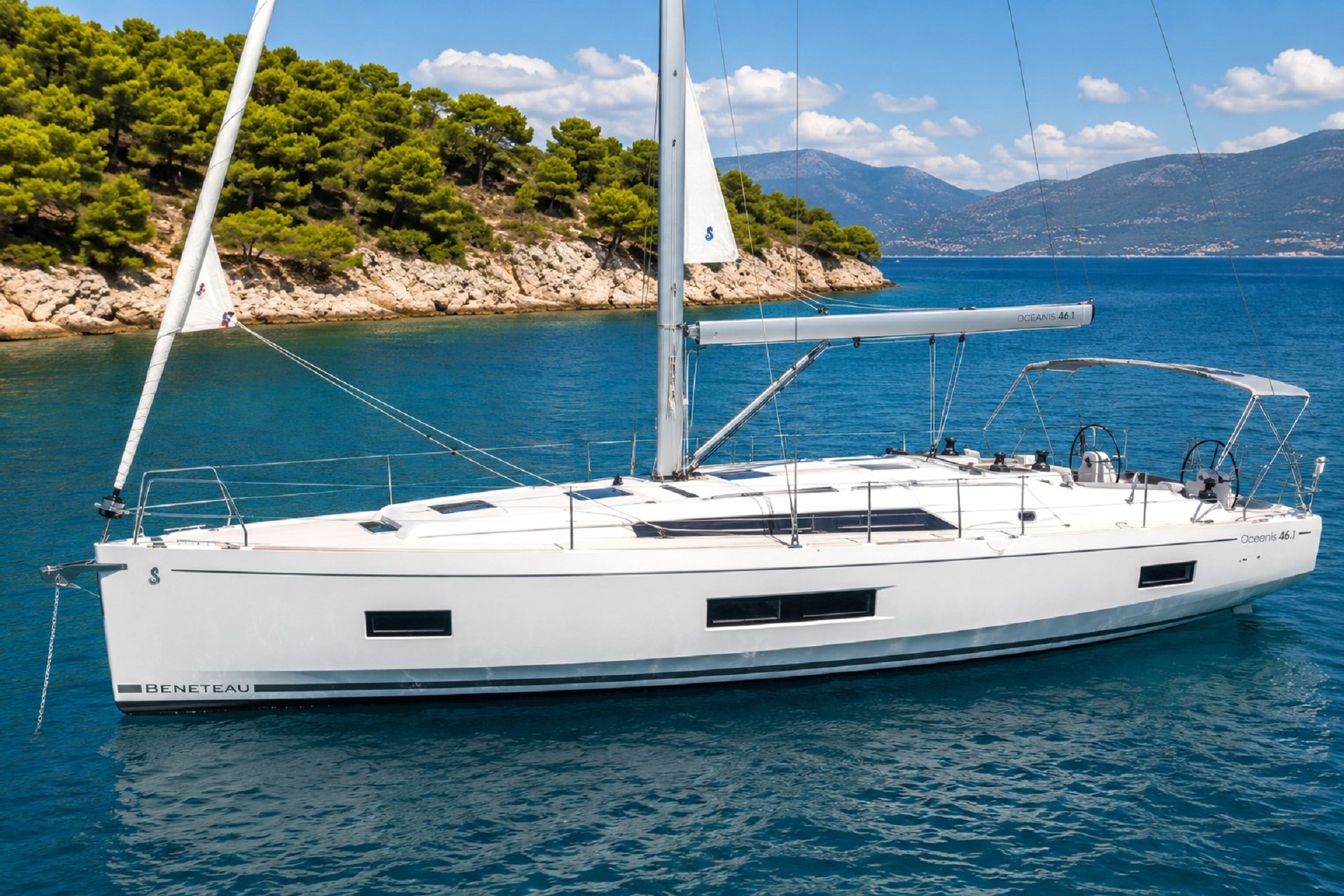
The Beneteau Oceanis 46.1 represents one of the most refined expressions of contemporary cruising yacht design in the 45 - 50 foot segment. Created by Finot-Conq with interiors by Nauta Design, this model brings together a rare combination of volume, balance, and sailing simplicity that has made it a standout choice across the Mediterranean charter fleet, especially in Croatia.
Its innovative stepped hull maximises interior space without compromising performance at sea, resulting in a yacht that feels significantly larger below deck while remaining responsive and stable under sail. This clever design approach allows the Oceanis 46.1 to deliver both generous living comfort and reassuring handling characteristics, making her equally suitable for relaxed coastal cruising and longer island-hopping itineraries.
On deck, the yacht is designed around ease of use and social sailing. A spacious cockpit, twin helm stations, and well-organised sail controls create an intuitive environment for skippers and guests alike, while the bright, modern interior ensures comfort throughout extended periods onboard.
Whether sailing between the islands of Split, exploring hidden bays around Vis, or enjoying longer passages toward Korčula or the Kornati archipelago, the Oceanis 46.1 delivers a cruising experience defined by freedom, comfort, and confidence at sea. It is this balance that has secured its place as one of the most popular and versatile charter yachts in the modern Beneteau range.
Oceanis 47
The Oceanis 47 represents the new generation of modern Mediterranean cruising yachts, designed to bring together space, simplicity, and sailing enjoyment in a single, highly refined platform. Built by Beneteau and shaped by the latest thinking in cruising yacht design, she offers a balanced combination of generous interior volume, intuitive handling, and confident performance across a wide range of conditions.
Positioned in the highly popular 45 - 50 foot segment, the Oceanis 47 is ideally suited for sailing holidays in Croatia and across the Adriatic, where island-hopping routes, short passages, and extended time at anchor define the rhythm of the voyage. Her layout is designed to support both relaxed family cruising and active sailing with friends, ensuring comfort on deck, ease of movement, and a bright, welcoming interior below.
Whether exploring the islands of Split, anchoring in secluded bays around Vis, or enjoying longer coastal passages toward Korčula or the Kornati archipelago, the Oceanis 47 delivers a smooth and adaptable sailing experience. She is a yacht that feels equally at home underway or at anchor, turning every part of the journey into an essential part of the holiday itself.
For sailors seeking a modern cruising yacht that combines comfort, usability, and dependable performance, the Oceanis 47 stands as one of the most versatile and attractive options in her class.