BALI CATAMARANS - REDEFINING SPACE, COMFORT, AND MODERN MULTIHULL CRUISING
Bali Catamarans has become one of the most disruptive and recognizable names in modern multihull sailing, redefining what sailors expect from cruising catamarans in terms of space, layout innovation, and onboard lifestyle. Developed in France by Catana Group, the brand emerged with a clear goal: to challenge traditional catamaran design conventions and create yachts that prioritize open living, freedom of movement, and a seamless indoor-outdoor connection.
From the beginning, Bali Catamarans positioned itself differently from other multihull builders. Instead of following the established “compartmentalized” catamaran layout philosophy - where interior spaces are divided into relatively closed saloon, cockpit, and galley zones - the brand introduced a more architectural approach to onboard space. This concept treats the yacht as a unified living environment rather than a collection of separate rooms. Large opening wall systems, rigid foredecks, and expansive aft lounges blur the boundary between inside and outside, effectively turning the entire boat into one continuous social area rather than segmented quarters.
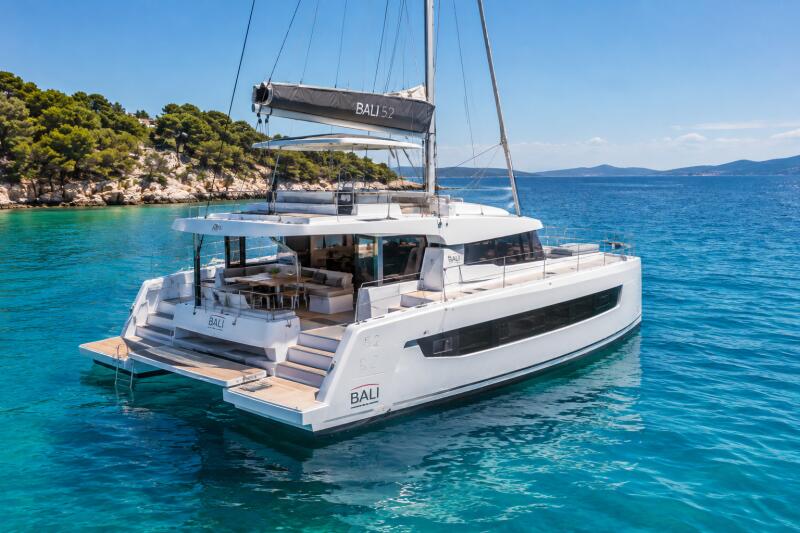
One of the defining innovations that helped Bali stand out is the emphasis on the so-called “garage door” aft opening, which transforms the saloon and cockpit into a single, open-plan terrace at anchor. When opened, it creates a wide, unobstructed passage that changes the feel of the yacht from a traditional sailing vessel into something closer to a floating villa. This approach reflects a broader shift in modern cruising expectations, where comfort at anchor and lifestyle functionality are valued just as highly as sailing performance.
The forward cockpit concept is another hallmark of the brand. Instead of leaving the bow area purely functional or reserved for sail handling, Bali integrates it as a fully usable lounge space, often directly connected to the saloon via a forward door. This allows guests to move freely from stern to bow without stepping outside the sheltered interior flow, a design choice that significantly improves both comfort underway and livability at anchor.
Internally, Bali Catamarans are known for maximizing usable volume, particularly in the saloon and galley areas. The raised saloon design enhances visibility and ventilation while allowing for large refrigeration systems, full-size kitchen layouts, and dining spaces that feel more like a modern apartment than a typical yacht interior. Cabins are typically positioned in the hulls with a strong focus on natural light, storage capacity, and private en-suite layouts, reinforcing the brand’s emphasis on long-term cruising comfort.
This design philosophy has had a noticeable influence on the wider multihull industry. While many traditional builders continue to prioritize segmented spaces and sailing efficiency-focused layouts, Bali has helped accelerate a parallel trend toward lifestyle-oriented cruising catamarans. Owners increasingly seek yachts that function not only as sailing machines but also as comfortable living platforms for extended stays onboard, whether for Mediterranean cruising, ocean passages, or charter operations.
As a result, Bali Catamarans has carved out a distinct identity within the global multihull market: bold, open, and deliberately unconventional. By rethinking how space is used at sea and prioritizing social living areas over traditional nautical compartmentalization, the brand has reshaped expectations of what a modern cruising catamaran can be.
A NEW PHILOSOPHY IN MULTIHULL DESIGN
The defining innovation behind Bali Catamarans lies in its deliberate shift toward open-plan living as the central organizing principle of yacht design. Traditional catamarans have long followed a more segmented approach, separating interior saloon spaces from exterior cockpit areas and requiring movement through narrower companionways, side decks, or partially enclosed transitions. This layout prioritizes structural convention and sailing tradition, but it often limits how naturally people can move through the vessel in day-to-day use at anchor.
Bali Catamarans, developed by the French shipyard Catana Group under the brand Bali Catamarans, fundamentally reinterpreted this relationship between space and movement. Instead of treating the yacht as a series of connected but distinct compartments, the design philosophy prioritizes continuity - both visually and physically - between interior and exterior zones. The goal is not simply to enlarge living areas, but to eliminate the psychological and functional barriers that traditionally separate them.
One of the most recognizable expressions of this approach is the aft “garage door” system. When opened, the entire aft bulkhead of the saloon lifts, effectively merging the cockpit and interior lounge into a single, uninterrupted living space. This transforms the yacht’s social core into an open terrace-like environment, dramatically expanding usable volume without increasing the vessel’s physical footprint. At anchor, this configuration becomes especially impactful, as airflow, light, and movement all flow freely through the boat, reinforcing the sense of being in a floating open-air residence rather than a closed marine structure.
This concept is reinforced by complementary design choices such as large forward cockpit access and wide, level floorplans that minimize steps between zones. The result is a circulation pattern onboard that feels intuitive and fluid, allowing guests to move from bow to stern without the typical constraints of narrow passageways or abrupt transitions between interior and exterior environments. In practice, this creates a yacht where social interaction naturally concentrates in shared open spaces rather than being divided into isolated cabins or seating areas.
The philosophy aligns particularly well with warm-water cruising conditions, where life onboard is strongly oriented toward outdoor living. In regions such as Croatia, Greece, and the Caribbean, the majority of daily onboard activity typically takes place at anchor or in sheltered bays. Swimming, dining, sunbathing, and social gatherings define the rhythm of the cruising experience, and the Bali layout is specifically optimized to support this lifestyle without compromise between comfort and functionality.
This has made the design particularly appealing to both private owners and charter operators. In the charter market, where guest experience and perceived space are critical value drivers, the ability to offer a “villa-like” environment at sea is a strong differentiator. The open saloon-cockpit concept enhances not only comfort but also the sense of luxury and freedom that clients associate with modern yacht cruising. At the same time, it reduces the friction of onboard movement, making the vessel more intuitive and accessible for guests who may be less experienced sailors.
Ultimately, this design direction represents a broader shift in multihull thinking: from yachts as sailing machines with living accommodation attached, to yachts as living environments that also happen to sail. By prioritizing spatial openness and lifestyle integration, Bali Catamarans has helped redefine what comfort at sea means in the modern cruising era.
SPACE OPTIMIZATION AND FLOATING APARTMENT CONCEPT
Bali Catamarans is widely associated with what is often described as the “floating apartment” concept - a design philosophy that places maximum emphasis on usable volume, comfort, and long-term livability at anchor. Unlike traditional yacht design approaches that tend to prioritize sailing efficiency and exterior aesthetics first, the Bali approach deliberately shifts focus toward how people actually inhabit the vessel over days or weeks of continuous cruising.
This philosophy is closely linked to the work of Catana Group, which developed the Bali Catamarans line as a response to changing expectations in the cruising and charter markets. Modern sailors increasingly spend more time at anchor than underway, especially in destinations like the Mediterranean and the Caribbean, and this has pushed designers to rethink what “comfort at sea” actually means in practical terms.
At the core of the floating apartment concept is spatial efficiency. Instead of distributing volume across multiple smaller, separated compartments, Bali concentrates living space into large, multifunctional zones. The saloon is typically the central focus, designed as a full-width living area with generous headroom and panoramic glazing that floods the interior with natural light. These large windows are not merely aesthetic; they are structural design elements that visually extend the interior into the surrounding seascape, reinforcing the feeling of openness and reducing the sense of confinement often associated with traditional yacht interiors.
The galley is another key area where this philosophy becomes evident. Rather than being isolated in a corner or tucked into a narrow passage, it is integrated into the main living space. This allows the person preparing meals to remain part of the social environment, whether guests are seated at the dining table, relaxing on lounge seating, or moving between interior and exterior spaces. This integration reflects a broader lifestyle-driven approach, where cooking, dining, and socializing are treated as interconnected activities rather than separate functions.
Storage solutions are carefully engineered to support extended cruising without compromising living comfort. Instead of relying on visible, bulky storage areas, Bali yachts distribute volume intelligently throughout hulls and interior structures. This allows owners and guests to carry provisions for longer passages while maintaining clean, uncluttered living spaces. The result is a balance between practicality and aesthetics that is particularly important for liveaboard cruising.
Furniture design also plays a central role in reinforcing flexibility. Seating areas are often modular or convertible, allowing spaces to adapt depending on whether the yacht is being used for private cruising, family travel, or charter operations. Dining areas, lounge zones, and navigation stations are arranged in a way that supports continuous interaction rather than isolated usage patterns. This creates a sense of flow throughout the interior, where movement feels natural and intuitive rather than restricted.
Perhaps the most important outcome of this design philosophy is the way it reshapes onboard experience. Guests are able to move freely between cooking, dining, relaxing, and navigating without encountering the typical spatial interruptions found in more conventional yacht layouts. There are fewer narrow corridors, fewer abrupt transitions between zones, and a stronger sense that the yacht is a single unified environment rather than a collection of separate rooms.
In essence, the floating apartment concept redefines what a cruising catamaran can offer. It shifts the focus from purely nautical considerations to lived experience, creating yachts that function not just as vessels for travel, but as complete residential environments at sea - comfortable, social, and highly adaptable to modern cruising lifestyles.
THE OPEN COCKPIT REVOLUTION
One of the most recognizable and disruptive innovations introduced by Bali Catamarans is the rethinking of the aft cockpit and foredeck relationship, most notably through the elimination of the traditional aft trampoline netting found on many classic catamaran designs. In conventional multihulls, the trampoline serves both as a structural element and a functional lounging space, but it also represents a largely non-solid, less versatile surface that is primarily associated with sailing dynamics rather than comfortable living.
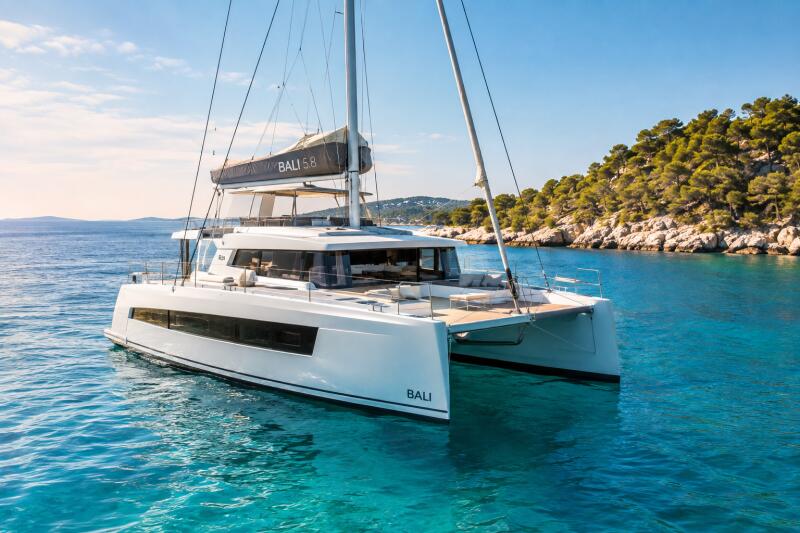
Bali Catamarans, developed by the French shipyard Catana Group under the brand Bali Catamarans, deliberately replaced this traditional element with a solid foredeck structure. This change fundamentally alters how space is used onboard, transforming what was once a semi-functional sailing component into a fully integrated living area.
The introduction of a solid forward deck represents a shift in design philosophy from “sailing-first utility space” to “living-first architectural space.” Instead of a flexible net area primarily used for sail handling or occasional lounging, the foredeck becomes a stable, continuous platform that can be actively used throughout the cruising experience. Sunbathing, reading, relaxation, and even informal social gatherings can take place on a surface that feels secure and residential rather than purely nautical.
This forward-deck concept is complemented by a significantly expanded and more open aft cockpit configuration. When combined with Bali’s signature aft “garage door” system, the cockpit effectively becomes a central social hub that connects seamlessly with the saloon interior. The result is a continuous living zone stretching from aft to forward sections, where guests can move freely without encountering the spatial breaks typical of traditional catamaran layouts.
From a functional perspective, this redesign also enhances safety and practicality at anchor. Solid decking reduces reliance on netting underfoot, providing more predictable footing when moving around the yacht, especially in conditions of wind, wave movement, or nighttime activity. It also improves usability for families or charter guests who may be less accustomed to navigating traditional sailboat structures. At the same time, the enclosed structural design allows for more efficient storage integration within the bow area, further supporting the “floating apartment” philosophy associated with Bali yachts.
The importance of this layout becomes especially evident in Mediterranean cruising environments such as the Balearic Islands, the Aeolian Islands, and Croatia’s extensive cruising grounds, including the Kornati Islands. In these regions, sailing itineraries are typically characterized by short passages between sheltered anchorages, bays, and island clusters rather than long offshore transits. As a result, the value of a yacht is measured less by high-performance sailing efficiency and more by the quality of life onboard at anchor.
In such conditions, the open cockpit and foredeck philosophy becomes particularly powerful. Guests spend the majority of their time onboard in relaxed, stationary environments, where dining, sunbathing, swimming, and social interaction define the experience. The Bali layout directly supports this lifestyle by maximizing usable deck space and creating multiple interconnected zones for relaxation and gathering, without forcing guests into confined or segmented areas.
Ultimately, the “open cockpit revolution” represents more than a design adjustment - it reflects a broader redefinition of what a cruising catamaran is meant to be. By replacing traditional sailing-focused elements with expansive, livable surfaces, Bali Catamarans has helped shift industry expectations toward yachts that prioritize human experience, comfort, and spatial freedom above all else.
SAILING PERFORMANCE MEETS COMFORT
While Bali Catamarans is primarily known for its emphasis on space, openness, and onboard lifestyle, the brand has also made deliberate efforts to ensure that this comfort-first philosophy does not come at the expense of practical sailing capability. The result is a design balance where livability and performance are carefully integrated rather than treated as opposing priorities.
The development approach taken by Catana Group for the Bali Catamarans range focuses on creating hulls that are efficient and stable while still accommodating the structural demands of large open living areas. Modern Bali models feature carefully engineered hull shapes that aim to reduce drag and improve passage-making consistency, particularly in typical cruising conditions such as moderate offshore winds and coastal routes.
Rather than pursuing extreme light-weight racing optimization, Bali yachts are designed around predictable handling and real-world usability. This includes balanced weight distribution across the vessel, which is especially important given the brand’s emphasis on large interior volumes, solid foredecks, and expansive glazing. By carefully managing structural reinforcement and load placement, the yachts maintain a stable sailing platform even when fully provisioned for extended cruising or charter use.
The sail plans on Bali catamarans are similarly designed with usability in mind. They typically favor configurations that are easy to handle with small crews, often incorporating self-tacking jibs, well-sized mainsails, and optional furling systems that simplify sail management. This makes the yachts particularly accessible to less experienced sailors or charter crews, where ease of operation is a critical factor in overall safety and enjoyment.
In terms of sailing behavior, Bali catamarans prioritize stability and comfort over aggressive performance metrics. The twin-hull configuration naturally reduces heeling, which eliminates much of the physical fatigue associated with monohull sailing. This creates a more relaxed onboard environment, where movement inside the yacht remains comfortable even under sail. For many users, especially families and groups, this steady motion is a significant advantage, as it allows passengers to move freely, prepare meals, or rest without constant adjustments to heel or balance.
While they are not positioned as high-performance racing multihulls, Bali yachts are fully capable coastal cruisers and competent offshore passagemakers. They perform reliably across a wide range of Mediterranean and oceanic conditions, offering sufficient speed to cover typical cruising distances efficiently while maintaining a strong focus on safety and onboard comfort. This makes them well-suited for extended itineraries, whether island-hopping or longer seasonal voyages.
This balance between comfort and functionality has played a major role in the brand’s widespread adoption within global charter fleets. In the charter market, the primary measure of success is not maximum velocity or racing capability, but rather reliability, ease of handling, and the overall guest experience. Bali catamarans excel in this environment because they provide spacious, hotel-like accommodations combined with straightforward sailing systems that reduce operational complexity for professional crews and bareboat sailors alike.
As a result, Bali has carved out a distinctive position in the multihull sector: not as a performance leader, but as a comfort-oriented cruiser that still delivers dependable sailing capability. This combination has proven especially effective in regions where charter demand is high and cruising conditions favor stable, predictable yachts over high-speed performance platforms.
POPULAR BALI CATAMARAN MODELS
Over the years, Bali Catamarans has developed a highly recognizable range of models that have achieved strong adoption across both the charter industry and private ownership market. Each generation refines the same core design philosophy while scaling it across different lengths and use cases, from compact cruising platforms to large luxury multihulls.
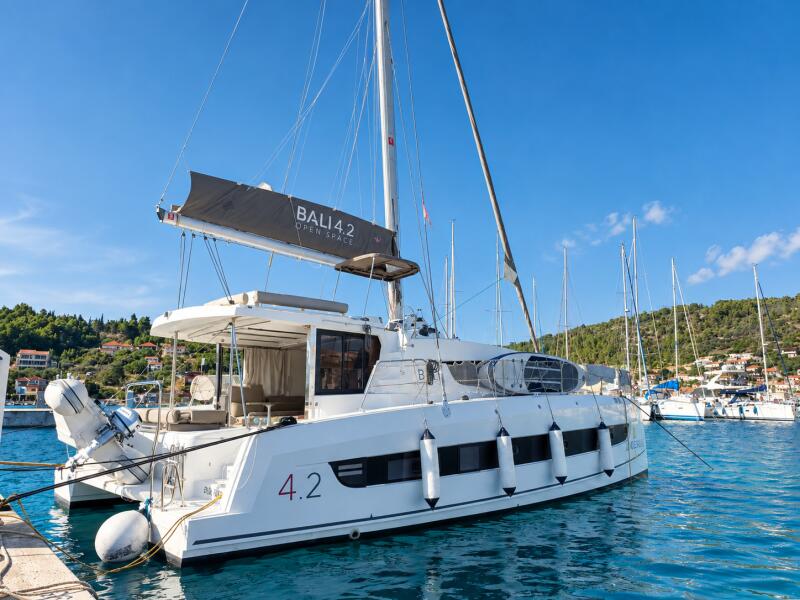
Within the mid-size segment, models such as the Bali 4.2, Bali 4.4, Bali 4.6, and Bali 4.8 represent some of the most successful and widely distributed cruising catamarans in the industry. These yachts are particularly popular in charter fleets because they offer an effective balance between manageable size, high guest capacity, and the signature Bali sense of space.
The Bali 4-series models are built around the idea of maximizing interior volume within relatively compact hull lengths. Their saloons are notably wide and open, often featuring full-height glazing and direct access to both forward and aft exterior areas. Cabins are designed with a strong emphasis on comfort and privacy, typically offering en-suite configurations that support multi-cabin charter layouts without compromising livability. Outdoor spaces remain equally important, with aft cockpit areas that seamlessly extend from the interior and forward lounges that provide additional relaxation zones.
As the range progresses upward, larger models such as the Bali 5.4 push the concept further into the realm of luxury floating residences. These yachts introduce expanded multi-zone living arrangements, including elevated flybridge areas, larger social decks, and more complex interior layouts designed for extended cruising or high-end charter operations. The increased volume allows for more generous social spaces, including larger dining areas, extended lounge seating, and more elaborate galley configurations that support long-term onboard living.
Across all models, however, the underlying design language remains consistent. Whether in the 40-foot or 55-foot range, Bali catamarans prioritize open-plan living, abundant natural light, and a continuous connection between interior and exterior environments. Large sliding or lifting panels, wide door openings, and level floor transitions all contribute to the brand’s signature “indoor-outdoor fusion” concept, which has become a defining characteristic of modern Bali design.
Another consistent feature across the range is the prioritization of livability over technical minimalism. While many traditional yacht builders focus on reducing weight, streamlining structures, and optimizing for performance efficiency, Bali deliberately allocates volume and structural space to enhance comfort. This includes larger refrigeration capacity, more generous storage solutions, and furniture layouts that support social interaction rather than purely functional sailing efficiency.
This consistency across models has helped Bali establish a strong identity in the global multihull market. Regardless of size, each yacht delivers a recognizable onboard experience: bright, open, and highly social, with a strong emphasis on relaxed cruising rather than performance-oriented sailing. This has made the range particularly attractive in charter destinations where guest comfort and onboard lifestyle are the primary drivers of satisfaction.
BALI CATAMARANS IN MEDITERRANEAN CHARTER CULTURE
Bali Catamarans has become a defining presence within Mediterranean charter sailing, particularly in regions where cruising is less about long offshore passages and more about comfort-driven, island-focused exploration. The brand’s design philosophy aligns closely with the realities of Mediterranean boating culture, where time at anchor, short daily sail legs, and social onboard living dominate the experience.
Across key destinations such as Croatia, Greece, Italy, and Spain, Bali catamarans have found a particularly strong operational fit. These regions share a common sailing pattern: relatively protected waters, predictable summer conditions, and dense clusters of islands and coastal anchorages that encourage frequent stops rather than continuous passage-making.
In this context, Croatia stands out as one of the most prominent markets for Bali catamaran usage. The Adriatic coastline offers an especially favorable environment for this type of vessel, with its calm summer seas, short inter-island distances, and abundant sheltered bays. Iconic cruising areas such as Hvar, Vis, Brač, and Korčula are particularly well suited to Bali’s open-plan design approach, where anchoring rather than sailing speed defines the rhythm of the voyage.
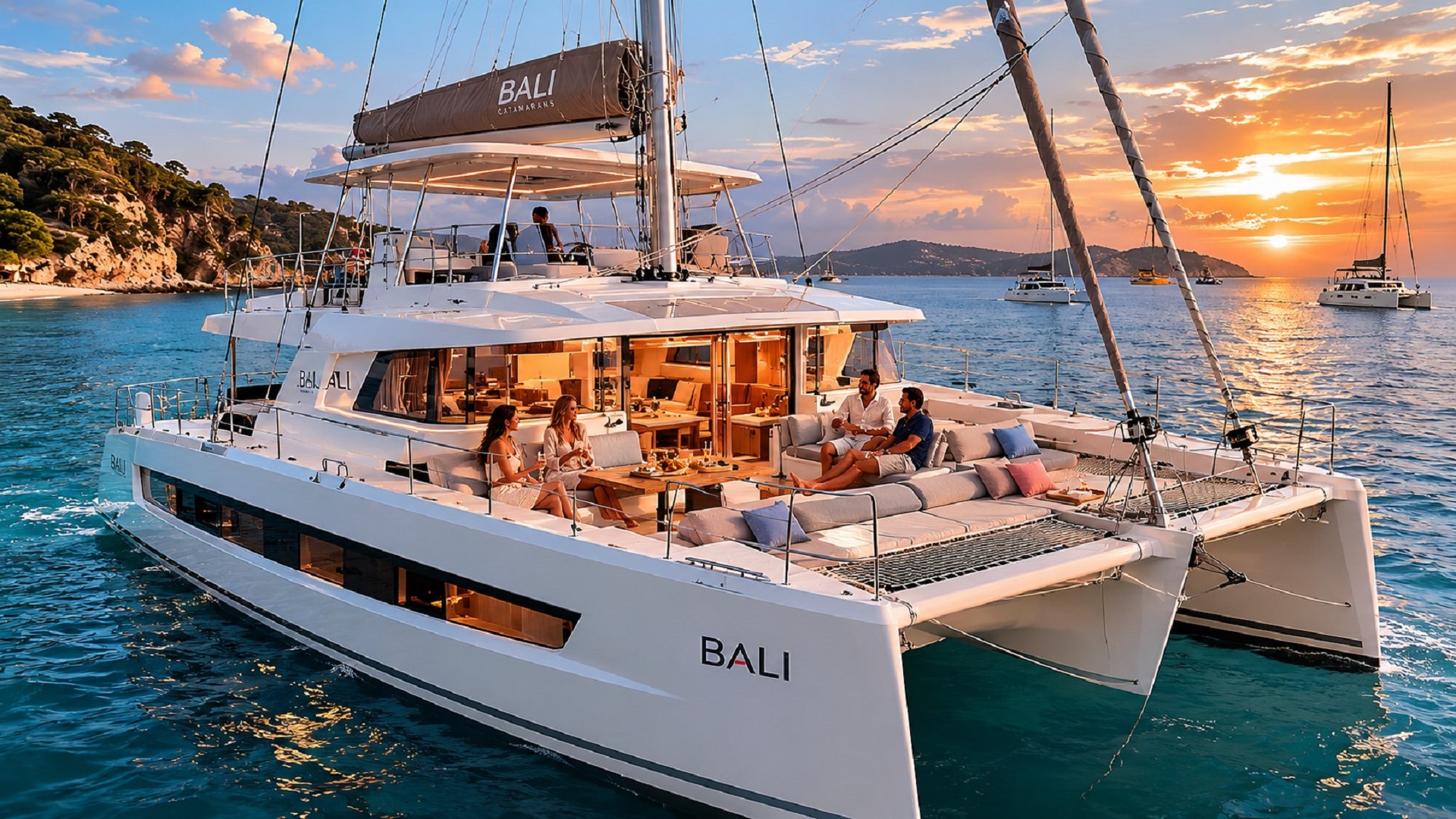
Because most Adriatic itineraries involve hopping between bays, beaches, and small coastal towns, the onboard experience becomes just as important as the destinations themselves. Bali catamarans enhance this dynamic by providing expansive social spaces that remain usable throughout the day, whether the yacht is underway or anchored in a quiet lagoon. The ability to open the saloon fully to the aft cockpit, combined with large foredeck lounging areas, allows guests to spread out comfortably without feeling confined to a single interior space.
For charter guests, this often results in a very different perception of what a sailing holiday looks like. Rather than a traditional yacht with clearly separated functional areas, a Bali catamaran feels closer to a floating holiday residence. The layout encourages continuous interaction between cooking, dining, relaxing, and swimming, with minimal physical or visual barriers between these activities. The galley is typically integrated into the main living space, meaning meal preparation becomes part of the social experience rather than a separate task.
This lifestyle-driven design is particularly impactful in warm-weather Mediterranean conditions, where much of the day is spent outdoors or transitioning between sea and deck. Swimming stops are frequent, and the ease of moving between the water and the yacht becomes a key part of the overall enjoyment. Wide aft platforms and open cockpit configurations make water access simple and natural, reinforcing the idea that the sea itself is an extension of the living space.
Ultimately, Bali Catamarans has become so widely adopted in Mediterranean charter culture because it aligns directly with how people actually use yachts in these regions. It is not simply about sailing from point A to point B, but about creating an environment where life on board feels relaxed, spacious, and socially engaging. In this sense, Bali catamarans have helped redefine the modern Mediterranean charter experience, shifting it toward a more residential, lifestyle-oriented form of cruising at sea.
INTERIOR DESIGN - MODERN LIVING AT SEA
The interior design philosophy of Bali Catamarans reflects a deliberate move toward contemporary residential aesthetics translated into a marine environment. Rather than relying on traditional nautical styling - often characterized by darker woods, compact compartments, and visually segmented spaces - Bali interiors embrace a modern, architectural language built around openness, light, and continuity.
Within the design framework developed by Catana Group for Bali Catamarans, interior spaces are conceived as extensions of contemporary coastal living rather than as purely functional marine accommodations. This approach results in interiors that feel closer to modern apartments, beach villas, or boutique hotel suites than to conventional sailing yachts.
A defining characteristic of Bali interiors is the emphasis on clean, uninterrupted visual flow. Straightforward lines, uncluttered surfaces, and carefully selected neutral color palettes contribute to an atmosphere of calm and spatial clarity. Instead of visually dividing spaces with heavy structural elements or enclosed partitions, the design uses subtle transitions, furniture placement, and light variations to define functional zones while preserving overall openness.
Expansive glazing plays a central role in shaping this experience. Large panoramic windows are positioned to maximize natural light intake while maintaining constant visual contact with the surrounding seascape. This ensures that even when occupants are inside the saloon, the sea remains a dominant visual reference point. The effect is both psychological and spatial: interiors feel significantly larger, and the boundary between inside and outside becomes increasingly fluid.
At the heart of the yacht, the saloon functions as a unified living environment rather than a formally divided room. Navigation stations, dining areas, and relaxation spaces coexist within a single open-plan layout. This integration encourages continuous social interaction and allows the space to adapt dynamically depending on activity - whether the yacht is underway, anchored, or hosting guests. The design avoids rigid separation between functional zones, reinforcing the idea that life onboard should flow naturally from one activity to another.
Lighting design further enhances this atmosphere. Natural light dominates during the day through large windows and open access points, while artificial lighting is typically warm, indirect, and strategically placed to maintain the sense of openness in the evening. The result is an environment that transitions smoothly between day and night use without losing its spatial coherence.
Cabin design follows the same philosophy of openness and comfort, but with a stronger emphasis on privacy and retreat. Instead of compact sleeping quarters typical of older yacht designs, Bali cabins are often configured as spacious en-suite rooms with generous headroom, large berths, and carefully planned storage solutions. The goal is to replicate the comfort level of modern hotel accommodation, ensuring that each guest has a personal space that feels both private and well-proportioned.
Materials and finishes are selected to reinforce a sense of modern simplicity rather than decorative complexity. Soft textures, light-toned surfaces, and minimalist detailing help maintain visual calm while still providing durability suitable for marine conditions. This balance between aesthetics and practicality is essential in ensuring that the interior remains both comfortable and resilient during extended cruising or charter use.
This design approach has proven especially appealing in the charter sector, where guest satisfaction is closely tied to perceived space, privacy, and comfort. By offering interiors that feel more like contemporary living spaces than traditional yachts, Bali catamarans effectively elevate the onboard experience. Guests are not simply accommodated; they are placed in an environment that supports relaxation, social interaction, and extended stays without the sense of confinement often associated with older vessel layouts.
In essence, the interior design philosophy of Bali Catamarans redefines what “living at sea” can feel like. It replaces compartmentalized nautical tradition with a modern residential mindset, creating yachts that function as bright, open, and highly livable environments where the experience of being on the water is constantly present, even when inside.
THE IMPACT OF BALI CATAMARANS ON MODERN SAILING
Bali Catamarans has played a meaningful and highly visible role in reshaping expectations within the modern multihull sector. Rather than following incremental design evolution, the brand introduced a more radical reinterpretation of what a cruising catamaran could prioritize, placing open space, livability, and interior-exterior integration at the center of its design philosophy. In doing so, it challenged long-standing conventions that had defined yacht architecture for decades.
Developed under the French shipbuilding group Catana Group, the Bali Catamarans range emerged at a time when the global sailing market was already shifting toward comfort-oriented cruising. However, Bali accelerated this transition by making spatial openness and onboard lifestyle not just an added benefit, but the core product identity. This repositioning had a ripple effect across the industry, influencing both competing manufacturers and customer expectations.
One of the most significant impacts of Bali’s design approach has been the normalization of large, open-plan living areas on cruising catamarans. Features such as full-width saloons, aft “garage door” openings, and forward cockpit integration were once considered unconventional or experimental. Today, many modern multihull designs incorporate similar principles, even if implemented in different structural forms. This reflects a broader acceptance within the industry that comfort and spatial experience are now central performance metrics in their own right.
Bali has also played an important role in broadening the appeal of multihull sailing beyond traditional owner-operators and experienced sailors. By reducing the perceived complexity of onboard movement and emphasizing intuitive layouts, the brand has made sailing yachts more accessible to families, first-time sailors, and charter guests who may not have prior nautical experience. Wide walkways, stable deck surfaces, and clearly defined social zones reduce the learning curve associated with life at sea, allowing users to focus on leisure rather than technical sailing familiarity.
In the charter industry, this accessibility has had a particularly strong impact. Operators increasingly seek vessels that maximize guest satisfaction, ease of use, and onboard comfort rather than purely performance-driven specifications. Bali catamarans align closely with these priorities, offering layouts that feel familiar and residential while still maintaining the essential characteristics of a capable sailing yacht. As a result, they have become a common sight in major charter destinations, where guest experience is the primary measure of success.
Beyond commercial adoption, Bali’s influence is also evident in how sailors and buyers now evaluate yacht design. Traditional distinctions between “sailing performance” and “onboard comfort” are no longer viewed as strictly separate categories. Instead, there is a growing expectation that modern cruising yachts should deliver a balanced combination of both, with particular emphasis on livability at anchor. Bali helped reinforce this shift by demonstrating that spatial comfort can be elevated to a defining design principle rather than treated as secondary to naval architecture.
In a broader sense, Bali Catamarans represents a generational change in sailing culture. The focus has moved from purely performance-oriented seafaring toward a more lifestyle-driven understanding of cruising, where the yacht functions as both a vessel and a living environment. This shift reflects changes in how people use boats today - spending more time anchored in scenic locations, engaging in social activities onboard, and treating sailing holidays as immersive residential experiences rather than continuous voyages.
Ultimately, the brand’s impact lies not only in the yachts themselves, but in the ideas they helped normalize. By reimagining how space, movement, and daily life can function on a catamaran, Bali has contributed to a broader redefinition of modern sailing - one in which comfort, openness, and human experience stand alongside traditional measures of nautical performance.
THE LASTING APPEAL OF BALI CATAMARANS
The long-term success of Bali Catamarans lies in a remarkably clear and consistently executed vision: sailing should be comfortable, social, and fundamentally open in its spatial experience. Rather than treating comfort as an add-on to traditional yacht architecture, the brand integrates it as the defining principle of design, shaping every element of layout, circulation, and onboard lifestyle around how people actually live at sea.
This philosophy, developed within the French shipbuilding environment of Catana Group through the Bali Catamarans line, has proven particularly durable because it aligns closely with how modern cruising is practiced. Today’s sailors are far more likely to spend extended periods at anchor, moving between islands at a relaxed pace, and prioritizing onboard quality of life over high-speed passage-making. Bali’s design language directly reflects this behavioral shift.
At the heart of this lasting appeal is spatial generosity. Bali catamarans consistently emphasize wide, open living areas, uninterrupted sightlines, and fluid transitions between interior and exterior environments. This creates an onboard atmosphere that feels less like a traditional sailing vessel and more like a contemporary floating residence. The psychological effect is significant: reduced sense of confinement, increased relaxation, and a stronger connection to the surrounding environment.
Equally important is the way these yachts support social interaction. The layout naturally brings people together in shared spaces, particularly in the saloon and cockpit, which function as a unified living zone. Whether cooking, dining, or relaxing, guests remain part of a continuous communal environment. This social cohesion is a key reason why Bali yachts are especially popular in charter settings, where shared experiences define the value of the voyage.
The versatility of the design also contributes to its enduring relevance. Whether anchored in a quiet Adriatic bay, such as those found along Croatia, exploring the island networks of Greece, or crossing open tropical waters in the Caribbean, Bali catamarans adapt naturally to different cruising contexts. Their layout is not dependent on high-speed passage conditions but instead optimized for the environments where most modern cruising actually takes place: sheltered waters, scenic anchorages, and island-hopping routes.
Light, both natural and architectural, is another defining element of the experience. Large windows, open bulkheads, and expansive deck areas ensure that the sea remains visually present throughout the yacht. This constant connection to the surrounding environment reinforces the feeling of freedom that draws many people to sailing in the first place, while still providing the comfort of a well-designed interior space when conditions require shelter.
Perhaps most importantly, Bali Catamarans has succeeded in redefining expectations. For many sailors, the brand is no longer simply a category of yacht but a reference point for a different way of thinking about life at sea. It represents a shift away from purely technical or performance-focused interpretations of sailing and toward a more lifestyle-oriented vision, where comfort, openness, and human experience are central.
In this sense, the lasting appeal of Bali catamarans is not only a result of their physical design, but of the idea they embody. They have helped establish a new benchmark for what modern cruising can feel like - one where the yacht is not just a means of travel, but a fully realized living environment shaped around freedom, social connection, and the simple pleasure of being at sea.
FUTURE OF OPEN-CONCEPT CATAMARAN DESIGN
Looking ahead, the design direction popularized by Bali Catamarans is likely to continue exerting a strong influence on the broader evolution of cruising multihulls. As sailing demographics expand and more owners and charter guests prioritize comfort, ease of use, and onboard lifestyle over traditional performance-focused criteria, the demand for open-concept layouts is expected to grow further across the industry. This shift is not a short-term trend, but part of a longer structural change in how sailing yachts are used - moving from passage-oriented vessels toward floating living environments designed for extended stays at anchor.
The core ideas introduced by Bali Catamarans - including seamless indoor-outdoor transitions, expansive social areas, and residential-style interiors - are already being interpreted, adapted, and refined by other builders in the multihull sector. While each shipyard maintains its own naval architecture philosophy and technical priorities, the general direction of travel is increasingly consistent: larger and more usable living spaces, greater reliance on natural light, and more flexible deck configurations that support diverse onboard activities.
At the same time, the next phase of development is likely to focus less on radical redesign and more on refinement and optimization. Naval architects are actively working to preserve the visual and spatial openness associated with Bali-style layouts while improving structural efficiency, hydrodynamic performance, and weight distribution. This involves advanced composite materials, smarter load-bearing frameworks, and more integrated structural solutions that allow for large openings - such as fold-down panels or wide saloon apertures - without compromising hull rigidity or offshore safety margins.
Hydrodynamic efficiency remains a parallel focus. As open living spaces naturally introduce architectural complexity, designers must carefully balance interior volume with underwater performance. Modern hull shaping, optimized bridge deck clearance, and refined daggerboard or keel configurations are all being explored to ensure that comfort-driven designs still deliver predictable passage-making capability across varied conditions.
Sustainability is also becoming an increasingly defining factor in the next generation of cruising catamarans. Hybrid propulsion systems, solar integration, improved battery storage, and more efficient onboard energy management are steadily transitioning from optional features to expected standards. In this context, the naturally ventilated, light-filled environments championed by Bali align well with energy-conscious cruising philosophies, reducing dependency on air conditioning and mechanical systems while enhancing comfort through passive design.
Digital integration is another area of evolution. Smarter onboard systems for navigation, energy monitoring, and automation are gradually simplifying yacht operation, making larger and more complex vessels easier to handle with smaller crews. This complements the open-concept philosophy by reducing operational complexity and allowing users to focus more on the experience of living onboard rather than managing technical systems.
Ultimately, the future of open-concept catamaran design is unlikely to move away from the principles established by Bali Catamarans. Instead, it will refine and extend them. The emphasis will remain on creating yachts that feel intuitive, spacious, and deeply connected to their surroundings, while progressively integrating new technologies and engineering solutions that enhance efficiency, sustainability, and real-world usability.
WHY BALI’S DESIGN LANGUAGE RESONATES WITH MODERN CRUISERS
One of the key reasons Bali Catamarans continues to resonate so strongly with sailors and charter guests is that its design language closely reflects broader lifestyle changes in how people travel, relax, and experience time on the water. Modern cruising has gradually shifted away from being defined primarily by technical sailing tradition or performance-focused seamanship, and has moved toward a more holistic interpretation of the journey - one where comfort, flexibility, and the quality of onboard living are central to the experience. In this context, Bali Catamarans has consistently aligned itself with evolving expectations rather than resisting them.
Within the philosophy of Bali Catamarans, space is not treated as an optional luxury feature or premium upgrade, but as the core value proposition of the entire design. This is particularly significant in today’s charter market, where guests increasingly evaluate yachts not only by their sailing capability or exterior aesthetics, but by how the vessel supports daily life over the course of a week or more at sea. The ability to share long, unhurried breakfasts in a fully open saloon, transition effortlessly between interior and exterior lounging zones, or enjoy uninterrupted panoramic sea views from nearly every seating position creates a strong emotional connection between guests and the vessel itself.
Another important factor driving this resonance is the simplicity and intuitiveness of the onboard experience. Bali layouts are designed to feel immediately understandable, even for guests with little or no sailing background. Wide passageways, open sightlines, and clearly defined functional zones reduce the cognitive and physical friction often associated with traditional yacht interiors. Movement onboard feels natural and instinctive rather than technical or constrained, which is particularly valuable in charter scenarios where guests are focused on relaxation rather than navigation or vessel management.
This accessibility effectively shifts the relationship between user and yacht. Instead of passengers adapting to a complex marine environment, the yacht is structured to adapt to human behavior. Social areas are central and continuous, circulation paths are straightforward, and the boundary between “inside” and “outside” is intentionally softened. The result is a spatial experience that feels closer to a contemporary vacation home than a traditional sailing vessel, without losing the essential connection to the sea.
This human-centered approach has helped redefine expectations across the wider multihull industry. Many modern cruisers now actively seek yachts that emphasize openness, natural light, and shared living spaces - design traits that Bali helped normalize and bring into mainstream acceptance. As a result, even competing manufacturers increasingly incorporate elements of open-plan living, expanded cockpit integration, and large-volume saloons into their own designs, reflecting a broader shift in what buyers perceive as essential rather than optional.
The influence extends beyond physical design into perception itself. The “ideal cruising catamaran” in the contemporary imagination is no longer simply fast, efficient, or technically advanced; it is spacious, sociable, and lifestyle-oriented. Bali has played a key role in shaping this mental model by consistently delivering yachts that embody these qualities in a tangible and immediately recognizable way.
Ultimately, the enduring appeal of Bali Catamarans lies in its ability to translate a simple but powerful idea - living well at sea - into a coherent and repeatable design language. By consistently prioritizing how people occupy, move through, and emotionally experience space onboard, the brand has created yachts that align closely with how modern cruisers actually want to travel: comfortably, socially, and with a constant sense of openness to the surrounding environment.
CHARTER MARKET SUCCESS AND GLOBAL ADOPTION
A major driver behind the global success of Bali Catamarans has been its unusually strong alignment with the operational realities of the professional charter market. Unlike private ownership, where individual preferences can dominate design decisions, charter operations require a precise balance of durability, ease of handling, guest comfort, and repeatable performance across multiple seasons. In this environment, design philosophy alone is not enough - what matters is whether that philosophy translates into consistent real-world usability under intensive commercial conditions.
Within this segment, Bali Catamarans has established itself as one of the most widely adopted modern catamaran brands, particularly across high-demand charter regions such as the Mediterranean and the Caribbean. These markets are characterized by strong seasonal turnover, diverse user profiles, and a high expectation of onboard comfort. Bali’s emphasis on space, openness, and intuitive circulation makes its yachts especially well suited to multi-cabin configurations, where several guest groups share the vessel while still expecting both privacy and generous communal areas.
One of the key reasons for this success is design efficiency in daily operations. Large, centrally integrated saloons connected seamlessly to aft cockpits allow crew members to move between service areas without obstruction, streamlining meal preparation, cleaning, and guest interaction. The galley’s integration into the main living space, rather than being isolated, improves service flow and enhances the social atmosphere onboard, allowing crew to remain engaged with guests while maintaining operational efficiency. This becomes particularly important during peak charter weeks, when yachts operate at full occupancy and service demands are continuous.
Equally important is the intuitive nature of the onboard layout from a guest perspective. Many charter clients are experiencing sailing yachts for the first time, often in a leisure-focused context rather than a technical sailing environment. Bali catamarans reduce the learning curve associated with traditional yacht movement by eliminating narrow transitions and clearly separating functional zones without creating physical barriers. Guests can quickly understand how to navigate the vessel, where to gather socially, and how to access outdoor areas, which significantly improves overall satisfaction and comfort.
Durability and operational resilience further reinforce their adoption in charter fleets. These yachts are designed to withstand repeated seasonal use, including frequent guest turnover, varied handling experience, and intensive cruising schedules. Materials, fittings, and structural components are selected not only for aesthetics and comfort, but also for long-term reliability under commercial operating conditions. This focus on robustness ensures that yachts remain visually and functionally consistent across multiple charter seasons, protecting both operator investment and guest experience.
From a commercial standpoint, this combination of factors creates a strong return-on-investment profile for fleet operators. High guest satisfaction leads to repeat bookings and strong market reputation, while predictable maintenance cycles and operational simplicity reduce downtime and logistical complexity. In competitive charter hubs such as the Balearic Islands, Croatia, and the broader Caribbean region, these advantages directly translate into higher utilization rates and stronger fleet performance.
As a result, Bali Catamarans has moved beyond being simply a recognizable design trend and has become a structural presence within modern charter fleets worldwide. Its widespread adoption demonstrates how a clearly defined design philosophy - when closely aligned with the practical demands of real-world operations - can influence not only yacht aesthetics, but also the economics, efficiency, and service expectations of the global sailing charter industry.
CONCLUSION - A REDEFINED STANDARD FOR MODERN MULTIHULLS
The evolution of Bali Catamarans ultimately reflects a broader and ongoing transformation in how modern sailing yachts are conceived, built, and experienced. What began as a deliberate challenge to conventional multihull design norms has matured into a coherent and widely recognized design philosophy - one that continues to influence expectations across both private ownership and the global charter industry.
Rooted in the vision developed by Catana Group through the Bali Catamarans line, this approach consistently prioritizes open space, natural light, and seamless interior-exterior integration. Rather than treating these elements as enhancements to traditional yacht design, Bali positions them as the structural foundation of the onboard experience itself. The result is a fleet of catamarans that feels fundamentally different in use - less segmented, more fluid, and more closely aligned with how people actually live at sea.
By redefining spatial priorities, Bali has helped establish a new benchmark for cruising comfort. In this framework, comfort is not limited to cabin size or seating ergonomics, but extends to the overall perception of space, freedom of movement, and connection to the surrounding environment. Large open saloons, continuous deck flow, and panoramic visibility transform the yacht into an environment that supports daily life as much as it supports navigation. This has contributed to a broader reclassification of what modern cruising yachts can be: not just transport platforms on water, but fully functional residential spaces adapted to marine conditions.
This shift has had lasting implications across multiple layers of the industry. For yacht owners, it has changed expectations around onboard lifestyle, making spaciousness and social livability central decision factors. For charter operators, it has introduced a model of guest experience where the yacht itself becomes a primary attraction rather than merely a mode of access to destinations. And for naval architecture more broadly, it has expanded the definition of performance beyond speed and handling to include livability, spatial efficiency, and experiential quality as equally important design outcomes.
In practical terms, this has encouraged a more holistic approach to yacht design, where engineering, architecture, and user experience are increasingly integrated rather than treated as separate disciplines. The success of Bali’s design language demonstrates that spatial innovation can be just as influential as hydrodynamic refinement in shaping the future of sailing yachts.
Ultimately, the enduring significance of Bali Catamarans lies in its clarity and consistency of vision. By resisting the need to compromise between comfort and functionality, and instead redefining how those concepts interact, the brand has placed human experience at the center of multihull design. As a result, Bali catamarans continue to represent a distinct and easily recognizable approach to modern sailing - one where the ocean is not merely traversed, but actively lived within, in a setting defined by openness, comfort, and spatial freedom.