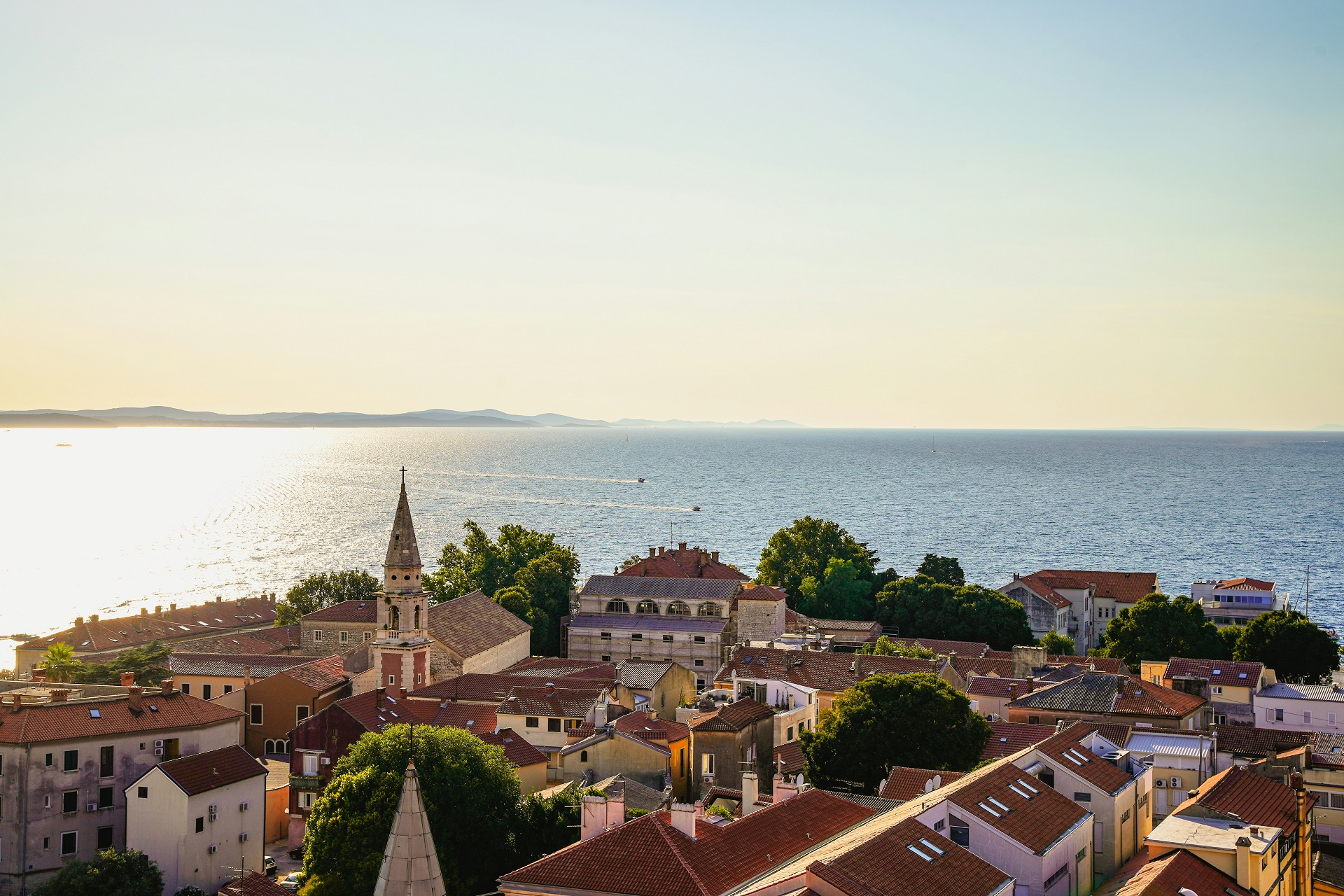
ZADAR SAILING GUIDE: WHERE HISTORY MEETS THE ADRIATIC GATEWAY
On Croatia’s northern Dalmatian coast, Zadar stands as one of the most important and strategically positioned sailing hubs in the Adriatic. Its significance is not only geographic, but also cultural and functional: it is a place where centuries of maritime tradition meet one of the most accessible gateways to open-sea cruising in the Mediterranean.
Unlike island destinations that require longer passages to reach, Zadar functions as an immediate launch point into the island world. Within minutes of leaving the marina, sailors enter the protected waters of the Zadar Archipelago, a dense and highly navigable network of islands that stretches across the northern Dalmatian sea. From there, routes naturally extend toward more remote cruising grounds, including the globally renowned Kornati National Park, where navigation becomes more open, fragmented, and visually dramatic.
What makes Zadar particularly important within the Adriatic sailing landscape is its dual identity. On one side, it is a fully functioning coastal city with deep historical roots, urban infrastructure, and a vibrant waterfront. On the other, it is a direct interface with the sea - an operational base where yachts, ferries, fishing boats, and charter fleets coexist within a compact maritime environment.
This duality gives Zadar a unique role. It is not just a place you pass through on the way to the islands; it is where the sailing experience begins to take shape. The transition from land to sea happens almost instantly, yet it feels gradual in experience. One moment you are within a historic urban setting, and shortly after, you are navigating between islands with open horizons and changing wind patterns.
The city itself reinforces this connection at every level. The old town is built on a peninsula surrounded by water on three sides, naturally integrating maritime space into daily life. Stone quays, ferries, and marina basins sit directly alongside Roman streets, medieval churches, and modern promenades. This proximity between historic architecture and active seafront creates a continuous visual and functional link to the sea.
For sailors, this means that departure from Zadar is never abrupt. The waterfront acts as a gradual transition zone, where preparation, provisioning, and final route planning happen just steps away from the vessel. Once underway, the city slowly recedes, replaced by the layered horizon of islands that define the northern Dalmatian sailing region.
In practical terms, Zadar offers one of the most efficient sailing gateways in the Adriatic. The short distance to the Zadar Archipelago allows for immediate island access, while the broader regional layout supports flexible itinerary design - whether focused on short coastal hops, relaxed island cruising, or extended routes toward Kornati and beyond.
Yet beyond logistics and geography, Zadar’s deeper value lies in its atmosphere. It is a place where maritime culture is not staged for visitors, but embedded in everyday life. Boats come and go constantly, wind shapes movement along the waterfront, and the sea remains visible from almost every point in the old town.
For this reason, Zadar is best understood not only as a starting point, but as a threshold. It marks the moment where urban rhythm gives way to maritime space, where planning turns into navigation, and where the Adriatic sailing experience truly begins.
A HISTORIC COASTAL CITY BUILT ON THE SEA
The first impression of Zadar is defined by its unusual geography. The historic old town sits on a narrow peninsula, surrounded by the Adriatic Sea on three sides. This natural configuration creates a sheltered maritime setting that has functioned as a harbour zone since antiquity, shaping the city’s identity long before modern sailing infrastructure existed.
From Roman times onward, this position made Zadar a strategic coastal settlement. The combination of deep water access, natural protection, and proximity to island routes allowed it to develop into one of the Adriatic’s key maritime centres. Over centuries, it evolved through Venetian influence, Austro-Hungarian administration, and modern Croatian development, yet its relationship with the sea has remained constant throughout each historical layer.
Today, this continuity is still visible in the structure of the waterfront. Walking along the seafront promenade, the connection between city and sea is immediate and uninterrupted. Stone quays extend directly into the water, ferry terminals operate alongside historic streets, and modern marina basins sit within view of centuries-old architecture. Churches, squares, and Roman archaeological remains are never far from the shoreline, creating a rare urban environment where history and maritime function coexist in the same physical space.
Unlike destinations designed primarily around tourism, Zadar remains an active working port. Fishing vessels depart in the early hours, ferries maintain regular connections to nearby islands, and yachts move continuously through the marina areas during the sailing season. This creates a layered maritime ecosystem where different types of sea traffic share the same waters in a naturally integrated way.
For sailors, this blend of activity and history is particularly significant. The port infrastructure is fully functional and well-equipped, yet it is embedded within a living urban environment rather than isolated from it. Provisions, fuel, maintenance, and charter operations are all accessible within walking distance of the old town, allowing logistical preparation to take place without losing connection to the city’s atmosphere.
At the same time, the visual and sensory experience of the waterfront reinforces Zadar’s maritime identity. The sound of water against stone, the movement of boats entering and leaving the harbour, and the constant presence of the sea on multiple sides of the peninsula all contribute to a strong sense of place. Even outside the marina zones, the sea remains visible and present from nearly every point in the historic core.
This combination of practical functionality and deep historical layering is what sets Zadar apart from many other coastal departure points. It is not simply a logistical base for sailing itineraries, but a city where maritime life is woven into daily urban existence. The transition from street to sea is not a separation, but a continuation.
For this reason, Zadar is often regarded as one of the most effective and atmospheric starting points for sailing in Croatia. It offers everything required for a smooth departure - services, access, and infrastructure - while simultaneously providing a strong cultural and historical backdrop that enhances the beginning of any Adriatic journey.
SAILING OUT OF ZADAR: FIRST STEPS INTO THE ARCHIPELAGO
Departing from Zadar is widely regarded as one of the most accessible and intuitive sailing starts in the Adriatic. Unlike coastal bases that require immediate offshore crossings or long transits to reach sheltered waters, Zadar places sailors directly at the threshold of an island system. Within a very short time after leaving the marina, the urban shoreline softens, the horizon opens, and the structured environment of the city gives way to a broad, navigable channel leading into the islands of the Zadar Archipelago.
This immediate transition is one of the defining advantages of the region. There is no gradual build-up of distance or complexity. Instead, the sailing environment changes almost instantly - from harbour basins and ferry lanes to open but protected waters framed by islands. The result is a departure experience that feels fluid and uncomplicated, even for crews setting off for the first time.
To the west and northwest, the first major landmasses that come into view are Ugljan Island and Pašman Island. These islands form a natural barrier between the mainland coast and the open Adriatic, shaping one of the most sheltered sailing corridors in northern Dalmatia. Their presence significantly reduces swell and moderates wind exposure, creating comfortable conditions almost immediately after leaving Zadar.
For many itineraries, these islands become the first overnight stop. The distances are short, typically allowing for relaxed afternoon departures and early anchoring in calm bays. Small harbours and natural coves along both Ugljan and Pašman provide multiple options for stopping, whether for a quiet night at anchor or a brief visit to a waterfront village. This proximity means that the first sailing day often feels more like a gentle introduction than a demanding passage.
The structure of the archipelago also supports flexible route planning. Because islands are closely spaced and well distributed across the channel, sailors can adjust direction easily based on wind conditions, crew preference, or timing. There is rarely a need for long detours or rigid schedules, as alternative anchorages are usually within a short sailing distance.
What makes sailing out of Zadar particularly appealing is this sense of gradual immersion. The archipelago does not present itself all at once. Instead, it unfolds in layers - first the larger, protective islands close to the mainland, followed by smaller, quieter destinations further out, and eventually leading toward more open and fragmented cruising grounds such as Kornati National Park.
This progression allows crews to naturally adapt to conditions. The initial sailing segment is typically calm and predictable, giving time to settle into onboard routines, adjust to wind patterns, and become familiar with the vessel. As the journey continues, the environment becomes progressively more varied, but without abrupt changes in complexity or exposure.
In essence, the departure from Zadar is defined by ease and continuity. The archipelago is immediately accessible, navigation is straightforward, and the surrounding islands provide a built-in framework for safe and flexible cruising. Rather than forcing an immediate transition into open sea conditions, the region allows sailors to ease into the Adriatic gradually, one island at a time.
WIND PATTERNS AND SAILING CONDITIONS NEAR THE CITY
The sailing environment around Zadar is defined by a level of seasonal predictability that makes it one of the most reliable charter bases in the Adriatic. While conditions in the wider Mediterranean can vary significantly, the northern Dalmatian coast benefits from a relatively stable summer wind structure and the natural protection of the Zadar Archipelago. This combination creates sailing conditions that are generally approachable, especially for crews looking for a balanced mix of comfort and exploration.
The most consistent feature of the summer season is the Maestral wind. This northwesterly thermal breeze typically develops during late morning or early afternoon as land temperatures rise. It builds gradually rather than arriving suddenly, which allows sailors to plan departures with a good degree of confidence. Once established, it provides steady and moderate sailing conditions that are ideal for the short inter-island passages typical of this region.
Within the archipelago, the Maestral is particularly well-suited to the geography. The relatively close spacing of islands such as Ugljan Island and Pašman Island means that wind angles remain manageable and sea states rarely become uncomfortable. Instead of long, exposed legs, sailing here is often a sequence of short, rhythmic crossings where conditions remain consistent from one island to the next.
Mornings in the Zadar sailing area tend to be calm and stable. Light winds or near-glassy seas are common before thermal effects begin to build. This creates an ideal window for leaving marinas, repositioning within anchorages, or planning short navigation legs. The stillness of the early day also enhances visibility in sheltered bays, making anchoring and manoeuvring straightforward and low-stress.
As the day progresses and the Maestral strengthens, the sailing experience becomes more dynamic but remains controlled. The wind typically reaches a comfortable moderate strength rather than extreme intensity, allowing for efficient cruising without excessive strain on crew or vessel. In this sense, the rhythm of the day naturally aligns with sailing activity: quiet mornings, active afternoons, and calm evenings at anchor.
The most notable exception to this pattern is the Bura wind, which can occasionally influence conditions in the region. Originating from the northeast, the Bura is a dry, gusty wind that can arrive quickly and with significant strength. When active, it tends to funnel through gaps in the coastal terrain, creating sharper wind shifts and increased gust variability, particularly in more exposed areas of the archipelago.
However, one of the key advantages of sailing from Zadar is the availability of shelter. The structure of the Zadar Archipelago provides multiple protected bays and lee sides of islands, allowing sailors to adjust positioning when stronger conditions develop. This flexibility significantly reduces weather-related constraints and supports safe cruising even during less stable periods.
Because of this natural protection and predictable seasonal wind pattern, the region is widely considered one of the most beginner-friendly sailing areas in Croatia. Unlike more exposed offshore routes further south, where longer passages and open-sea conditions dominate, the Zadar area allows for gradual progression in sailing experience. Crews can build confidence through short passages, sheltered navigation, and frequent access to safe anchorages.
Ultimately, the wind conditions around Zadar strike a rare balance. They are consistent enough to plan reliable itineraries, varied enough to remain engaging, and moderated by geography in a way that keeps sailing accessible throughout the main season.
MARINA INFRASTRUCTURE AND SAILING SERVICES
One of the defining strengths of Zadar as a sailing base is the depth and reliability of its nautical infrastructure. Unlike more remote departure points where services may be limited or dispersed across smaller island harbours, Zadar offers a concentrated and highly developed maritime support system that is fully integrated into the city’s coastal layout.
Several modern marinas operate within and just outside the city, forming the operational backbone of the region’s charter industry. Among them, facilities such as D-Marin Borik and Uvala Draženica Marina provide comprehensive services tailored specifically to sailing yachts and charter fleets. These include secure berthing, technical support, fuel stations, water and electricity connections, and assistance with pre-departure preparation.
For sailors, this level of infrastructure significantly simplifies the beginning of any itinerary. Provisioning is straightforward, with supermarkets, specialty shops, and marine suppliers all located within easy reach of the marina zones. This allows crews to fully prepare vessels before departure without the need for additional stops once underway. Everything from fresh food and drinks to technical equipment and spare parts can be sourced efficiently in one place.
Maintenance and technical services are another important aspect of Zadar’s nautical offering. The presence of experienced marine technicians, repair facilities, and service yards ensures that both charter yachts and privately owned vessels can be quickly prepared or serviced as needed. This reliability is a key reason why the city remains a preferred base for longer seasonal operations as well as short-term charters.
Fuel and logistical support are similarly well organised. Dedicated fueling stations within marina complexes allow for quick turnaround times before departure, reducing delays and enabling smooth transitions from shore to sea. This operational efficiency is particularly valuable at the start of weekly charter itineraries, where timing and coordination play an important role.
What sets Zadar apart, however, is not only the presence of these services, but their proximity to the historic city centre. Unlike many dedicated marina towns that operate separately from urban life, Zadar integrates both seamlessly. Within a short walk from the docks, sailors can find themselves in the heart of the old town, surrounded by Roman ruins, Venetian architecture, and lively waterfront promenades.
This proximity creates a unique pre-sailing experience. It is entirely possible to spend the morning exploring historic streets, have lunch by the sea, and return to the marina within minutes to set sail in the afternoon. The transition from cultural exploration to active cruising is immediate and effortless, without requiring transport or long transfers.
Evenings before departure often reflect this blend of convenience and atmosphere. Waterfront restaurants, cafés, and promenades remain active into the night, while yachts prepare quietly in nearby berths. The result is a setting where anticipation builds naturally, framed by both urban energy and maritime calm.
It is this combination - comprehensive nautical infrastructure paired with direct access to a historic coastal city - that solidifies Zadar’s role as one of the most important charter hubs in the Adriatic. It is not simply a place to start a journey, but a place where preparation, culture, and sailing life exist side by side in a single, cohesive environment.
GATEWAY TO THE ZADAR ARCHIPELAGO
Once the urban shoreline of Zadar fades into the distance, the sailing experience quickly shifts into its defining phase. This is where the Adriatic opens into the structured island world of the Zadar Archipelago - a dense and highly navigable system of islands, channels, and sheltered passages that form one of the most versatile cruising regions in Croatia.
The transition is immediate but gradual in feeling. There is no long offshore crossing required to reach open sailing grounds. Instead, islands appear in layers, shaping a natural progression from mainland proximity to more remote and varied seascapes. This structure is what makes the region so appealing for both first-time charter crews and experienced sailors looking for flexible, low-stress itineraries.
Closest to Zadar, larger islands such as Ugljan Island and Pašman Island form the first navigational and geographical barrier between the mainland and the open Adriatic. These islands are heavily influential in shaping local sailing conditions, as they reduce swell, moderate wind impact, and create a network of protected channels between them and the coast. Their proximity allows for very short sailing legs, often under a few hours, making them ideal for the first stages of any itinerary.
Within these waters, sailing is typically calm and predictable. Anchorages are frequent, distances are manageable, and the coastline offers a continuous sequence of bays, small harbours, and sheltered passages. This makes the area particularly well suited to relaxed cruising, where movement is optional rather than necessary, and where daily planning can easily adapt to conditions.
As routes extend further outward, the character of the archipelago begins to shift. Islands such as Iž Island introduce a quieter, more traditional atmosphere, with smaller settlements and less frequent maritime traffic. The sailing experience here becomes more reflective, with longer periods at anchor and a stronger sense of separation from the mainland.
Continuing further west and southwest, the landscape opens toward larger and more varied islands such as Dugi Otok. This area introduces a greater contrast in terrain and exposure, with dramatic coastal cliffs, wide open sea views, and more pronounced wind influence. At the same time, sheltered bays and inland passages still provide balance, allowing sailors to choose between calm anchorages and more dynamic sailing conditions.
What defines the Zadar Archipelago as a cruising environment is precisely this flexibility. Unlike linear coastal routes or isolated island chains, it functions as an interconnected network. Sailors are not locked into fixed passages or long offshore transits. Instead, they can adjust direction, timing, and destination continuously based on wind, weather, or preference.
This makes route planning exceptionally adaptable. A sailing itinerary can remain close to the mainland for short, relaxed daily hops, or extend outward into more remote island groups for a greater sense of exploration. The structure of the archipelago supports both approaches equally well, without requiring major changes in navigation style or vessel capability.
In practical terms, this means that once a yacht leaves Zadar, the entire sailing experience becomes modular. Each island can function as a stop, a turning point, or a transition into a different sailing environment. There is no single fixed path, only a network of possibilities shaped by geography and conditions.
This is what makes the gateway into the Zadar Archipelago so significant. It is not just an entry point into island cruising, but the beginning of a highly flexible sailing system - one that allows the Adriatic to be experienced in multiple ways, all within a relatively compact and accessible region.
DAY SAILING, ISLAND HOPPING, AND FLEXIBLE ITINERARIES
One of the most compelling aspects of sailing from Zadar is the exceptional flexibility it offers once underway. The structure of the surrounding Zadar Archipelago is dense, well-protected, and naturally segmented into short sailing corridors, which allows itineraries to be shaped dynamically rather than rigidly planned in advance.
Because distances between islands are relatively small, it is entirely possible to visit multiple locations within a single sailing day without rushing or undertaking long offshore legs. A morning departure from one bay can easily lead to a midday swim stop in another island cove, followed by a relaxed afternoon passage and an evening anchorage elsewhere. This rhythm creates a sailing experience that feels fluid and adaptable, where movement is frequent but never demanding.
At the same time, the region supports a completely different approach: extended stays in a single anchorage. Sheltered bays across islands such as Ugljan Island and Pašman Island allow crews to remain anchored comfortably for longer periods, particularly in stable summer conditions. This flexibility means itineraries can shift between active exploration and quiet immersion without logistical complications.
Further into the archipelago, islands such as Iž Island introduce a slower dimension to the journey. Here, sailing routes naturally become less about coverage and more about rhythm. Stops tend to lengthen, anchorages become more central to the experience, and daily movement often depends more on weather and mood than on pre-set plans.
For those seeking a more expansive sailing environment, routes can extend toward Kornati National Park. This transition introduces a different type of navigation - more open, visually dramatic, and defined by a larger number of islands and channels spread across a wider seascape. Even so, the distance from Zadar remains manageable, allowing the journey to shift gradually rather than abruptly.
What makes this entire system particularly effective is its lack of structural pressure. There is no requirement to follow a fixed route or reach specific destinations within set timeframes. Instead, itineraries are built around choice - how far to sail each day, how long to remain at anchor, and which direction to take based on wind and preference.
This adaptability is especially valuable in the Adriatic, where conditions can vary subtly throughout the day. Morning calm, afternoon Maestral, and occasional wind shifts can all influence movement, yet the proximity of islands ensures that alternatives are always within reach.
In essence, sailing from Zadar allows for a highly responsive style of cruising. It supports both structured plans and spontaneous decisions, short hops and longer explorations, active sailing days and extended periods of stillness. The result is an itinerary style defined less by constraint and more by freedom within a well-connected maritime landscape.
SWIMMING, ANCHORAGES, AND COASTAL STOPS
The sea surrounding Zadar and the wider Zadar Archipelago offers a layered sailing environment where swimming, anchoring, and short coastal stops naturally blend into the rhythm of the journey. Rather than being separate activities, they form a continuous cycle that defines daily life at sea in this part of the Adriatic.
Closer to the mainland, the coastline is more developed and functionally oriented. Bays near the city and adjacent settlements tend to be easier to access, often with basic infrastructure, sheltered waters, and proximity to services. These areas are particularly useful at the beginning or end of a sailing itinerary, where convenience and protection take priority over isolation. While water clarity here is generally good, it is influenced by higher levels of maritime activity and proximity to urban shoreline.
As sailors move outward from Zadar into the surrounding islands, the character of the sea begins to change noticeably. The influence of land-based activity decreases, and the water gradually becomes clearer, more transparent, and more vibrant in color. This improvement is especially evident around islands such as Ugljan Island and Pašman Island, where sheltered bays combine calm conditions with increasingly natural surroundings.
Further into the archipelago, swimming and anchoring take on a quieter, more immersive quality. Smaller islands and less populated areas offer bays where boats sit in still water, often surrounded by rocky shorelines, pine vegetation, and undisturbed coastal scenery. Here, water clarity is typically at its best, with visibility that can extend deep beneath the surface in stable summer conditions.
In these environments, anchoring becomes part of the experience rather than a purely functional act. Boats are positioned in natural coves or sheltered inlets, often with minimal surrounding activity. The absence of heavy traffic or structured beach development allows for long periods of stillness, where the sea feels uninterrupted and closely integrated into the landscape.
Swimming stops in the Zadar Archipelago are rarely formal or pre-planned. Instead, they emerge organically throughout the day as part of short sailing legs between islands. A typical passage might include a morning departure, a mid-journey anchoring for swimming in a quiet bay, and a continuation toward another island in the afternoon. This fluid structure makes the sea an active, constant presence rather than a destination in itself.
Because distances between islands are relatively short, these stops are frequent and easily incorporated into daily navigation. There is no need for extended offshore passages or rigid scheduling, which allows swimming to become a natural pause in movement rather than a separate activity requiring planning.
The result is a sailing rhythm where the boundary between travel and leisure dissolves. In and around Zadar, the sea is not just a route between destinations - it is part of every stage of the journey. Whether anchored in a sheltered mainland bay or floating in a quiet island cove, swimming becomes a continuous thread connecting each part of the itinerary.
EVENING LIFE IN THE OLD TOWN
One of the understated advantages of beginning a sailing journey from Zadar is the opportunity to experience its historic core before or after time at sea. Unlike many purely functional charter bases, Zadar allows the sailing experience to extend directly into urban life, where evenings naturally unfold within walking distance of the marina and waterfront areas.
As daylight softens, the atmosphere along the seafront becomes especially distinctive. The waterfront promenade - stretching along the edge of the peninsula - transitions into a relaxed evening space where locals, sailors, and visitors move at an unhurried pace. The sound of the sea remains constant in the background, while the light changes across stone facades, marina masts, and open terraces overlooking the Adriatic.
Within the old town, narrow streets open into small squares filled with cafés, wine bars, and restaurants. These spaces are closely integrated into the city’s historical fabric, where Roman foundations, Venetian architecture, and modern coastal life exist side by side. Even a short walk inland from the harbour quickly reveals layers of history embedded in the urban landscape, reinforcing the sense that the city has always been shaped by its relationship with the sea.
The maritime identity of Zadar remains visible throughout the evening. Sailing yachts continue to arrive and depart from nearby marinas, ferry lights move steadily across the horizon, and the waterfront remains active without becoming overwhelming. This constant but gentle maritime movement creates a backdrop that connects the city’s social life directly to its nautical function.
Dining in the old town is naturally tied to this setting. Restaurants line both the waterfront and interior streets, offering a range of local Dalmatian cuisine alongside international options. Many terraces are positioned so close to the sea that diners can watch boats moving in and out of the harbour while the sun sets over the archipelago. The experience feels integrated rather than staged, with the sea remaining visually and acoustically present throughout the evening.
What distinguishes Zadar further is the ease of movement between marina and city. There is no separation between sailing infrastructure and urban life. A yacht can be secured in a modern marina, provisions prepared nearby, and within minutes the crew can be walking through centuries-old streets or dining beside the water. This proximity creates a seamless transition between two environments that are often separated in other coastal destinations.
For sailors, this means that the journey does not begin abruptly at sea, but gradually, through immersion in the city’s rhythm. The anticipation of departure builds naturally within a setting that is already connected to maritime life, making the evening before sailing feel like an integral part of the voyage rather than a separate stage.
In this way, the old town of Zadar becomes more than a backdrop to sailing logistics. It functions as an extension of the nautical experience itself - a place where history, daily life, and maritime movement converge, shaping the transition from land to sea in a way that is both practical and atmospheric.
FINAL THOUGHTS: WHY ZADAR IS ONE OF CROATIA’S BEST SAILING BASES
Zadar continues to hold a central position in Croatian sailing because it brings together three elements that are not often found in the same place: reliable infrastructure, immediate access to open sailing waters, and direct entry into one of the most varied island systems in the Adriatic. This combination makes it not only convenient, but also strategically ideal for designing flexible sailing itineraries of different lengths and styles.
From the moment a yacht leaves the marina, the transition into the sea is immediate, yet never abrupt. Within minutes, the coastline opens into the structured network of the Zadar Archipelago, where sheltered channels, closely spaced islands, and predictable wind conditions create an accessible sailing environment. This allows for easy island-hopping routes that can be adapted daily depending on weather, crew preference, or simply the desire to linger in a particular anchorage.
For more relaxed itineraries, this region offers an almost ideal cruising rhythm. Short sailing legs between islands such as Ugljan Island and Pašman Island allow for multiple stops in a single day without fatigue or long offshore exposure. Calm anchorages, frequent swimming opportunities, and the ability to adjust plans on the fly make the area particularly well suited to easygoing summer sailing.
At the same time, the sailing range from Zadar extends far beyond its immediate surroundings. Routes naturally progress toward more open and visually dramatic waters, eventually reaching the expansive island landscape of Kornati National Park. Here, navigation becomes more spacious and fragmented, with countless islands forming one of the most distinctive cruising environments in the Mediterranean. The ability to move from sheltered archipelago sailing to open island exploration within a single itinerary is one of Zadar’s key advantages.
This versatility is what makes the city especially valuable as a base. It does not lock sailors into a single style of cruising. Instead, it supports multiple approaches - short coastal hops, multi-day island circuits, or extended exploration routes that combine different sailing environments within the same journey.
Equally important is the ease of logistics that Zadar provides. With modern marina facilities, provisioning options, and technical support located close to the historic centre, preparation and departure are efficient and straightforward. At the same time, the presence of a living, historically rich old town ensures that the sailing experience is never purely functional. Culture, atmosphere, and maritime identity are all present before the voyage even begins.
Ultimately, Zadar’s strength lies in its role as a threshold. It is the point where land-based life transitions seamlessly into the rhythm of the Adriatic. One moment, you are walking through centuries-old streets beside Roman ruins and Venetian architecture; the next, you are navigating between islands with open horizons ahead.
For sailors, this is what defines its importance. Zadar is not simply a departure point on a chart. It is the beginning of a journey shaped by simplicity, flexibility, and possibility - where every route into the Adriatic starts with both ease and expectation.