DISCOVER DUGI OTOK BY SAIL: A HIDDEN GEM OF THE ADRIATIC
Stretching like a long, narrow brushstroke across the Croatian coastline, Dugi Otok - literally “Long Island” - remains one of Dalmatia’s most quietly spectacular sailing destinations. Positioned just west of Zadar, this elongated island forms a natural barrier between the sheltered inland channels and the open Adriatic, creating a sailing environment that is both diverse and deeply rewarding.
What sets Dugi Otok apart is not just its striking geography, but the feeling of space and authenticity that still defines it. While many of Croatia’s islands have embraced rapid tourism development, Dugi Otok has retained a more understated identity. Its coastline is long and indented, scattered with hidden bays where you can anchor in near-complete solitude - even in the height of summer. Villages remain small and grounded in tradition, with daily life revolving around fishing, olive growing, and the rhythms of the sea rather than the demands of tourism.
For sailors, this translates into something increasingly rare in the Adriatic: freedom. Freedom to choose your anchorage without pressure, to arrive in a harbor without crowds, and to experience the coastline as it once was - unhurried and genuine. As you sail along the island, the landscape shifts constantly. The eastern side welcomes you with calmer waters, gentle bays, and protected inlets, while the western coast rises dramatically from the sea, shaped by wind and waves into cliffs, caves, and rugged rock formations that feel almost untouched.
There’s a quiet magic to approaching Dugi Otok under sail. The transition from the busier channels near the mainland to the open horizons of the outer islands is subtle but unmistakable. The sea deepens in color, the air feels cleaner, and the pace slows almost instinctively. You begin to notice details - the scent of pine carried on the Maestral breeze, the sound of cicadas echoing from the shore, the shifting light across the water as the sun moves westward.
Time on Dugi Otok is measured differently. Mornings often begin with a swim in perfectly still water, the surface reflecting the surrounding hills like glass. Afternoons bring steady sailing winds, ideal for exploring further along the coast or hopping between nearby islands. Evenings are reserved for simple pleasures: a quiet anchorage, a meal prepared with local ingredients, and the soft glow of sunset fading into a sky filled with stars.
Whether you find yourself anchored beneath towering limestone cliffs, drifting in a turquoise bay, or tied up in a small village harbor where fishermen mend their nets nearby, the island invites you to slow down. It doesn’t overwhelm with attractions or demand a packed itinerary. Instead, it offers something far more valuable - a sense of calm, connection, and discovery that unfolds naturally with each nautical mile.
In a region known for its beauty, Dugi Otok stands out not by being louder or more developed, but by remaining true to itself. For those willing to venture slightly off the well-trodden sailing routes, it delivers an experience that feels both personal and unforgettable - an Adriatic journey defined not by crowds or schedules, but by wind, water, and the quiet rhythm of island life.
SAILING TO DUGI OTOK: A ROUTE WORTH TAKING
Reaching Dugi Otok is refreshingly simple, yet the journey itself carries a sense of quiet adventure that sets the tone for everything that follows. Departing from Zadar, you leave behind the historic skyline and busy marina traffic and gradually ease into a more relaxed rhythm of sailing. Depending on wind and sea conditions, the crossing typically takes between two and three hours - long enough to feel like a passage, but short enough to remain accessible even on a flexible itinerary.
The route naturally guides you through the sheltered inner channels, weaving between the islands of Ugljan and Pašman. These waters are calm and protected, making them ideal for a smooth departure, especially for crews easing into their first day at sea. Fishing boats, small ferries, and local traffic add a gentle liveliness to the surroundings, while the coastline on either side offers constant visual interest - stone houses, olive groves, and small jetties that hint at the region’s deep maritime roots.
As you continue westward, the channels begin to widen and the landscape subtly shifts. The protection of the inner islands gives way to more open water, and with it comes a change in both light and movement. The sea takes on deeper shades of blue, the breeze strengthens, and the horizon expands. This transition - from enclosed passages to the open Adriatic - is one of the most satisfying moments of the journey, especially under sail, when the boat begins to move more freely with the wind.
Approaching Dugi Otok from the east, the island reveals itself gradually. At first, it appears as a long, low silhouette, but as you draw closer, its contrasting character becomes clear. The eastern shoreline is indented and welcoming, dotted with bays, small harbors, and anchorages that offer protection and easy access. In contrast, the western side - facing the open sea - rises in dramatic limestone cliffs shaped by centuries of wind and waves. This duality is what makes the island so compelling for sailors: calm and shelter on one side, raw, untamed beauty on the other.
With a length of roughly 45 kilometers and a width that rarely exceeds five, Dugi Otok feels tailor-made for exploration by boat. Distances between key stops are short, allowing you to move at your own pace without long or demanding passages. You can comfortably sail from the northern tip near Veli Rat to the southern reaches of Telašćica within a single day, yet the richness of the coastline encourages you to linger.
Each bay feels like a destination in itself. One day might be spent anchored in a quiet inlet with nothing but the sound of wind in the pines; the next could bring a gentle sail to a village harbor where you step ashore for fresh seafood and a glass of local wine. This flexibility is one of Dugi Otok’s greatest strengths - it adapts effortlessly to both short visits and extended cruising.
For those planning a longer stay, the island reveals its depth over time. Hidden coves become familiar, favorite anchorages emerge, and the rhythm of daily sailing settles into something intuitive. You’re never rushed to move on, yet always tempted to see what lies just around the next headland.
In many ways, the sail to Dugi Otok is more than just a transfer from one point to another - it’s a transition into a different state of mind. By the time you arrive, the mainland already feels distant, replaced by a sense of openness and calm that defines the experience of sailing this remarkable island.
TELAŠĆICA NATURE PARK: A NATURAL HARBOR LIKE NO OTHER
At the southeastern edge of Dugi Otok lies Telašćica Nature Park, a place that feels almost purpose-built for sailors. This vast, deeply indented bay has served as a natural refuge for centuries, offering exceptional protection from most wind directions and making it one of the safest and most reliable harbors in the Adriatic. Whether you arrive seeking shelter from changing weather or simply looking for a peaceful overnight stop, Telašćica delivers a sense of security that is hard to match elsewhere along the coast.
The approach itself is memorable. As you round the southeastern tip of the island, the landscape opens into a wide, calm expanse of water that cuts deep into the land. The entrance is broad and easy to navigate, and once inside, the sea becomes noticeably calmer, shielded by the surrounding hills. The bay stretches for several kilometers, branching into smaller inlets and coves that invite exploration and offer a variety of mooring options depending on wind conditions and personal preference.
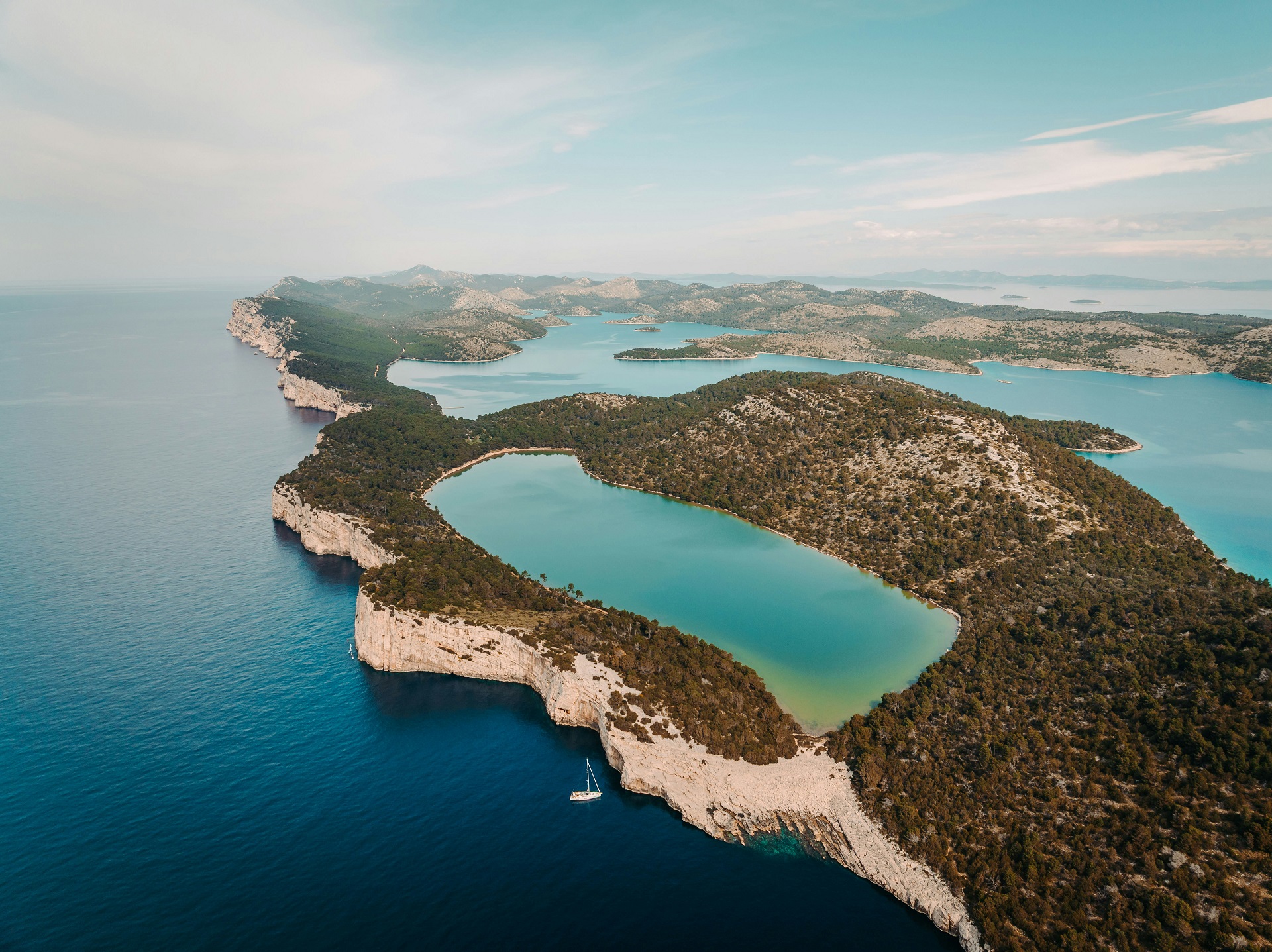
What makes Telašćica truly unique is the dramatic contrast between its inner calm and the raw power of the outer coastline. Just beyond the bay, on the seaward side of the park, rise the famous cliffs - sheer limestone walls that plunge almost vertically into the open Adriatic. Reaching heights of up to 160 meters, these cliffs are among the most striking natural features in Croatia. Standing at their edge, you feel the full force of the open sea below, waves crashing against the rock in a constant display of energy. At sunset, the cliffs take on warm golden tones, creating one of the most unforgettable views in the region.
Back inside the bay, the atmosphere shifts completely. Pine forests line the shores, filling the air with their distinctive scent, while the water remains calm and reflective. It’s not uncommon to find entire sections of the bay nearly empty, allowing you to anchor in complete tranquility even during the peak of summer. The silence here is striking - broken only by the gentle movement of water against the hull or the distant sound of wildlife from the surrounding hills.
A short walk inland reveals another of Telašćica’s highlights: Lake Mir. This calm saltwater lake sits just behind the cliffs, separated from the sea by a narrow strip of land. Thanks to its shallow depth and limited circulation, the water in Lake Mir is often significantly warmer than the surrounding sea, making it an ideal spot for a relaxing swim. The area around the lake is also perfect for a quiet walk, with simple paths leading to viewpoints that overlook both the lake and the open Adriatic beyond.
For sailors, Telašćica is as practical as it is beautiful. Well-maintained buoy fields are distributed throughout the bay, providing secure mooring options in many of the most sheltered areas. Anchoring is also permitted in designated zones, though it’s important to respect local regulations and environmental guidelines, as the park is a protected area. Park rangers regularly patrol the bay, and entrance fees are collected, typically based on the size of the vessel.
Spending the night in Telašćica is an experience that stays with you. As evening falls, the bay becomes even quieter, and the sky - free from light pollution - fills with stars. The stillness of the water, combined with the sense of being surrounded by untouched nature, creates a rare feeling of isolation and calm. It’s the kind of place where time slows down completely, and where the simple act of being at anchor becomes deeply satisfying.
Telašćica is more than just a stop on a sailing route - it’s a destination in its own right. Whether you stay for a single night or linger for several days, exploring its coves, walking its trails, and taking in its views, it offers a perfect balance of safety, beauty, and authenticity that defines the very best of sailing in Croatia.
SAKARUN BEACH: CARIBBEAN COLORS IN THE ADRIATIC
On the northwestern edge of Dugi Otok lies Sakarun Beach, a place that often surprises even experienced sailors with its almost tropical appearance. Frequently ranked among the most beautiful beaches in Croatia, Sakarun stands out for its unusual combination of fine white sand and luminous, shallow waters that shift between shades of turquoise and light blue throughout the day.
Unlike many Adriatic beaches, which are typically pebbled and quickly drop into deeper water, Sakarun is wide, sandy, and gently sloping. This creates a long stretch of shallow sea that reflects sunlight in a way that gives the bay its signature glowing color. From the deck of a yacht at anchor, the view is striking - an expanse of pale seabed beneath crystal-clear water, framed by low pine forests and open sky. On calm days, the sea here can appear almost unreal in its clarity and brightness.
For sailors, Sakarun is primarily a daytime anchorage, and one of the most enjoyable on the island when approached at the right time. The seabed offers generally good holding in sand, making anchoring straightforward in settled conditions. However, its beauty also draws attention. During the peak of summer, especially in July and August, the bay becomes a popular stop not only for yachts but also for excursion boats arriving from nearby islands and the mainland.
Timing makes all the difference. Arriving early in the morning, when the sea is still and the light is soft, allows you to experience Sakarun at its most peaceful. Alternatively, late afternoon and early evening bring a different kind of magic. As day visitors depart, the bay gradually empties, and the low sun enhances the colors of the water, creating a calmer, more intimate atmosphere. It’s during these quieter hours that Sakarun truly lives up to its reputation.
While the bay is open to winds from the northwest, it is generally comfortable in stable summer conditions, particularly during the morning hours before the Maestral strengthens. If stronger winds are expected, it’s wise to treat Sakarun as a short stop rather than an overnight anchorage and plan to move to a more protected bay later in the day.
Despite its popularity, Sakarun has managed to retain a relaxed, unpretentious feel. There are no large developments or intrusive infrastructure - just a simple beach bar set back among the trees, offering refreshments and a place to cool off in the shade. The surrounding pine forest provides a natural backdrop, and a short walk inland reveals quiet paths and viewpoints away from the shoreline.
For those looking to extend their stay, nearby villages such as Božava and Veli Rat offer excellent alternatives for overnight mooring. Both provide a more sheltered setting, along with restaurants, small shops, and a welcoming local atmosphere that contrasts nicely with the open, beach-focused experience of Sakarun.
In many ways, Sakarun represents a different side of Dugi Otok. While much of the island is defined by rugged cliffs and secluded anchorages, here you find openness, light, and a sense of ease. It’s a place to pause during the day, swim in some of the clearest water in the Adriatic, and simply enjoy the moment before continuing your journey along this remarkable island.
VELI RAT LIGHTHOUSE: A LANDMARK OF THE ADRIATIC
Standing proudly near the northern tip of Dugi Otok, the Veli Rat Lighthouse is one of the most recognizable maritime landmarks in the Adriatic. Built in 1849, its striking 42-meter tower rises above the surrounding pine forest, making it the tallest lighthouse on the Croatian coast. For sailors approaching from the open sea, it serves not only as a navigational aid but also as a symbolic gateway to the quieter, wilder side of the archipelago.
The lighthouse itself has a certain timeless presence. Its pale yellow facade - rumored to have been constructed using a mixture that included thousands of egg whites for added strength - contrasts beautifully with the deep greens of the surrounding forest and the intense blues of the sea. Visible from miles away, it has guided generations of mariners safely along this part of the coast, where open Adriatic conditions can shift quickly.
Approaching the area by boat is a rewarding experience in itself. The coastline here is less indented than on the eastern side of the island, giving it a more open, expansive feel. Small coves and rocky inlets are scattered along the shore, many of them accessible only by sea. The water is exceptionally clear, and on calm days, it takes on the same luminous quality found at nearby Sakarun Beach, just a short distance to the south.
The village of Veli Rat offers a modest but welcoming harbor where visiting yachts can find mooring, though space is limited. It’s the kind of place where arriving early is rewarded, especially during the summer months. Once secured, the atmosphere is peaceful and unhurried - far removed from the busier marinas found elsewhere along the coast. Even in high season, evenings here tend to be quiet, with only the sounds of the sea and the occasional passing boat breaking the silence.
From the harbor, a short walk leads you to the lighthouse through shaded paths lined with pine trees. The surrounding area invites exploration on foot, with simple trails branching off toward hidden beaches, rocky viewpoints, and open clearings that offer sweeping views of the Adriatic. One of the highlights is climbing - or simply standing near - the lighthouse grounds at sunset, when the fading light casts long shadows across the landscape and the sea turns deep shades of gold and blue.
The northern edge of Dugi Otok feels distinctly different from its southern and eastern parts. It is more exposed, more open to the horizon, and carries a subtle sense of remoteness that many sailors find especially appealing. There are fewer settlements, fewer distractions, and more space to appreciate the raw elements - wind, sea, and sky.
Spending a night in Veli Rat, whether at anchor nearby or moored in the small harbor, offers a rare kind of stillness. As darkness falls, the lighthouse continues its steady rhythm, its beam sweeping across the water just as it has for over a century. It’s a quiet reminder of the island’s deep connection to the sea and a fitting backdrop for an evening spent reflecting on the journey.
For those sailing along Dugi Otok, Veli Rat is more than just a waypoint - it’s a place to pause, take in the scale of the Adriatic, and experience the island at its most serene and elemental.
BRBINJ, BOŽAVA, AND SAVAR: AUTHENTIC ISLAND VILLAGES
While the dramatic cliffs and turquoise bays of Dugi Otok often capture first impressions, the true soul of the island reveals itself in its small, timeworn villages. These settlements are not shaped by tourism trends but by centuries of island life - fishing, olive cultivation, and a quiet dependence on the sea. Here, stone houses cluster along sheltered coves, wooden boats rest gently in the shallows, and the rhythm of the day follows the sun rather than a schedule.
Arriving in any of these villages by boat feels personal. There are no large marinas or crowds rushing for berths - just calm waterfronts where a visiting yacht is still something noticed, sometimes even welcomed with a curious glance or a friendly wave. Even in the height of summer, these places retain a sense of authenticity that is becoming increasingly rare along the Adriatic.
On the eastern side of the island, Brbinj is often the first meaningful stop for those approaching from Zadar. The village is set within a deeply indented bay that naturally divides into two well-protected anchorages: Lučina Bay and Brbinj Bay. Both offer excellent shelter in most conditions, making Brbinj a reliable choice when weather patterns shift or when a calm overnight stop is needed. The presence of a ferry connection to the mainland adds a practical dimension, allowing for provisioning or crew changes, yet it never disrupts the village’s quiet character. Ashore, you’ll find a handful of local eateries and small shops, all operating at an unhurried pace that reflects the island’s way of life.
Further north, Božava presents a slightly livelier but still intimate atmosphere. Often considered one of the island’s most welcoming ports, it has a small marina that provides safe and convenient mooring for visiting yachts. The harbor is framed by traditional houses and shaded by pine trees, creating a setting that feels both cozy and scenic. Božava is also strategically positioned, making it an ideal base for exploring nearby highlights such as Sakarun Beach or the northern coastline around Veli Rat. Beyond the waterfront, the surrounding landscape opens into gentle hills and quiet roads, perfect for cycling or walking through olive groves and low Mediterranean vegetation. Evenings in Božava tend to gather around the harbor, where the soft clinking of glasses and the scent of freshly prepared seafood create a relaxed, sociable atmosphere.
Savar, by contrast, offers a more introspective experience. Tucked away along the central eastern coast, it is perhaps the most tranquil of the three villages - a place where silence and simplicity define the mood. The anchorage here is peaceful and surrounded by natural beauty, with olive trees stretching inland and low hills providing shelter from the wind. Savar’s history is subtly present in its old stone quarries, which once supplied material for buildings across the region, and in the small 9th-century church that sits on a nearby peninsula, quietly overlooking the sea. There is little in the way of modern development, and that is precisely its appeal. Time feels slower here, and a stop in Savar often becomes less about activities and more about simply being present in the moment.
Together, these villages form a network of anchorages that define the eastern side of Dugi Otok. Each offers something slightly different - Brbinj’s practicality and shelter, Božava’s gentle liveliness and accessibility, and Savar’s deep tranquility - but all share the same underlying character of authenticity and calm.
For sailors, they provide more than just safe places to moor. They offer a connection to the island’s identity, a chance to step ashore and experience a way of life that has changed little over generations. Whether you stay for a few hours or a few days, these villages leave a lasting impression - not through spectacle, but through their quiet, enduring charm.
DIVING THE MICHELE WRECK: AN UNDERWATER HIGHLIGHT
Beneath the surface of the waters surrounding Dugi Otok lies a completely different world - one that is just as compelling as the island’s dramatic coastline. Among its underwater highlights, the Michele shipwreck stands out as one of the most rewarding dive sites in the Adriatic, offering a rare combination of history, structure, and marine life.
Resting at depths between 21 and 30 meters off the island’s western side, the wreck of the Michele is accessible yet still deep enough to retain a sense of mystery. This Italian merchant vessel met its fate during World War II, and over the decades, the sea has gradually reclaimed it. Today, what remains is not just a sunken ship, but a living reef - an evolving ecosystem where nature and history have merged.
Descending toward the wreck is an experience in itself. As the outline of the ship begins to emerge from the blue, details slowly come into focus - the skeletal frame, sections of the hull, and remnants of its structure resting quietly on the seabed. The atmosphere is both peaceful and slightly haunting, a reminder of the ship’s past life and the events that led to its sinking.
What makes the Michele particularly special is the abundance of marine life it now supports. Schools of fish move effortlessly through the open sections of the wreck, while smaller species find shelter within its crevices. Sponges and corals have colonized the metal surfaces, adding texture and color to what was once a purely industrial structure. Depending on the conditions, you may also encounter groupers, sea bream, and other Adriatic species that have made the wreck their home.
Visibility in this area is often excellent, especially during the summer months, allowing divers to fully appreciate both the scale of the wreck and the clarity of the surrounding water. Light filtering down from the surface creates shifting patterns across the structure, enhancing the visual impact and making each dive slightly different from the last.
While the Michele is best suited to certified divers due to its depth, it remains accessible to a wide range of experience levels with the guidance of local dive centers. Excursions are regularly organized from nearby villages such as Božava and Veli Rat, where professional instructors and guides provide equipment, safety briefings, and local knowledge. For those less experienced, introductory dives or guided descents make it possible to explore the site safely while gaining confidence underwater.
Even for those who prefer to stay closer to the surface, the surrounding waters offer excellent snorkeling opportunities, with clear visibility and a variety of marine life along the nearby reefs and rocky seabed. While the wreck itself lies too deep for snorkeling, the experience of being in these waters adds another dimension to a sailing journey around Dugi Otok.
Diving the Michele is more than just a recreational activity - it’s a moment of connection with the hidden side of the Adriatic. It reveals a quieter, more introspective aspect of the sea, where history rests undisturbed and nature continues its slow, patient transformation. For sailors willing to venture below the surface, it becomes one of the most memorable experiences the island has to offer.
DINING ON DUGI OTOK: SIMPLE, HONEST, DELICIOUS
Dining on Dugi Otok is not about chasing trends or elaborate menus - it’s about rediscovering the essence of Dalmatian cuisine in its purest form. The island’s culinary identity is shaped by what is available locally and seasonally, which means meals are built around freshness, simplicity, and tradition. For sailors, this often becomes one of the most memorable parts of the journey: stepping ashore after a day at sea and sitting down to food that feels both authentic and deeply satisfying.
The foundation of most dishes is the sea itself. Fish is typically caught the same morning and prepared with minimal intervention - grilled over an open flame, drizzled with local olive oil, and served with blitva, a classic combination of Swiss chard and potatoes. Octopus appears in many forms, from tender salads to slow-cooked peka, where it is prepared under a heavy iron bell with vegetables, herbs, and sometimes lamb or veal. Black risotto, rich with cuttlefish ink, is another staple, offering deep flavor and a connection to the island’s fishing heritage.
What makes these meals special is not complexity, but care. Recipes are often passed down through generations, and preparation is unhurried. When you order peka, for example, you are not simply choosing a dish - you are committing to a process that takes hours, allowing flavors to develop slowly over glowing embers. This pace of cooking naturally encourages a slower style of dining, where meals stretch into long, relaxed evenings.
The experience is further enhanced by local wines from the Zadar region, which pair beautifully with the island’s cuisine. Crisp whites and robust reds are commonly served alongside meals, often produced by small family vineyards. To finish, a glass of homemade rakija - whether fig, grape, or herb-infused - is almost always offered, a gesture of hospitality as much as a tradition.
Some of the most rewarding dining experiences can be found in the island’s small villages, particularly Božava, Veli Rat, and Savar. Here, konobas - family-run taverns - are often located right by the water, allowing you to dine just steps from where your boat is moored or anchored. The settings are simple but atmospheric: wooden tables, the scent of the sea in the air, and the soft sound of waves against the shore.
Service follows the same rhythm as the island itself - warm, personal, and never rushed. It’s not uncommon to be greeted by the owner, who might recommend the day’s catch or suggest a house specialty. Conversations flow easily, and meals often feel less like transactions and more like shared experiences.
On Dugi Otok, food is not just nourishment - it’s a reflection of place, culture, and time. Each meal tells a story of the island’s connection to the sea and the land, offering a taste of something that has remained largely unchanged for generations. For sailors passing through, these moments - simple, honest, and delicious - become an essential part of the journey.
SAILING CONDITIONS AROUND DUGI OTOK
Dugi Otok offers a well-balanced sailing environment that appeals to a wide range of crews, from experienced sailors looking for dynamic conditions to those preferring a more relaxed, predictable itinerary. Its position along the outer edge of the Zadar Archipelago means you’re never far from open water, yet the island itself provides plenty of shelter when conditions change.
During the summer months, the prevailing wind is the Maestral, a reliable northwesterly that typically builds gradually from late morning and peaks in the afternoon. This thermal wind is one of the defining features of sailing in this region. It provides steady, manageable conditions that are ideal for cruising along the island’s western coast, where the open Adriatic allows the breeze to develop fully. Under sail, this often translates into smooth, enjoyable passages with consistent wind angles and minimal swell.
Mornings, by contrast, are usually calm or lightly variable, creating perfect conditions for departing anchorages, swimming stops, or short repositioning sails. This daily rhythm—calm mornings followed by windier afternoons—naturally shapes the pace of life on board and allows for flexible planning without the need for long or demanding passages.
The geography of Dugi Otok plays a crucial role in how these conditions are experienced. The western side of the island is exposed to the full influence of the open sea. Here, the coastline is rugged and dramatic, with cliffs and deep water close to shore. Sailing along this side can be exhilarating, particularly when the Maestral is established, but it requires awareness of changing sea states and limited shelter options. Anchorages are fewer and generally less protected, making this side better suited for passing sails rather than overnight stops in unsettled weather.
In contrast, the eastern side offers a completely different experience. Protected by the chain of islands closer to the mainland, these waters are calmer and more forgiving. Bays are more frequent, anchorages are better sheltered, and navigation is generally more relaxed. This is where most overnight stops take place, especially for those seeking comfort and security. Villages and small harbors are also concentrated along this side, providing access to supplies, dining, and mooring facilities.
When weather systems shift, understanding local wind patterns becomes essential. The Bora, a strong and often gusty northeasterly, can descend quickly and with significant force, particularly in transitional seasons. It tends to create short, steep waves and can make exposed areas uncomfortable or unsafe. During Bora conditions, well-protected bays on the eastern side of the island, as well as deeper inlets, offer the best shelter.
The Jugo, a southeasterly wind, brings a different set of challenges. It builds more gradually than the Bora but can generate a longer swell and persistent conditions over a wider area. When Jugo is forecast, protection from the southeast becomes a priority, and anchorages must be chosen carefully to avoid exposure.
In both cases, safe havens such as Telašćica Nature Park provide excellent refuge. Its deep, enclosed bay offers reliable protection from most wind directions, making it one of the most dependable shelters in the region. Similarly, the areas around Veli Rat and Božava can offer good protection depending on the wind direction, though selecting the right anchorage or mooring remains key.
For provisioning and basic services, the village of Sali serves as the island’s main hub. Located near Telašćica on the southeastern side, Sali provides access to water, supplies, and other essentials, making it an important logistical stop during your cruise.
Overall, sailing around Dugi Otok is defined by variety and adaptability. Within a relatively small area, you can experience both the energy of the open Adriatic and the calm of sheltered bays, adjusting your route according to conditions and preference. With a bit of awareness and planning, the island offers consistently rewarding sailing - whether you’re chasing the afternoon wind along the cliffs or settling into a quiet anchorage as the day draws to a close.
ISLAND HOPPING FROM DUGI OTOK
One of the greatest advantages of basing a sailing itinerary around Dugi Otok is its exceptional position within the Zadar Archipelago. From here, you are surrounded by a dense cluster of islands and islets, most of which remain far quieter than the more famous southern Dalmatian destinations. Distances are short, conditions are generally favorable in summer, and the variety of landscapes within a single sailing radius is remarkable. In practice, this means you can design an itinerary that feels expansive and adventurous without ever needing long offshore passages.
Just a short sail away lies Zverinac, a small and peaceful island that feels almost untouched by time. Its single main harbor is deeply sheltered and surrounded by traditional stone houses, olive groves, and a handful of local residents who maintain a slow, island-based rhythm of life. For sailors, Zverinac is often chosen as a calm overnight stop - an easy anchorage or mooring where the water is still, the nights are quiet, and the stars feel unusually close. It’s the kind of place where nothing demands attention, and that simplicity is exactly its appeal.
Slightly further along the archipelago, Ist offers a more varied coastline with multiple coves and inlets. Ist is gently hilly and green compared to some of the more rugged islands nearby, giving it a softer visual character. The island is split between two main harbors, both suitable for yachts, and offers a mix of sheltered anchorages and small village life. Sailing around Ist reveals quiet bays where you can stop for a swim in clear water or anchor for a relaxed lunch surrounded by open views and minimal traffic.
Nearby Molat expands the sense of space even further. It is one of the larger islands in the northern Zadar region, yet still feels uncrowded and largely undeveloped in a tourism sense. Its coastline is deeply indented, creating numerous anchorages that work well in different wind conditions. For sailors, Molat offers flexibility: you can find calm, protected waters even when conditions are less stable elsewhere in the archipelago. The island’s small villages and harbors provide basic services, but the real attraction is the sense of isolation and natural beauty.
To the south of Dugi Otok lies one of the Adriatic’s most iconic sailing destinations - the Kornati Islands. This extraordinary cluster of islands is often described as a nautical labyrinth, where hundreds of barren limestone islets rise dramatically from deep blue water. Unlike the greener islands of the Zadar region, the Kornati are stark, minimal, and almost lunar in appearance. Sailing here feels different: navigation becomes a visual experience of rock, sea, and sky, with very few signs of human presence beyond stone walls and occasional konobas tucked into hidden bays. It’s a place that every sailor should experience at least once - not for comfort or amenities, but for its raw, elemental beauty.
Heading north from Dugi Otok brings you into even quieter waters. Islands such as Sestrunj and Rivanj offer a different kind of sailing experience altogether - one defined by solitude. These islands are sparsely inhabited and rarely visited, making them ideal for crews looking to step away from busier routes. Anchorages here are simple but effective, often consisting of open bays with good holding and little to no surrounding infrastructure. Nights spent here are particularly memorable: no harbor lights, no background noise just the sound of water against the hull and an uninterrupted sky above.
Taken together, this network of nearby islands turns Dugi Otok into more than just a destination - it becomes a central hub for exploration. Within a few hours’ sail in any direction, the landscape shifts dramatically, from sheltered green islets and quiet fishing villages to stark limestone formations and remote anchorages. This density of variety is what makes the region so rewarding for cruising: every short passage brings something different, yet the overall distances remain comfortably manageable.
BRIEF HISTORY OF DUGI OTOK
The history of Dugi Otok stretches far beyond its current identity as a sailing destination. Long before yachts began tracing its coastline, the island was shaped by thousands of years of human presence, adaptation, and quiet endurance. Its story is not defined by grand cities or major historical events, but by continuity - layers of life gradually built upon one another in a landscape that has always been both generous and demanding.
Archaeological findings indicate that the earliest inhabitants of Dugi Otok were Illyrian tribes, who settled across the Adriatic coast during prehistoric times. These early communities were closely tied to the sea, relying on fishing, small-scale agriculture, and coastal navigation. Evidence of their presence can still be traced in fragments of pottery, burial sites, and ancient pathways that once connected early settlements across the island’s interior.
With the arrival of the Romans, Dugi Otok became part of a broader network of Adriatic trade and rural organization. While it never developed into a major urban center, Roman influence left a lasting imprint on the island’s agricultural structure and land use. Olive cultivation, in particular, was expanded and systematized during this period, laying the foundation for groves that continue to define parts of the landscape today. Some of the dry-stone field systems still visible across the island may trace their origins back to this era or even earlier, reflecting a continuity of land management that has endured for centuries.
Following the fall of the Roman Empire, Dugi Otok experienced the same waves of change that swept across much of Dalmatia. Control shifted through various regional powers, including the Byzantine and later Venetian spheres of influence. Despite these transitions, the island’s relative isolation meant that large-scale development never took hold. Instead, life remained closely tied to the sea, with small fishing communities and agricultural hamlets forming the backbone of settlement patterns.
This isolation proved to be a defining factor in preserving the island’s character. Unlike more accessible coastal regions, Dugi Otok developed slowly and organically. Villages remained small, often separated by long stretches of untouched landscape. Stone was the dominant building material, and architecture remained simple and functional, shaped by necessity rather than ornamentation. Over time, this created a distinctive visual identity - clusters of pale stone houses nestled among olive groves and low hills, connected by narrow paths rather than paved roads.
Religious and cultural life also left its mark on the island in the form of small chapels and churches, many of which date back several centuries. These modest structures, often located in quiet or elevated positions overlooking the sea, reflect the importance of faith and community in island life. They were not built as grand monuments, but as intimate spaces for local gatherings, celebrations, and reflection - many of which are still in use today or carefully preserved as part of the island’s heritage.
Perhaps the most striking aspect of Dugi Otok’s history is its continuity. Despite political changes, economic shifts, and the gradual arrival of modern infrastructure, the fundamental rhythm of life has remained remarkably consistent. Olive trees planted generations ago still produce fruit. Stone walls built by ancestors still divide fields. Fishing traditions continue in much the same way they have for centuries, adapted but not replaced.
Even today, as sailing routes bring visitors from across the world, the island retains this layered sense of time. It does not present history as something distant or separate; instead, it is woven into the landscape itself. Every cove, village, and hillside carries traces of those who lived there before, creating a quiet but powerful connection between past and present.
For sailors, this historical depth adds another dimension to the experience of Dugi Otok. Beyond its natural beauty and anchorages, the island offers a subtle reminder that the Adriatic has been a lived-in, working sea for millennia - and that its shores continue to tell stories written slowly, one generation at a time.
WHY SAILORS LOVE DUGI OTOK
What makes Dugi Otok truly remarkable is not a single defining feature, but the way everything comes together in balance. Many islands in the Adriatic excel in one direction - some are dramatic but exposed, others are safe but crowded, and others are convenient but heavily developed. Dugi Otok manages to sit comfortably in the middle of all these extremes, offering a sailing experience that feels both varied and effortless.
On one side, the island delivers the full character of the open Adriatic. Its western coastline is bold and untamed, shaped by wind and waves into cliffs, caves, and long stretches of rugged limestone. Sailing here feels expansive and immersive, with the horizon always open and the sea carrying a sense of depth and movement that reminds you you’re on the edge of the Adriatic’s outer islands. It’s a landscape that feels elemental - wind, water, and rock interacting without interruption.
On the other side, Dugi Otok offers protection and ease. Its eastern coastline is naturally sheltered by the island chain closer to the mainland, creating calm bays, quiet anchorages, and approachable village harbors. This contrast is one of the island’s greatest strengths: within a relatively short sail, conditions can shift from open-water cruising to completely sheltered anchoring. For sailors, this flexibility is invaluable, allowing routes to adapt naturally to weather and mood rather than rigid planning.
Equally important is the island’s infrastructure - or more precisely, its measured level of development. Dugi Otok has enough facilities to support comfortable cruising: small marinas, mooring fields, local shops, and traditional konobas are all present where needed. Yet it avoids the density and intensity of heavily developed destinations. There are no oversized resorts dominating the coastline, no overcrowded marinas forcing competition for space, and no sense that the natural environment has been reshaped for tourism. Instead, development remains low-key and integrated into the landscape.
This balance extends to its villages as well. Places like Božava, Brbinj, and Savar provide exactly what a sailor needs - shelter, access to essentials, and a welcoming shore - but without losing their sense of identity. Life here still follows local rhythms rather than seasonal pressure, and visitors are integrated into that rhythm rather than overwhelming it.
Perhaps the most defining quality of Dugi Otok, however, is space. Space in the literal sense - open anchorages where you are not tightly packed among dozens of other boats, and where finding a quiet spot to drop anchor is still possible even in peak season. But also space in a broader sense: mental space, visual space, and emotional space. The coastline feels open rather than congested, the sea feels expansive rather than confined, and the overall experience encourages slowing down rather than rushing between destinations.
This sense of space transforms how you sail. Instead of planning every stop in advance or competing for the most popular mooring spots, you can remain flexible. You can follow the wind, adjust your route in real time, and choose anchorages based on mood rather than necessity. One day might be spent in a lively village harbor, the next in a completely secluded bay where the only sound is the water against the hull.
Even simple moments take on greater meaning here. Swimming off the boat in clear, quiet water. Watching the sun set behind distant islands with no other vessels in sight. Dining on deck after a slow afternoon sail. These experiences are not extraordinary in themselves - but on Dugi Otok, they feel more present, more unfiltered, and more personal.
In the end, what sets Dugi Otok apart is not that it offers more than other islands, but that it offers the right combination of elements in the right proportions. It is dramatic without being overwhelming, accessible without being crowded, and developed without losing its identity. For sailors, that balance is rare - and it is exactly what makes the island unforgettable.
FINAL THOUGHTS: DUGI OTOK AWAITS
Dugi Otok is not an island that reveals itself quickly. It doesn’t compete for attention with spectacle or excess, nor does it rely on a single “must-see” attraction. Instead, it unfolds gradually, rewarding those who allow time for it to do so. It is a place that asks for patience - not in a demanding way, but in a way that gently reshapes your rhythm the longer you stay.
From the moment you arrive by sea, there is a subtle shift in pace. The coastline does not overwhelm with density or noise; it stretches out, quiet and varied, inviting exploration without pressure. You are not guided toward a single highlight - you are free to drift between moods and landscapes, choosing your own path through anchorages, coves, and villages.
At the southeastern edge, the experience of Telašćica Nature Park leaves a lasting impression. Its deep, sheltered bay, dramatic cliffs, and hidden inland salt lake form a landscape that feels both powerful and calm at once. It is a place where many sailors pause longer than planned, simply because leaving feels unnecessary.
Far to the northwest, Sakarun Beach offers an entirely different kind of beauty - bright, open, and almost Caribbean in tone. Its shallow turquoise waters and soft sand create a sense of ease that contrasts with the island’s more rugged edges. Together, these two locations alone show the range Dugi Otok holds within a single coastline.
Between them lie countless smaller anchorages, quiet villages like Božava and Savar, and stretches of coastline where you may not see another boat for hours. Each stop feels distinct, yet none feel forced. The island encourages spontaneity - changing plans based on wind, light, or simply the desire to stay a little longer in a particular bay.
For sailors departing from Zadar or even further south from Šibenik, Dugi Otok often begins as one stop among many in a broader itinerary. Yet it has a way of changing expectations. What was meant to be a brief visit frequently becomes an extended stay, as crews discover that the island offers not just places to see, but a different way of experiencing time at sea.
Its greatest strength lies in this quiet transformation. The island doesn’t demand attention - it earns it slowly. It encourages you to anchor in one place longer than planned, to swim a little further from the boat, to sit through an entire sunset without moving, and to let the days stretch out without urgency.
In a region filled with remarkable sailing destinations, Dugi Otok stands apart not because it is louder or more dramatic, but because it is more balanced. It offers contrast without chaos, beauty without overcrowding, and freedom without complication.
For anyone planning an Adriatic sailing journey, this long, understated island deserves more than a passing glance. It deserves time. And often, it deserves exactly what sailors are rarely given elsewhere - space to slow down, settle in, and simply enjoy being at sea.