BIOGRAD NA MORU SAILING GUIDE: GATEWAY BETWEEN ZADAR AND THE KORNATI ISLANDS
On Croatia’s central northern Dalmatian coast, Biograd na Moru holds a particularly strategic position within the Adriatic sailing network. It is widely regarded as one of the most practical and well-organised charter bases in the region, sitting almost perfectly between the sheltered island system of the Zadar Archipelago and the vast, open-water maze of Kornati National Park.
This location is not incidental. Biograd lies at a natural transition point where coastal navigation gradually shifts into more open island cruising. From here, sailors can choose between multiple directions without long repositioning sails, which makes it an exceptionally efficient base for both weekly charters and shorter itineraries.
Unlike purely historic coastal towns that function mainly as cultural destinations, or remote island settlements focused on quiet isolation, Biograd na Moru is defined primarily by its maritime purpose. Over time, it has developed into a fully integrated sailing hub where infrastructure, services, and geography align around nautical activity. The town’s identity is therefore closely tied to the sea not only aesthetically, but operationally.
Its evolution into a key charter centre is rooted in this practicality. Modern marinas, provisioning options, and technical support are all concentrated within a compact coastal area, allowing crews to prepare and depart efficiently. At the same time, the sailing environment begins immediately beyond the harbour walls, meaning there is no separation between urban space and cruising waters.
From a navigational perspective, this creates a rare advantage. Within a short distance of departure, sailors can already be among the islands of the Zadar Archipelago, where sheltered channels and short inter-island passages dominate the early stages of most itineraries. Alternatively, heading further south or west opens the route toward the more expansive and visually striking landscapes of Kornati National Park, where navigation becomes more open and island formations more dispersed.
This dual access is one of Biograd’s defining strengths. Few sailing bases in Croatia offer such an immediate choice between protected archipelago cruising and more adventurous offshore island exploration. As a result, itineraries can be designed with a high degree of flexibility, adapting easily to weather conditions, crew experience, or personal preference.
In contrast to destinations that require longer coastal transits before reaching sailing grounds, Biograd places sailors directly at the threshold of some of the Adriatic’s most important cruising areas. The transition from harbour to open water is measured in minutes rather than hours, which significantly enhances both efficiency and comfort at the start of any voyage.
Ultimately, Biograd na Moru functions as more than just a departure point. It is a logistical and geographical connector between two of the most significant sailing environments in northern Dalmatia. This role - bridging sheltered island systems with open national park waters - gives it a level of importance that extends beyond convenience, positioning it as one of the core gateways for sailing in Croatia.
A COASTAL TOWN BUILT AROUND THE SEA
The identity of Biograd na Moru is fundamentally shaped by its relationship with the Adriatic. Positioned on a small peninsula along the central northern Dalmatian coast, the town is surrounded by water on multiple sides, and this geography has defined its development for centuries. Its historical role as a royal Croatian coastal settlement is still visible in its urban layout and waterfront orientation, even as it has evolved into a modern nautical centre.
Today, Biograd functions as both a living coastal town and a fully equipped sailing hub. The transition between these two identities is seamless rather than divided. Marinas, beaches, and promenades are not placed on the outskirts of the town - they are embedded directly into its structure. This creates a continuous coastal edge where everyday urban life and maritime activity exist side by side.
The waterfront is particularly illustrative of this integration. Fishing boats are moored alongside sailing yachts, while ferries and small commercial vessels move steadily through the same maritime space. This layered use of the harbour reinforces Biograd’s long-standing connection to the sea, where different forms of navigation and coastal activity coexist without clear separation.
Unlike more isolated island destinations, where maritime life is seasonal and often quiet, Biograd na Moru maintains a more constant rhythm throughout the year. Even outside peak sailing season, the waterfront remains active, shaped by local fishing activity, transport routes, and everyday coastal use. During summer, this activity intensifies as charter fleets, private yachts, and visiting sailors add to the movement within the harbour.
The town’s peninsular layout also contributes to its distinct atmosphere. Streets naturally lead toward the sea, and the coastline is never far from view. This creates a sense of proximity to the water that is constant rather than occasional. Whether walking through the centre, along the promenade, or toward the marina areas, the presence of the Adriatic is always immediate.
Architecturally, Biograd reflects this dual identity. Traditional coastal elements sit alongside modern infrastructure, with stone facades and historic references blending into contemporary marina facilities and hospitality developments. The result is a town that feels neither purely historic nor entirely modern, but continuously shaped by both.
This combination of active maritime use and integrated urban life gives Biograd na Moru a distinctive character within the Adriatic sailing landscape. It is not a destination that exists apart from its nautical function, but one that is structured around it. The sea is not a backdrop - it is part of the town’s daily rhythm, visible in movement, commerce, and leisure alike.
For sailors, this creates a unique departure environment. The transition from land to sea does not require leaving a quiet, detached marina zone. Instead, it happens within a living coastal setting where maritime activity is already in motion. This reinforces Biograd’s role as a town where sailing is not only facilitated, but fully integrated into its identity.
SAILING OUT OF BIOGRAD: IMMEDIATE ACCESS TO ISLANDS
One of the key advantages of departing from Biograd na Moru is how quickly the sailing environment transitions from harbour infrastructure into open island waters. There is no long coastal transit required before reaching meaningful cruising grounds. Instead, the marina exits directly into a structured maritime corridor that immediately opens toward some of the most important sailing regions in northern Dalmatia.
As soon as a yacht clears the harbour area, it enters the wider system of the Zadar Archipelago. This archipelago acts as a natural buffer between the mainland and the open Adriatic, shaping both wind conditions and navigational options. The result is an immediate shift into sheltered waters where sailing becomes smoother, more predictable, and easier to manage from the very first nautical mile.
To the northwest, the route quickly leads toward larger islands such as Pašman Island and Ugljan Island. These islands form one of the most accessible cruising zones in the Adriatic, with a dense concentration of bays, anchorages, and small harbours. Distances between stops are short, often allowing for multiple swimming breaks, anchoring opportunities, and relaxed navigation within a single day.
This proximity makes the early stages of any itinerary particularly comfortable. Crews can ease into sailing rhythm without pressure, adjusting to conditions while remaining within sheltered waters. The geography of the archipelago ensures that alternative anchorages are always nearby, allowing routes to adapt easily to wind or preference.
In the opposite direction, toward the southwest, the sailing environment gradually opens up and becomes more expansive. Here, the landscape transitions toward the more remote and visually distinctive waters of Kornati National Park. Unlike the closer island clusters, this area is characterised by a more fragmented geography, with hundreds of islands, islets, and channels spread across a wider seascape.
Navigation in this region feels more open and exploratory. While still protected from full offshore exposure, the sense of space increases significantly, and sailing passages become longer and more visually varied. It is in this direction that itineraries often take on a more adventurous tone, combining island exploration with broader Adriatic scenery.
What makes Biograd na Moru particularly effective as a departure point is the ease of choosing between these two contrasting sailing environments. Within a very short distance from the marina, sailors can either remain within the sheltered structure of the Zadar Archipelago or gradually transition into the more open and dramatic landscapes of Kornati waters.
This dual-access positioning removes one of the common constraints of coastal sailing: the need to commit early to a fixed type of route. Instead, decisions can be made dynamically, based on weather conditions, crew experience, or simply the desired pace of travel.
As a result, sailing out of Biograd is defined by immediacy and choice. The sea is not something that must be reached - it is already present at the edge of the town. From that point onward, the Adriatic opens in multiple directions, each offering a different style of cruising within the same compact region.
SAILING CONDITIONS AROUND BIOGRAD
The sailing environment around Biograd na Moru is widely regarded as one of the most stable and manageable in the Adriatic during the main summer season. Its position along the central northern Dalmatian coast, combined with the protective geometry of nearby islands, creates a naturally moderated sea state that supports comfortable cruising throughout most of the year.
A key factor influencing these conditions is the surrounding structure of the Zadar Archipelago. Islands such as Pašman Island and Ugljan Island act as a natural barrier between the mainland and the open Adriatic. This barrier significantly reduces swell penetration and softens wind impact, particularly in coastal channels and near-shore sailing areas. As a result, even when conditions vary in the wider region, the waters around Biograd often remain comparatively calm.
The dominant seasonal influence is the Maestral wind, a northwesterly thermal breeze that develops consistently during the summer months. Typically forming in late morning or early afternoon, the Maestral builds gradually as land temperatures rise, creating a reliable and predictable sailing pattern. For crews departing from Biograd na Moru, this wind is particularly advantageous, as it aligns naturally with daytime sailing schedules.
Once established, the Maestral provides steady and moderate sailing conditions that are ideal for short inter-island passages. In this region, sailing is rarely about long offshore legs; instead, it is defined by a sequence of manageable crossings between sheltered anchorages. The wind strength is usually sufficient for enjoyable sailing performance without becoming demanding, making it suitable for a wide range of experience levels.
Morning conditions in the Biograd area are typically calm or lightly ventilated. This period of reduced wind activity is a key feature of the local sailing rhythm. It allows for smooth departures from marinas, uncomplicated anchoring manoeuvres, and relaxed repositioning between overnight stops. The sea surface is often flat in the early hours, which further enhances visibility and simplifies navigation within the archipelago channels.
Occasionally, the Bura wind can influence the region. Originating from the northeast, it is known for its dry, gusty characteristics and can introduce sharper and more variable conditions. When active, it tends to accelerate through gaps in the coastal terrain, creating localized wind effects that may require attention, particularly in more exposed areas.
However, one of the defining strengths of sailing around Biograd na Moru is the availability of shelter. The proximity of islands within the Zadar Archipelago ensures that alternative anchorages are rarely far away. Whether conditions intensify or shift unexpectedly, crews can typically adjust course within a short sailing distance, moving into more protected bays or lee-side anchorages without disrupting the overall itinerary.
This adaptability significantly enhances safety and flexibility. Instead of requiring major route changes or long detours, weather adjustments in this region are often minor and localised. As a result, itineraries remain fluid and resilient, even when conditions vary.
Overall, sailing around Biograd na Moru is defined by predictability within a dynamic environment. The combination of the Maestral’s reliability, the archipelago’s natural protection, and the availability of sheltered alternatives ensures that most sailing days remain comfortable, navigable, and well within reach of safe anchorages.
MARINA INFRASTRUCTURE AND NAUTICAL SERVICES
Biograd na Moru is widely recognised as one of the most important nautical service hubs in Croatia, and its reputation is built on the strength and density of its marina infrastructure. Unlike smaller coastal towns where sailing facilities are limited or spread out, Biograd concentrates a high level of maritime services within a compact and highly efficient coastal zone, making it a preferred base for both charter operations and private yacht cruising.
At the core of this infrastructure are two major marinas: Marina Kornati Biograd and Marina Šangulin. Together, they form the operational backbone of the town’s sailing activity, handling a significant volume of seasonal charter departures, returns, and vessel maintenance throughout the year.
These marinas are designed to support full-service nautical operations rather than simply providing mooring space. Yacht provisioning is straightforward, with access to supermarkets, marine supply shops, and specialised chandlers located nearby. This allows crews to fully prepare vessels before departure, ensuring that all logistical needs are met in a single location.
Technical support is another key advantage. Both marinas offer maintenance and repair services, covering everything from routine checks to more specific mechanical or technical issues that may arise before or after a sailing itinerary. This level of support is particularly valuable for charter fleets operating on tight weekly schedules, where turnaround time is an important factor.
Fuel stations within the marina areas further streamline operations, allowing yachts to be fully prepared for departure without requiring additional stops. The integration of fuelling, provisioning, and technical services within the same coastal zone significantly reduces complexity at the beginning and end of sailing trips.
What enhances the efficiency of Biograd na Moru even further is the proximity of these marinas to the town centre. Unlike more isolated marina complexes that require transport or extended transfers into urban areas, Biograd’s infrastructure is directly embedded into the town itself. As a result, everything needed for departure is within walking distance.
Shops, bakeries, markets, and provisioning points are easily accessible, allowing crews to complete last-minute preparations without logistical difficulty. At the same time, restaurants, cafés, and waterfront promenades are also nearby, creating a seamless blend between preparation and leisure.
This integration of marina infrastructure and urban life is one of Biograd’s defining strengths. It allows sailing crews to move fluidly between practical tasks and relaxed coastal experiences without leaving the immediate area. One moment can be spent preparing provisions or completing check-in formalities, and the next walking along the waterfront or dining by the sea.
In practical terms, this makes Biograd na Moru one of the most efficient embarkation points in the Adriatic. The concentration of services, combined with excellent access to surrounding sailing routes in the Zadar Archipelago and toward Kornati National Park, ensures that the start and end of any itinerary are as smooth as the sailing itself.
This balance of operational capability and coastal accessibility is what positions Biograd not just as a marina town, but as a fully developed nautical centre designed around the needs of modern sailing in Croatia.
A NATURAL STARTING POINT FOR KORNATI EXPLORATION
One of the defining strategic advantages of Biograd na Moru is its immediate proximity to one of the most distinctive sailing landscapes in the Adriatic: Kornati National Park. Unlike many cruising areas that require long offshore passages or multi-day positioning to reach their most iconic zones, Kornati begins just a short sail from Biograd’s marina line, making it exceptionally accessible even within a relaxed weekly charter itinerary.
This closeness fundamentally shapes how sailing routes are designed in the region. Within only a few hours of departure, yachts can transition from the sheltered waters of the Zadar Archipelago into the more open, fragmented seascape of the Kornati system. The change is not only geographical, but atmospheric - moving from island-protected channels into a wider, more expansive environment where navigation becomes more visually dramatic and spatially open.
The Kornati archipelago itself is unlike most other parts of the Croatian coast. It is defined by a stark and almost minimalistic landscape: a dense concentration of mostly uninhabited islands, low vegetation, limestone formations, and deep blue channels cutting between landmasses. Rather than traditional coastal settlements or forested bays, the scenery here is more elemental, shaped strongly by wind, sea, and rock.
Starting from Biograd na Moru allows sailors to reach this environment quickly, often within the first day of sailing. This is a significant operational advantage, especially for charter itineraries that typically span only one week. Instead of spending multiple days transiting toward key sailing areas, crews can immediately immerse themselves in one of the Adriatic’s most iconic national parks.
At the same time, Biograd’s position ensures that access to Kornati does not come at the expense of shelter or flexibility. Even after entering the more open waters of the archipelago, nearby routes remain available back toward more protected areas within the Zadar Archipelago. This allows sailors to adjust their plans based on weather conditions, comfort level, or simply the desire for variety.
This duality is one of the reasons Biograd works so effectively as a base. It offers both immediate access to open-sea scenery and continued proximity to calmer, more enclosed island waters. In practical terms, this means itineraries can shift fluidly between two different sailing environments without requiring long repositioning sails.
For example, a typical route might begin with a short crossing from Biograd into Kornati waters, followed by exploration of selected islands and channels within the park. Later in the itinerary, sailors can return toward more sheltered anchorages in the Zadar Archipelago, combining varied sailing experiences within a single loop rather than committing to a single style of cruising.
What makes this particularly valuable is the balance it creates between accessibility and contrast. Kornati National Park provides open, dramatic, and relatively remote sailing conditions, while the surrounding archipelago offers calm, structured, and easily navigable waters. Biograd sits exactly between these two environments, functioning as a bridge rather than a boundary.
In this sense, Biograd na Moru is not only a convenient departure point, but also a natural gateway into one of the Adriatic’s most unique maritime landscapes. Its position allows sailors to experience Kornati at its best - early, easily, and without sacrificing the comfort and flexibility of sheltered island cruising nearby.
SWIMMING, ANCHORAGES, AND COASTAL STOPS
The coastline surrounding Biograd na Moru offers a well-balanced mix of accessible swimming areas, sheltered anchorages, and more remote coastal stops, making it one of the most versatile sailing regions in northern Dalmatia. Its position between the mainland and the island systems of the Zadar Archipelago ensures that sailors can move seamlessly between developed coastal zones and quieter natural environments within a short sailing distance.
Close to the town itself, swimming conditions are highly accessible. The waterfront areas of Biograd are integrated into the urban fabric, with beaches, promenades, and designated swimming zones located within easy reach of marinas and the town centre. These areas are typically well-maintained and convenient for short stops, especially at the beginning or end of a sailing itinerary when provisioning or crew changes may be required. Water clarity here is generally good, although it reflects the higher level of coastal activity typical of a busy nautical town.
As sailing routes extend outward from Biograd na Moru, the character of the coastline begins to shift noticeably. The influence of urban activity fades, replaced by more natural and less developed surroundings. Islands within the Zadar Archipelago quickly become the primary focus of navigation, offering a wide selection of sheltered bays and anchorages.
Among the closest and most frequently visited are Pašman Island and Ugljan Island. These islands provide an extensive network of calm coves, sandy or mixed seabeds, and well-protected anchorages suitable for both daytime swimming stops and overnight stays. The proximity to Biograd means that sailors can reach these locations quickly, often within a single short passage, making them ideal for early itinerary stages.
Water clarity in these island zones is typically higher than near the mainland, particularly in more enclosed bays. The combination of reduced maritime traffic and natural coastal formations creates favourable conditions for swimming directly from anchor. These stops are often informal and spontaneous, integrated naturally into the sailing rhythm rather than scheduled in advance.
Further away, as routes progress toward Kornati National Park, the nature of anchorages changes again. Here, bays become more open and visually dramatic, with stark limestone landscapes and deeper channels defining the scenery. Facilities are minimal or absent, and the sense of isolation increases significantly. Anchoring in this area is less about convenience and more about immersion in a raw, unspoiled maritime environment.
This gradual transition - from developed coastal beaches near Biograd, through sheltered island bays, to the more remote Kornati waters - creates a layered sailing experience within a single itinerary. Each zone offers a different type of stop, whether for swimming, anchoring, or overnight stays, allowing sailors to adapt their route dynamically.
One of the key advantages of sailing from Biograd na Moru is precisely this flexibility. Swimming stops are not confined to specific destinations but occur naturally throughout the journey. A typical sailing day may include multiple opportunities to anchor, swim, and explore different coastal environments without significant deviation from the planned route.
In this way, the coastline around Biograd functions as a continuous sequence of accessible and varied maritime spaces. From urban beaches to quiet island coves and finally the open landscapes of Kornati, it offers a progression of experiences that can be combined freely depending on wind, weather, and preference.
EVENING ATMOSPHERE AND TOWN LIFE
Evenings in Biograd na Moru are closely tied to the sea, and the town’s maritime identity becomes especially visible as daylight fades. The waterfront promenade naturally transforms into the main social axis of the town, where movement slows but never stops entirely, and where sailing life continues to shape the atmosphere even after boats are moored for the night.
Along the edge of the harbour, the promenade is lined with restaurants, cafés, and relaxed bars that face directly toward the marina basins. This orientation is not accidental - it reflects the town’s long-standing connection to maritime activity. While guests dine or walk along the waterfront, they remain visually connected to the sailing environment, with masts, lights, and anchored yachts forming a constant backdrop.
The presence of active marinas such as Marina Kornati Biograd and Marina Šangulin contributes significantly to this evening rhythm. Yachts continue to arrive and depart in the late hours of the day, crews prepare for the next stage of their itinerary, and the harbour remains gently animated well into the evening. This creates a layered atmosphere where leisure and nautical function coexist seamlessly.
Unlike quieter island settlements in the Zadar Archipelago, where evenings often dissolve into near-complete stillness, Biograd retains a more dynamic character. The town is not solely shaped by tourism or seasonal sailing traffic, but also by year-round local life. Residents, workers, and visiting sailors all share the same coastal spaces, resulting in an evening environment that feels active but not overwhelming.
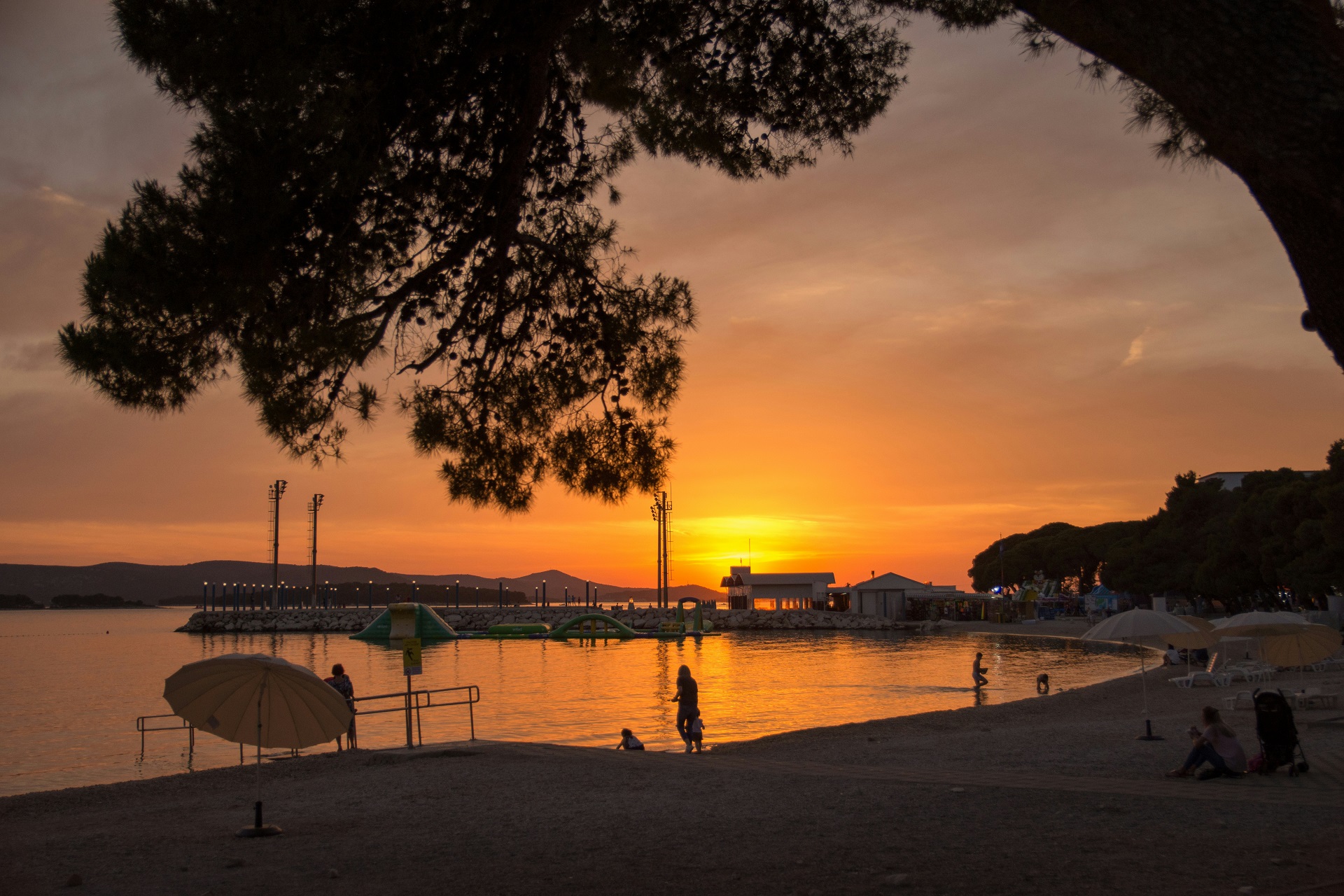
This balance is particularly evident in the transition between day and night. As the sun sets over the Adriatic, the light reflects off the water and marina surfaces, gradually shifting the tone of the waterfront. Early evening is often the busiest period, with people gathering for dinner, strolling along the promenade, or preparing for departure the following day. Later, the atmosphere softens, and the pace becomes more relaxed, with quieter conversations and slower movement along the shore.
Dining plays a central role in this evening experience. Tables are often positioned to face the sea, allowing uninterrupted views of harbour activity and open water beyond. The proximity to the marina means that the sailing environment is never far away, even during a casual evening meal. This reinforces the town’s identity as a place where maritime life is not separate from social life, but integrated into it.
Sunset views are another defining element. From the waterfront of Biograd na Moru, the sun typically sets over the islands and open channels of the archipelago, casting long reflections across the water. As light fades, the outlines of masts, boats, and distant islands become more pronounced, creating a calm but visually rich maritime scene.
Overall, evening life in Biograd reflects its dual character. It is both a working nautical centre and a coastal town with an active social rhythm. The result is an atmosphere that remains lively without becoming chaotic, where sailing culture, local life, and waterfront leisure coexist naturally within a single shared space.
BIOGRAD NA MORU IS A KEY SAILING BASE
Biograd na Moru holds its position as one of the most important sailing bases in Croatia not because of a single defining feature, but because of how effectively multiple advantages converge in one location. Its geographic position, infrastructure, and direct access to contrasting sailing environments combine to create a base that supports a wide range of cruising styles within a compact area of the Adriatic.
Sitting between the sheltered waters of the Zadar Archipelago and the more open, expansive landscape of Kornati National Park, Biograd functions as a natural hinge point in the northern Dalmatian sailing network. This central positioning allows itineraries to flow in multiple directions without requiring long repositioning sails or complex planning. Sailors can easily choose between calm island-hopping routes or more adventurous offshore explorations, often within the same week.
This flexibility is reinforced by the short sailing distances characteristic of the region. From Biograd, islands such as Pašman Island and Ugljan Island are quickly reachable, providing immediate access to sheltered bays and well-protected anchorages. At the same time, the transition toward Kornati waters is equally straightforward, allowing crews to experience more open-sea conditions without extended passages.
The strength of Biograd na Moru also lies in its nautical infrastructure. With established marinas such as Marina Kornati Biograd and Marina Šangulin, the town offers a high level of operational efficiency for charter operations. Provisioning, maintenance, fuelling, and crew logistics are all concentrated within a compact coastal zone, making embarkation and disembarkation smooth and time-efficient.
Beyond practicality, Biograd’s sailing appeal is also defined by variety. Few bases in Croatia provide such direct access to two contrasting maritime environments: the structured, island-rich waters of the Zadar region and the more open, visually dramatic landscape of Kornati. This duality allows itineraries to be shaped with significant freedom, adapting easily to weather conditions, sailing experience, or simply the desired rhythm of travel.
Importantly, this versatility does not come at the expense of simplicity. The sailing environment around Biograd remains predictable during the main season, with stable winds, short passages, and a high density of safe anchorages. This makes it suitable for both experienced crews seeking variety and less experienced sailors looking for a manageable and well-supported cruising area.
Ultimately, Biograd na Moru functions as more than just a departure point. It is a connector between different sailing worlds within the Adriatic - linking sheltered archipelagos, open national park waters, and a highly developed nautical infrastructure into a single, coherent base.
For sailors, this combination translates into clarity and freedom: clear access to some of the best cruising grounds in Croatia, and the freedom to explore them in multiple directions without complexity. In that sense, Biograd is not only a key sailing base - it is one of the most efficient gateways into the diversity of the Adriatic itself.