POREČ SAILING GUIDE: ROMAN HERITAGE AND A CALM ISTRIAN COASTAL STOP
On the western coast of Istria, where the shoreline remains relatively open and gently indented, lies Poreč - a coastal town that blends Roman heritage, structured maritime facilities, and a steady Adriatic sailing rhythm. Unlike more dramatically positioned harbour towns such as Rovinj, Poreč is less about vertical visual impact and more about balance: accessibility, history, and functional coastal navigation.
From the sea, the approach does not build toward a single dramatic focal point but instead unfolds gradually. The coastline remains low and readable, with the urban area extending in a relatively even band along the shore. The harbour structure becomes visible early, allowing sailors to transition from coastal cruising into port entry without abrupt changes in scale or complexity. This sense of continuity is one of the defining characteristics of sailing in this part of Istria.
Historically, Poreč has always been shaped by its position on the sea. Its Roman origins are still present in the underlying street grid, which gives the old town a structured, almost geometric clarity compared to more organically evolved medieval coastal settlements. Over centuries, this orderly foundation evolved into a functional maritime town, where trade, fishing, and later tourism all adapted to the same compact coastal framework.
Unlike purely heritage-focused destinations, Poreč remains actively connected to everyday maritime movement. The waterfront is not a preserved historical edge but a working coastal interface where boats, ferries, and leisure craft share space. This dual identity - historic yet operational - gives the town a grounded character that fits naturally into sailing itineraries without feeling staged or separated from real coastal activity.
For sailors exploring the northern Adriatic, Poreč often appears as a natural mid-route stop because of its geographic positioning. It sits comfortably between the northern Istrian coastline and the more visually distinctive southern stretches leading toward Rovinj and Brijuni. This makes it an efficient waypoint within both clockwise and counterclockwise cruising loops around the peninsula.
The ease of approach further reinforces its role as a practical stopover. The surrounding waters are generally stable during the main sailing season, and the coastline offers enough shelter to moderate wave conditions even when winds are more active. This allows for straightforward entry and exit, reducing the need for complex timing or extended waiting periods offshore.
Once inside the harbour environment, the structure of Poreč supports both short stays and longer pauses. Crews can use the town for provisioning, rest, or weather adjustments while remaining close to the sailing network of Istria. The integration between town and waterfront means that services, supplies, and coastal life are all within easy reach of the mooring area.
What distinguishes Poreč within this broader sailing context is not dramatic scenery or isolated natural anchorage, but reliability. It offers a consistent maritime experience in a region where conditions can vary between open coastal stretches and more sheltered inner bays. This predictability makes it especially valuable for itineraries that prioritize smooth progression rather than variability.
At the same time, Poreč still maintains a sense of coastal openness. The shoreline is not enclosed or overly developed in a continuous urban strip, but instead allows visual connection to the sea from multiple points within the town. This reinforces the feeling that maritime movement and urban life remain closely linked, even in a structured environment.
For sailors moving through Istria, Poreč functions as a stabilizing presence within the route. It is a place where navigation becomes simpler, logistics become easier, and the rhythm of sailing aligns with a more measured coastal pace.
In the broader Adriatic context, it represents a quieter form of sailing experience - one that is not defined by visual drama or remote isolation, but by clarity, continuity, and ease of movement along a historically layered coastline.
A ROMAN TOWN SHAPED BY THE SEA
The identity of Poreč is deeply rooted in its Roman past, and this historical foundation is still clearly visible in how the town is organized today. Unlike many coastal settlements that evolved more organically over medieval or modern periods, Poreč retains a strong sense of planned structure inherited from its origins as a Roman castrum. The street layout follows a clear grid system that extends inland from the waterfront, creating a sense of order and orientation that is immediately noticeable when moving through the old town.
This geometric logic is not just an archaeological remnant - it continues to shape the lived experience of the town. Streets lead in straight, predictable lines toward the sea, and the transition from inner town to waterfront feels deliberate rather than gradual or fragmented. In a sailing context, this reinforces the impression that Poreč has always been a place designed with maritime connection in mind, even when viewed from land.
The most significant architectural expression of this historical continuity is the Euphrasian Basilica, located within the old town area. Recognized as a UNESCO World Heritage Site, it represents one of the most important early Christian monuments on the Adriatic coast. Its mosaics, structure, and preserved complex reflect centuries of cultural layering, from Roman foundations to Byzantine influence. While it does not serve a nautical purpose, its presence strengthens the perception that Poreč has long functioned as a stable administrative and religious centre on the coast of Istria.
This historical depth is important in understanding how the town fits into a sailing itinerary. Many Adriatic ports are primarily shaped by seasonal tourism or modern marina development, but Poreč carries a longer sense of continuity. It is not a settlement that expanded around sailing activity - it is a coastal town that has always been connected to the sea through structured, long-term occupation.
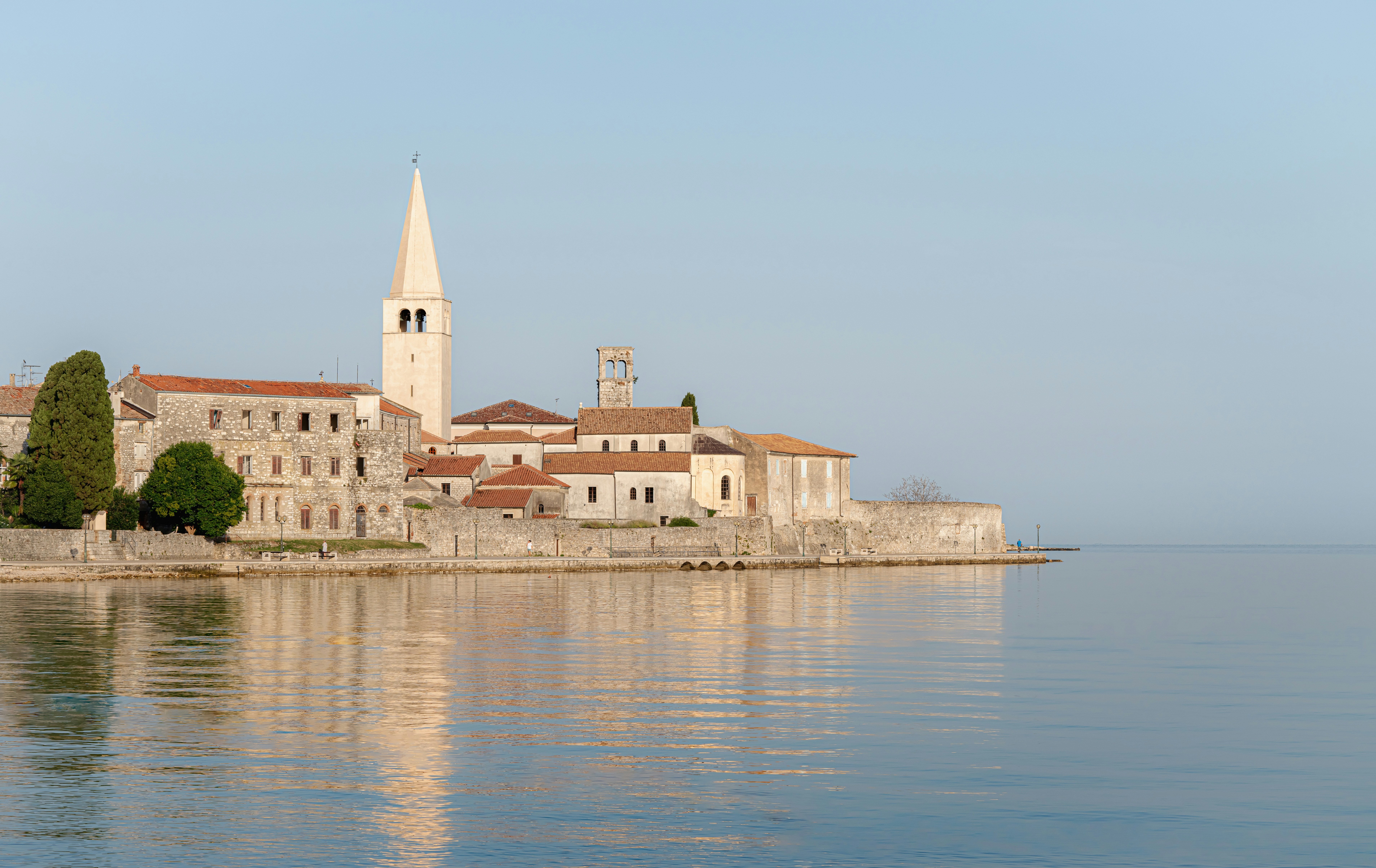
From the perspective of arriving by yacht, however, this layered history expresses itself in a more subtle way. Instead of a steep or visually dominant skyline, the town presents a relatively low and horizontal coastal profile. The old town does not rise dramatically above the water, but instead spreads gently along the shoreline, maintaining a consistent visual rhythm.
The harbour area itself is open and functional rather than enclosed or theatrically framed. This gives the approach a calmer character compared to more visually dense Istrian destinations such as Rovinj, where the old town creates a strong vertical silhouette visible from far offshore. In Poreč, the visual transition from sea to land is more gradual, with fewer abrupt shifts in elevation or architectural density.
As a result, the overall impression when approaching Poreč by sea is one of balance and clarity. The coastline feels stable and readable, the harbour integrates naturally into the urban edge, and the historical core remains present without dominating the visual field.
Within the wider context of Istria, this combination of Roman structure, maritime continuity, and restrained coastal form makes Poreč distinct. It is not a town defined by spectacle, but by coherence - where history, geography, and navigation align in a way that feels steady and uninterrupted from both land and sea.
SAILING APPROACH AND HARBOUR LAYOUT
Approaching Poreč by yacht is generally straightforward, especially for crews navigating along the western coast of Istria. The coastline in this section of the Adriatic is relatively even and easy to interpret visually, without the complex island clusters or deep fjord-like inlets found in other parts of Croatia. As a result, navigation tends to be intuitive, with clear shoreline reference points guiding the final approach.
Rather than a single dramatic reveal, the transition toward Poreč develops gradually. The first signs of the town appear as a low, continuous urban strip along the coast, slowly gaining definition as the vessel closes distance. Only closer in does the harbour structure become clearly distinguishable, with breakwaters, marina basins, and waterfront activity forming a more detailed maritime environment. This layered approach gives arrival a calm, progressive character rather than a sudden visual impact.
The harbour system of Poreč is designed with functionality in mind, supporting both local maritime activity and visiting yachts throughout the season. The outer breakwaters play a key role in shaping the inner basin, reducing wave penetration and creating a more controlled water surface inside the harbour. This is particularly valuable during peak summer months, when the western coast of Istria experiences increased sailing traffic along its main north–south corridor.
Inside the harbour, the layout is relatively clear and structured. Berthing areas are organized to accommodate different vessel types, from local fishing boats to charter yachts and visiting cruisers. The separation of traffic zones helps maintain order even during busier periods, allowing for smoother manoeuvring compared to more densely packed historic harbours.
One of the key differences between Poreč and more visually compact coastal towns such as Rovinj is the openness of its entry and internal layout. While Rovinj offers a tightly enclosed, visually dramatic harbour approach framed by its peninsula old town, Poreč prioritizes ease of access and navigational simplicity. The entrance is wider, the basin more open, and the spatial structure less compressed.
This makes the approach particularly comfortable for crews on longer itineraries along Istria. There is less need for precise timing or tightly coordinated manoeuvres, and more room for gradual adjustment as the vessel transitions from open coastal waters into the harbour environment.
From a practical sailing perspective, this simplicity is a major advantage. It reduces entry stress, allows for more flexible arrival timing, and supports a smoother overall experience when combining multiple stops along the Istrian coastline. For itineraries that include several ports in a single voyage, this predictability becomes especially valuable.
At the same time, the harbour remains closely integrated with the town itself. The waterfront is not separated from daily life but directly connected to it, allowing sailors to step from the dock into an active urban environment within minutes. Shops, services, and coastal promenades are all located within easy reach of the marina area, reinforcing the sense that Poreč is both a maritime hub and a functioning coastal town.
In the broader context of northern Adriatic sailing, Poreč therefore occupies a practical middle ground. It does not rely on dramatic geography or complex harbour geometry, but instead on clarity, structure, and ease of use - qualities that make it a reliable and efficient stop within longer coastal routes along Istria.
SAILING CONDITIONS AROUND POREČ
The sailing conditions around Poreč are generally stable throughout the main summer season, reflecting the broader climatic patterns of the western coast of Istria. This part of the northern Adriatic is characterized by moderate wind exposure, relatively predictable daily cycles, and a coastline that provides frequent natural shelter, making it particularly well-suited to relaxed coastal cruising rather than demanding offshore navigation.
The dominant seasonal influence is the Maestral, a reliable summer wind that typically develops in the afternoon from the northwest. Around Poreč, this breeze tends to be steady rather than forceful, shaped by the proximity of land and the absence of large open-sea funnels. As a result, sailing conditions are usually comfortable and consistent, supporting smooth movement along the coast without sudden changes in intensity.
For sailors departing from Poreč, the Maestral creates ideal conditions for short to medium coastal passages. Northbound routes toward Novigrad or further up the Istrian peninsula benefit from a predictable wind angle, while southbound legs toward Rovinj often allow for relaxed down-coast sailing with manageable sea states. This regularity makes itinerary planning straightforward, even for crews with mixed sailing experience.
Morning conditions in this region are typically calm. Winds are often very light or absent altogether, and the sea surface remains smooth close to shore. This early-day stillness is one of the most characteristic features of sailing in Istria. It provides a comfortable window for leaving harbour, adjusting sails gradually, and navigating near the coastline without pressure or urgency.
These calm morning conditions are particularly beneficial when operating from structured harbour environments such as Poreč. Manoeuvring within the marina or harbour basin is simplified, visibility is usually excellent, and the absence of significant wind allows for precise and stress-free departures. For many crews, this sets a relaxed tone for the rest of the sailing day.
As the day progresses, the gradual onset of the Maestral introduces a reliable sailing rhythm. The wind typically strengthens in the afternoon, offering enough power for efficient coastal movement while remaining within comfortable limits for cruising yachts. This balance between calm mornings and active afternoons is one of the reasons the western Istrian coastline is considered highly accessible for charter sailing.
Occasionally, the Bura wind can influence the wider northern Adriatic region, including the waters around Poreč. When it occurs, it brings stronger northeasterly gusts and cooler, drier air. In exposed areas, this can create more dynamic sailing conditions, particularly near open stretches of coastline.
However, the geography of Istria provides significant natural moderation. The coastline is interspersed with bays, inlets, and sheltered zones that allow sailors to adjust course and seek protection when needed. The relatively short distances between key points along the coast further enhance this flexibility, making it easy to modify routes without major disruption.
This adaptability is one of the defining strengths of sailing in the Poreč region. Conditions may vary, but they rarely become limiting. Instead, they encourage responsive planning, where crews can shift between sailing, anchoring, and coastal exploration depending on wind and comfort levels.
Overall, the sailing environment around Poreč is defined by balance and predictability. Winds are generally moderate, sea states remain manageable, and the coastline offers enough protection to support continuous cruising. For sailors navigating through Istria, this creates a reliable and accessible sailing corridor - one that prioritizes comfort, flexibility, and steady coastal progression over complexity or exposure.
ANCHORAGES AND COASTAL EXPLORATION
While Poreč itself primarily functions as a structured harbour stop within Istria, the surrounding coastline offers a broader and more varied anchoring environment that becomes increasingly interesting once a vessel moves away from the immediate urban waterfront. Rather than relying on a dense network of marinas or formal nautical facilities, this stretch of the western Istrian coast is defined by a combination of small bays, open coastal pockets, and transitional waters that support flexible cruising.
To both the north and south of Poreč, the coastline alternates between developed sections and more natural stretches. This variation is a key feature of sailing in the region, as it allows crews to shift easily between urban access points and quieter, less structured environments. Nearer to town, coastal influence is more noticeable, with greater activity and proximity to settlements. As distance increases, however, the shoreline gradually opens into calmer, less populated areas where the visual and acoustic presence of land diminishes.
In these quieter zones along Istria, sailors often find more favourable conditions for relaxed anchoring and swimming. The water tends to become clearer away from urban influence, especially in sheltered inlets where wave action is minimal and seabed visibility improves. Rocky and mixed seabed areas are common, interspersed with patches of sand and seagrass, creating a natural anchoring environment that remains straightforward in stable weather conditions.
Unlike heavily structured charter regions further south in Croatia, where anchorages are often closely tied to marina systems or designated mooring fields, the area around Poreč retains a more open coastal character. This means that stopping points are less formal and more dependent on natural geography and prevailing conditions. Crews typically select anchorages based on wind direction, comfort, and proximity to planned sailing routes rather than fixed infrastructure.
As vessels continue along the coast, either northward or southward from Poreč, anchoring options gradually become more dispersed. These locations are often used for short swimming stops during the day or simple overnight stays when conditions are calm. The emphasis here is less on facilities and more on natural shelter, with bays providing protection from prevailing winds and allowing for quiet, low-impact anchoring.
This progression toward more open and less developed anchoring environments is one of the defining characteristics of coastal sailing in Istria. It creates a rhythm where structured harbour stops like Poreč are balanced by more spontaneous, nature-oriented pauses along the coastline. The result is a sailing experience that alternates between functionality and simplicity, without requiring strict adherence to marina-based planning.
For many sailors, this flexibility is a significant advantage. It allows itineraries to remain fluid, adapting to weather, timing, and personal preference without losing coherence. A day might begin in the structured environment of Poreč, continue with a coastal sail along the Istrian shoreline, and end in a quiet bay chosen purely for its protection and atmosphere rather than infrastructure.
Ultimately, the anchorages and coastal stops around Poreč reinforce the broader character of this part of the Adriatic: accessible, varied, and naturally balanced. They provide just enough structure for comfortable navigation, while still preserving the sense of openness that defines sailing along the Istrian coast.
SWIMMING AND COASTAL ATMOSPHERE
Swimming around Poreč reflects the broader character of the northern Adriatic: clean, generally calm, and closely tied to a natural shoreline rather than heavily engineered resort infrastructure. In this part of Istria, the coastline does not rely on large beach complexes or artificial swimming zones, but instead offers a more direct and unstructured relationship with the sea.
Near the town itself, access to the water is straightforward and frequent. Rocky coastal sections extend along parts of the waterfront, interspersed with small bathing areas and accessible entry points where the sea meets the urban edge. This creates a continuous interface between town life and swimming activity, where entering the water feels like a natural extension of being on the coast rather than a separate, designated experience.
For sailors, this proximity is particularly practical. Stopping near Poreč often means swimming can be integrated immediately into the rhythm of the sailing day. There is no need for long transfers or structured beach access - boats anchor or pause near suitable shoreline areas, and the sea becomes accessible within moments.
As distance from the urban core increases, especially when moving toward quieter coves along Istria, the character of the water changes noticeably. In these more sheltered or less trafficked areas, water clarity often improves, particularly during stable summer conditions when wind and wave activity remain low. The surface becomes smoother, light penetrates more deeply, and visibility extends down toward the seabed with greater clarity.
These variations in transparency are closely tied to local conditions. Areas with reduced boat traffic and limited coastal development tend to offer the clearest water, especially in early morning hours or during calm periods between wind cycles. In such moments, the sea takes on a distinctly still and open quality that enhances the sense of immersion.
The seabed composition around Poreč is typically mixed, combining rock formations, sandy patches, and areas of seagrass. This variation contributes to both ecological diversity and visual interest beneath the surface. In clear conditions, these elements are easily visible from above, adding depth to even short swimming stops and shallow anchoring spots.
Unlike destinations where swimming is centred around organised beach infrastructure or resort-managed zones, the experience in this region is more naturally integrated into sailing routines. Swimming is not confined to specific locations or schedules; instead, it occurs organically as part of daily movement along the coast. A quiet anchorage, a midday pause, or an evening stop can all naturally become opportunities to enter the water.
This fluid integration between sailing and swimming is one of the defining qualities of the northern Adriatic experience around Poreč. The sea is not treated as a separate attraction, but as a constant presence throughout the journey - accessible, calm, and closely connected to the coastline itself.
Ultimately, swimming here is less about destinations and more about continuity. The coastline of Istria supports a rhythm where movement by boat, time at anchor, and time in the water all blend into a single coastal experience shaped by simplicity and natural conditions.
EVENING LIFE BY THE WATERFRONT
Evenings in Poreč unfold at a measured coastal pace, shaped more by the natural rhythm of the sea than by high-intensity nightlife. As daylight softens over Istria, the waterfront gradually transforms into a relaxed social zone where maritime life, local dining, and slow evening movement blend into a single continuous atmosphere.
The promenade becomes the focal point of this transition. Restaurants and cafés line the harbour edges, opening their terraces toward the water where anchored boats and passing yachts remain part of the visual background. The soundscape is subdued - conversation, clinking glasses, and gentle harbour movement replacing the more functional energy of the daytime sailing activity.
Unlike more vertically compressed historic centres such as Rovinj, where evening life concentrates tightly around steep streets and elevated viewpoints, Poreč distributes its activity across a wider coastal area. The old town, marina, and waterfront promenade are connected but not compressed into a single dense core. This spatial openness creates a more even flow of movement, where people naturally spread out along the shoreline rather than clustering in confined streets.
For sailors, this layout is particularly comfortable. Walking from the marina to the old town or along the waterfront does not involve steep transitions or narrow, crowded passages. Instead, movement remains horizontal and direct, reinforcing the town’s overall sense of accessibility and balance. It is easy to shift between a quiet dinner by the sea, a short walk through the historic centre, and a return to the harbour without leaving the coastal atmosphere behind.
Despite its calm structure, the evening scene in Poreč retains a clear maritime identity. Boats remain visible throughout the harbour well into the evening hours, gently shifting position with small changes in wind or current. The presence of masts, deck lights, and softly illuminated hulls ensures that the sea is never visually distant from the town’s social life.
As the sun sets over Istria, the harbour gradually takes on a more reflective quality. Light fades across the water surface, turning movement into silhouette and reflection. The transition from day to night is gradual rather than abrupt, with no sharp separation between activity and stillness.
This continuity is what defines evening life in Poreč. The town does not shift into a different identity after sunset; it simply softens. Maritime activity slows, conversations extend later into the night, and the waterfront remains gently animated without becoming crowded or overwhelming.
For sailors, this creates an easy and natural end to the day. After time spent navigating the Istrian coast, anchoring in nearby bays, or moving between short coastal passages, evenings in Poreč offer a return to stability - where the sea is still present, but no longer demanding movement, only observation and presence.
CONNECTION TO WIDER ISTRIAN SAILING ROUTES
Poreč occupies a central and strategically useful position along the western coast of Istria, making it a natural link within broader northern Adriatic sailing itineraries. Its location works particularly well for coastal navigation that prioritizes short passages, predictable conditions, and flexible routing between a series of distinct harbour towns and natural anchorages.
To the north, sailing routes from Poreč continue toward Novigrad and the upper stretches of the Istrian coastline. This section of the coast is characterized by a relatively open shoreline with a mix of small harbours and quieter stretches of sea. Distances between stops remain manageable, allowing for relaxed day sailing where crews can move gradually along the coast without extended offshore segments. The northern direction therefore tends to feel steady and structured, with Poreč acting as a natural midpoint before the coastline becomes more compact and less densely populated.
To the south, itineraries from Poreč transition toward more visually distinctive and atmospherically varied sailing environments. The route leads in the direction of Rovinj, where the coastline becomes more architecturally dense and the approach to the old town gains dramatic visual character. Beyond Rovinj, the sailing landscape continues toward Brijuni National Park, a protected archipelago where navigation becomes more regulated and the maritime environment shifts toward calmer, preservation-focused waters.
This southbound progression introduces a clear change in sailing atmosphere. While Poreč and the northern coastline emphasize functional cruising and structured coastal access, the waters further south gradually incorporate more layered visual and environmental experiences. Brijuni, in particular, represents a transition into a quieter, more controlled maritime zone where natural preservation plays a central role in shaping navigation and anchoring behaviour.
Because of this central positioning, Poreč functions as an important balancing point within itineraries along Istria. It allows sailors to adjust direction easily depending on weather, timing, or itinerary style, without committing to long or complex passages. This flexibility is especially valuable in a region where conditions remain generally stable but can shift between more open coastal exposure and sheltered island-adjacent waters.
In practical terms, Poreč can serve multiple roles within a sailing route. It may function as a provisioning stop where crews restock supplies before continuing south or north. It can also serve as an overnight harbour, offering shelter and access to services within a compact and easily navigable setting. At the same time, it works effectively as a transitional point between more visually striking destinations, allowing sailors to break up longer coastal segments into manageable sections.
The broader structure of sailing in Istria supports this kind of flexibility. Distances between key destinations are relatively short, and the coastline provides frequent access to sheltered water. This means that routes can be adjusted dynamically, with Poreč acting as one of several stable reference points along the way.
Ultimately, its value within the wider sailing network is defined less by uniqueness and more by positioning. Poreč sits at a natural intersection of northern and southern Istrian sailing flows, connecting quieter coastal segments with more visually expressive harbour towns and protected maritime zones. This makes it an adaptable and dependable component of any extended sailing itinerary along the western Adriatic coast.
ISTRIAN SAILING ROUTE: POREČ
Poreč is not a destination defined by dramatic first impressions or tightly packed medieval skylines rising above the sea. Unlike more visually intense coastal towns such as Rovinj, it does not rely on vertical density or cinematic arrival moments to leave an impact. Instead, its strength lies in something more subtle and enduring: consistency, accessibility, and a long-standing connection to the maritime life of Istria.
Within an Istrian sailing itinerary, Poreč represents a different kind of value. It offers a structured and dependable coastal stop where navigation remains straightforward, harbour access is efficient, and the overall sailing environment stays calm and readable. Rather than demanding attention through complexity or spectacle, it supports the rhythm of a journey that moves steadily along the western Adriatic coast.
For sailors, this reliability is often what makes Poreč essential. The town connects easily with neighbouring harbours to the north and south, allowing itineraries to flow naturally without requiring long offshore passages or tightly constrained timing. Whether used as a midday stop, an overnight harbour, or a logistical pause, it fits into broader routes across Istria with minimal friction.
Its sheltered harbour conditions and well-established maritime infrastructure further reinforce this role. Crews benefit from predictable entry, protected waters, and access to services that support both short stops and extended coastal cruising. This practicality is especially valuable in a region where sailors often combine multiple destinations within a single passage, adjusting plans according to wind, comfort, and pace.
Beyond functionality, Poreč also carries a sense of historical continuity that adds depth to its maritime identity. The Roman origins of the town and its long-standing role as a coastal settlement give it a grounded presence on the Adriatic. It is not a modern construct built around sailing tourism, but a place where the sea has always been part of daily structure and urban development.
This layered identity - part historical, part functional - creates a balanced coastal atmosphere. Life around the waterfront remains active but not overwhelming, shaped by both local routines and visiting vessels passing through the northern Adriatic sailing network.
In a region known for contrast - between the dramatic silhouettes of coastal towns, the quiet isolation of islands, and the protected waters of national parks - Poreč occupies a stabilizing middle ground. It is neither the most visually striking nor the most remote destination, but it offers something equally important: continuity.
Ultimately, Poreč belongs on an Istrian sailing route because it represents the practical backbone of coastal navigation. It is a place where Roman history meets modern maritime use, where the coastline remains open and accessible, and where sailing remains uncomplicated, steady, and quietly reliable within the broader rhythm of the Adriatic.